

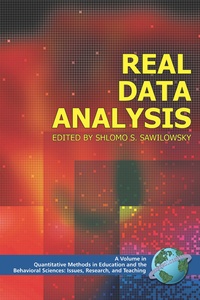
Real Data Analysis
1st Edition
Published on 1. January 2007
445 pages
978-1-60752-578-3 (ISBN)
Description

The invited authors of this edited volume have been prolific in the arena of Real Data Analysis (RDA) as it applies to the social and behavioral sciences, especially in the disciplines of education and psychology. Combined, this brain trust represents 3,247 articles in refereed journals, 127 books published, US $45.3 Million in extramural research funding, 34 teaching and 92 research awards, serve(d) as Editor/Assistant Editor/Editorial Board Member for 95 peer reviewed journals, and provide (d) ad hoc reviews for 362 journals. Their enormous footprint on real data analysis is showcased for professors, researchers, educators, administrators, and graduate students in the second text in the AERA/SIG ES Quantitative Methods series.
All prices
More details
Other editions
Additional editions
Shlomo S. Sawilowsky
Real Data Analysis
Book
12/2006
Information Age Publishing
€78.10
Article not available at the moment
Content
1 - Cover [Seite 1]
2 - Contents [Seite 5]
3 - Preface [Seite 9]
4 - Part I - Foundations [Seite 23]
4.1 - Chapter 1. The Coevolution of Statistics and HZ [Seite 25]
4.2 - Chapter 2. Effective Sample Size: A Crucial Concept [Seite 43]
4.3 - Chapter 3. Advances in Missing Data Methods and Implications for Educational Research [Seite 53]
4.4 - Chapter 4. Methods for Simulating Real World Data for the Psycho-Educational Sciences [Seite 101]
4.5 - Chapter 5. How and Why I Use Real, Messy Data to Investigate Theory and Inform Decision Making [Seite 121]
5 - Part II - Statistical Methods [Seite 127]
5.1 - Chapter 6. Using E-mail Messages to Help Students Prepare for a Statistics Exam [Seite 129]
5.2 - Chapter 7. Randomization Tests: Statistical Tools for Assessing the Effects of Educational Interventions When Resources are Scarce [Seite 137]
5.3 - Chapter 8. A Skipped Multivariate Measure of Location: One- and Two-Sample Hypothesis Testing [Seite 147]
5.4 - Chapter 9. Robust Step-Down Tests for Multivariate Group Differences [Seite 161]
5.5 - Chapter 10. Dunn-Sidák Critical Values and p Values [Seite 171]
5.6 - Chapter 11. Controlling Experiment-Wise Type I Errors: Good Advice for Simultaneous and Sequential Hypothesis Testing [Seite 177]
5.7 - Chapter 12. Robustness and Power of Ordinal d for Paired Data [Seite 185]
5.8 - Chapter 13. Factorial ANOVA in SPSS: Fixed-, Random-, and Mixed-Effects Models [Seite 207]
5.9 - Chapter 14. ANOVA: Effect Sizes, Simulating Interaction vs. Main Effects, and a Modified ANOVA Table [Seite 213]
5.10 - Chapter 15. ANCOVA and Quasi-Experimental Design: The Legacy of Campbell and Stanley [Seite 235]
6 - Part III - Measurement [Seite 261]
6.1 - Chapter 16. Thinking About Item Response Theory from a Logistic Regression Perspective: A Focus on Polytomous Models [Seite 263]
6.2 - Chapter 17. Some Practical Uses of Item Response Time to Improve the Quality of Low-Stakes Achievement Test Data [Seite 293]
6.3 - Chapter 18. Using Moving Averages to Detect Exposed Test Items in Computer-Based Testing [Seite 299]
6.4 - Chapter 19. An Empirical Calibration of the Effects of Multiple Sources of Measurement Error on Reliability Estimates for Individual Differences Measures [Seite 309]
6.5 - Chapter 20. Latent Structure of Attitudes toward Abortion [Seite 315]
7 - Part IV - Data Analysis [Seite 321]
7.1 - Chapter 21. Hierarchical Linear Models and the Estimation of Students' Mathematics Achievement [Seite 323]
7.2 - Chapter 22. Grade Inflation: An Examination at the Institutional Level [Seite 337]
7.3 - Chapter 23. Using Discrete-Time Survival Analysis to Study Gender Differences in Leaving Mathematics [Seite 347]
7.4 - Chapter 24. Nonparametric Procedures for Testing for Dropout Rates on University Courses With Application to an Italian Case Study [Seite 357]
7.5 - Chapter 25. Nonparametric Approaches for Multivariate Testing With Mixed Variables and for Ranking on Ordered Categorical Variables With an Application to the Evaluation of PhD Programs [Seite 377]
7.6 - Chapter 26. Randomized Replicated Single-case Experiments: Treatment of Pain-Related Fear by Graded Exposure In Vivo [Seite 409]
7.7 - Chapter 27. Whole Brain Correlations: Examining Similarity Across Conditions of Overall Patterns of Neural Activation in fMRI [Seite 419]
7.8 - 28. Principal Component Analysis of Senate Voting Patterns [Seite 427]
8 - About the Authors [Seite 433]
2 - Contents [Seite 5]
3 - Preface [Seite 9]
4 - Part I - Foundations [Seite 23]
4.1 - Chapter 1. The Coevolution of Statistics and HZ [Seite 25]
4.2 - Chapter 2. Effective Sample Size: A Crucial Concept [Seite 43]
4.3 - Chapter 3. Advances in Missing Data Methods and Implications for Educational Research [Seite 53]
4.4 - Chapter 4. Methods for Simulating Real World Data for the Psycho-Educational Sciences [Seite 101]
4.5 - Chapter 5. How and Why I Use Real, Messy Data to Investigate Theory and Inform Decision Making [Seite 121]
5 - Part II - Statistical Methods [Seite 127]
5.1 - Chapter 6. Using E-mail Messages to Help Students Prepare for a Statistics Exam [Seite 129]
5.2 - Chapter 7. Randomization Tests: Statistical Tools for Assessing the Effects of Educational Interventions When Resources are Scarce [Seite 137]
5.3 - Chapter 8. A Skipped Multivariate Measure of Location: One- and Two-Sample Hypothesis Testing [Seite 147]
5.4 - Chapter 9. Robust Step-Down Tests for Multivariate Group Differences [Seite 161]
5.5 - Chapter 10. Dunn-Sidák Critical Values and p Values [Seite 171]
5.6 - Chapter 11. Controlling Experiment-Wise Type I Errors: Good Advice for Simultaneous and Sequential Hypothesis Testing [Seite 177]
5.7 - Chapter 12. Robustness and Power of Ordinal d for Paired Data [Seite 185]
5.8 - Chapter 13. Factorial ANOVA in SPSS: Fixed-, Random-, and Mixed-Effects Models [Seite 207]
5.9 - Chapter 14. ANOVA: Effect Sizes, Simulating Interaction vs. Main Effects, and a Modified ANOVA Table [Seite 213]
5.10 - Chapter 15. ANCOVA and Quasi-Experimental Design: The Legacy of Campbell and Stanley [Seite 235]
6 - Part III - Measurement [Seite 261]
6.1 - Chapter 16. Thinking About Item Response Theory from a Logistic Regression Perspective: A Focus on Polytomous Models [Seite 263]
6.2 - Chapter 17. Some Practical Uses of Item Response Time to Improve the Quality of Low-Stakes Achievement Test Data [Seite 293]
6.3 - Chapter 18. Using Moving Averages to Detect Exposed Test Items in Computer-Based Testing [Seite 299]
6.4 - Chapter 19. An Empirical Calibration of the Effects of Multiple Sources of Measurement Error on Reliability Estimates for Individual Differences Measures [Seite 309]
6.5 - Chapter 20. Latent Structure of Attitudes toward Abortion [Seite 315]
7 - Part IV - Data Analysis [Seite 321]
7.1 - Chapter 21. Hierarchical Linear Models and the Estimation of Students' Mathematics Achievement [Seite 323]
7.2 - Chapter 22. Grade Inflation: An Examination at the Institutional Level [Seite 337]
7.3 - Chapter 23. Using Discrete-Time Survival Analysis to Study Gender Differences in Leaving Mathematics [Seite 347]
7.4 - Chapter 24. Nonparametric Procedures for Testing for Dropout Rates on University Courses With Application to an Italian Case Study [Seite 357]
7.5 - Chapter 25. Nonparametric Approaches for Multivariate Testing With Mixed Variables and for Ranking on Ordered Categorical Variables With an Application to the Evaluation of PhD Programs [Seite 377]
7.6 - Chapter 26. Randomized Replicated Single-case Experiments: Treatment of Pain-Related Fear by Graded Exposure In Vivo [Seite 409]
7.7 - Chapter 27. Whole Brain Correlations: Examining Similarity Across Conditions of Overall Patterns of Neural Activation in fMRI [Seite 419]
7.8 - 28. Principal Component Analysis of Senate Voting Patterns [Seite 427]
8 - About the Authors [Seite 433]

