

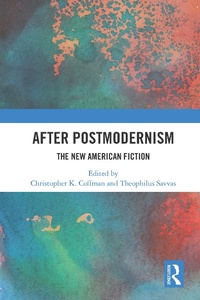
After Postmodernism
The New American Fiction
1st Edition
Published on 17. December 2020
158 pages
978-1-000-28901-5 (ISBN)
Description

Several of American literature's most prominent authors, and many of their most perceptive critics and reviewers, argue that fiction of the last quarter century has turned away from the tendencies of postmodernist writing. Yet, the nature of that turn, and the defining qualities of American fiction after postmodernism, remain less than clear.
This volume identifies four prominent trends of the contemporary scene: the recovery of the real, a rethinking of historical engagement, a preoccupation with materiality, and a turn to the planetary. Readings of works by various leading figures, including Dave Eggers, Jonathan Franzen, A.M. Homes, Lance Olsen, Richard Powers, William T. Vollmann, and David Foster Wallace, support a variety of arguments about this recent revitalization of American literature.
The chapters in this book were originally published as a special issue of the journal Textual Practice.
This volume identifies four prominent trends of the contemporary scene: the recovery of the real, a rethinking of historical engagement, a preoccupation with materiality, and a turn to the planetary. Readings of works by various leading figures, including Dave Eggers, Jonathan Franzen, A.M. Homes, Lance Olsen, Richard Powers, William T. Vollmann, and David Foster Wallace, support a variety of arguments about this recent revitalization of American literature.
The chapters in this book were originally published as a special issue of the journal Textual Practice.
Reviews / Votes
'While some work on contemporary American fiction has been shaped by the crosswinds of transitory trends and superficial labels, American Fiction After Postmodernism is a major and substantial volume that anchors its readings in a much deeper understanding of how the contemporary novel has changed over time. Alert to the influence of DeLillo and Nabokov, attuned to mainstream voices (Eggers, Franzen), whilst also bringing welcome readings of often overlooked writers (Homes, Olsen), Savvas and Coffman's collection offers fine-grained analyses of what has happened to postmodernism's key concerns-from the Jamesonian shadow cast over history and affect to its ambitions to historical greatness-alongside pioneering readings of new areas, such as genrefication and vegetarianism.'Stephen Burn, Reader in Post-1945 American Literature at the University of Glasgow, UK.
'Post-postmodern' has long been a broad and unwieldy designation for what's going on in U.S. literature now, and this rich collection not only evokes the stakes of naming the contemporary but shows just how many branches of the network will lie hidden beneath any chosen term, unearthing affect, ecology, textual materialism, and much else in important recent fiction.'
Jeffrey Severs, Associate Professor, University of British Columbia, and author of David Foster Wallace's Balancing Books: Fictions of Value (2017).
More details
Edition
1. Auflage
Language
English
Place of publication
London
United Kingdom
Publishing group
Taylor & Francis Ltd
Target group
College/higher education
ISBN-13
978-1-000-28901-5 (9781000289015)
Copyright in bibliographic data and cover images is held by Nielsen Book Services Limited or by the publishers or by their respective licensors: all rights reserved.
Schweitzer Classification
Other editions
Additional editions
Book
09/2023
1st Edition
Routledge
€62.50
Shipment within 15-20 days
Book
11/2020
1st Edition
Routledge
€205.00
Shipment within 15-20 days
Persons
Christopher K. Coffman is Senior Lecturer in Humanities at Boston University, MA, USA. He is the author of Rewriting Early America: The Prenational Past in Postmodern Literature (2019) and co-editor of William T. Vollmann: A Critical Companion (2015).
Theophilus Savvas is Lecturer in English at the University of Bristol, UK. He is the author of American Postmodernist Fiction and the Past (2011).
Theophilus Savvas is Lecturer in English at the University of Bristol, UK. He is the author of American Postmodernist Fiction and the Past (2011).
Content
Introduction: American fiction after postmodernism
Theophilus Savvas and Christopher K. Coffman
1. Vegetarianism in the Anthropocene: Richard Powers and Jonathan Franzen
Theophilus Savvas
2. The genrefication of contemporary American fiction
Alexander Moran
3. Feverish fictions: William T. Vollmann and American literary history after postmodernism
Christopher K. Coffman
4. Metaffective fiction: structuring feeling in post-postmodern American literature
Ralph Clare
5. Entropology and the end of nature in Lance Olsen's Theories of Forgetting
Alison Gibbons
6. Typical Eggers: transnationalism and America in Dave Eggers's 'globally-minded' fiction
Bran Nicol
7. Making it long: men, women, and the great American novel now
Kasia Boddy
Theophilus Savvas and Christopher K. Coffman
1. Vegetarianism in the Anthropocene: Richard Powers and Jonathan Franzen
Theophilus Savvas
2. The genrefication of contemporary American fiction
Alexander Moran
3. Feverish fictions: William T. Vollmann and American literary history after postmodernism
Christopher K. Coffman
4. Metaffective fiction: structuring feeling in post-postmodern American literature
Ralph Clare
5. Entropology and the end of nature in Lance Olsen's Theories of Forgetting
Alison Gibbons
6. Typical Eggers: transnationalism and America in Dave Eggers's 'globally-minded' fiction
Bran Nicol
7. Making it long: men, women, and the great American novel now
Kasia Boddy
