

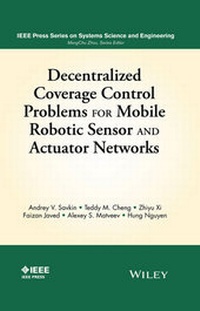
Decentralized Coverage Control Problems For Mobile Robotic Sensor and Actuator Networks
Description

More details
Other editions
Additional editions
Persons
Content
CHAPTER 1
INTRODUCTION
1.1 Distributed Coverage Control of Mobile Sensor and Actuator Networks
Sensing coverage is an important issue in the field of sensor networks. For wireless sensor networks, it is considered to be a measure of their quality of service; see, e.g., [13, 32, 64,129] and references therein. Due to the rapid development of communication and microelectronics technologies, it became possible to employ spatially distributed wireless sensor networks for performing tasks like target tracking, hazardous environment monitoring, and border surveillance in a geographically vast area. To ameliorate the performance of coverage by such a network, the sensors should be placed at proper, ideally optimal, locations. However, for a large-scale network, it would be a daunting and expensive task. To improve coverage and reduce the cost of deployment, employing movement-assisted or mobile sensors is an attractive option; see, e.g., [15,66,114,122,124]. A network of such sensors is typically implemented by deploying a group of mobile sensor equipped robots, where each robot can be viewed as a mobile sensing node. The robots can be unmanned autonomous terrain, underwater, or aerial vehicles. Their sensing capabilities are utilized to sense and monitor a spatial area of interest.
Three types of coverage problems for mobile wireless sensor networks are defined in the seminal paper by Gage [35], namely:
- Barrier coverage: to achieve a static arrangement of nodes that minimizes the probability of undetected intrusion through the barrier,
- Sweep coverage: to move a number of nodes across a sensing field so that it addresses a specified balance between maximizing the detection rate of events and minimizing the number of missed detections per unit area,
- Blanket coverage: to achieve a static arrangement of nodes that maximizes the detection rate of targets appearing in the sensing field.
In barrier coverage, a sensing barrier is formed by an array of sensing nodes so that any intrusion through the barrier is detected [19, 58, 59, 65, 112, 125]. Sweep coverage is achieved by moving a number of sensing nodes across a sensed field to search for and detect targets in the field [12, 26, 38, 133]. Finally, the purpose of blanket coverage is to monitor a given area so that targets appearing in this area are detected by the network of sensing nodes [29,42,122,124,137].
Practical applications of the described three types of coverage in mobile robotic sensor networks include minesweeping [12], border patrolling [59], environmental studies, detecting and localizing the sources of hazardous chemicals leakage or vapour emission, detecting sources of pollutants and plumes, environmental monitoring of disposal sites on the deep ocean floor [54], sea floor surveying for hydrocarbon exploration [9], ballistic missile tracking, bush fire monitoring, oil spill detection at high seas, environmental extremum seeking [28, 78, 137], environmental field level tracking [79], target capturing [132], and many others.
In order to achieve objectives in these coverage problems, each sensor in a network should cooperate with other sensors to fulfil a common goal. The cooperation takes place in the form of coordinated control of the sensors movement using the information from the network. However, to reduce the cost of operation, each sensor may have very limited resources, e.g., communication, sensing, or computing powers, and may suffer from severe detection and communication constraints. Therefore, the use of a centralized control algorithm is not a practical approach since not the entire global information is available to each sensor. To compensate for the lack of global information and centralized controllers, decentralized and distributed approach should be considered.
Broadly speaking, distributed control of self-deploying mobile robotic sensors falls within the general area of decentralized control, but the unique aspect of it is that mobile robotic sensors are dynamically decoupled; i.e., the motion of any sensor does not directly affect the other sensors. The study of decentralized control for groups of autonomous vehicles or robots has emerged as a challenging research area in the last decade; see, e.g., [7,39,45,48,52,53,69,85,89,92,96,105,113,115,127]. Distributed control laws for such groups of mobile robots are indeed motion coordination rules that rely only on a local information. In this control framework, each mobile robot is driven on the basis of information about coordinates or velocities of only a few other robots, typically its currently closest neighbors. To develop such local control rules, researchers in this new emerging area of engineering are finding much inspiration from the field of biology, where the problem of animal aggregation is central in both ecological and evolutionary theory. Animal aggregations, such as schools of fish, flocks of birds, or swarms of bees, are believed to use simple, local motion coordination rules at the individual level, which at the same time result in remarkably complex intelligent behaviors at the group level; see, e.g., [6,34,84,111,126].
To explain and simulate these behaviors, Vicsek et al. [120] proposed a simple discrete-time model of a system of several autonomous agents, where each agent's motion is updated using a local rule based on its own state and the states of its "neighbors". This simple but interesting model was then analytically studied by a number of researchers, e.g., [53,55,92,96,131,135]. Moreover, modifications of the Vicsek model have also been carried out in, e.g., [55,62,63,135]. For example, a Vicsek-type model with adaptive velocities is proposed in [62,63], whereas a heterogeneous sensing Vicsek model is introduced in [130]. In addition, the converging rate of the Vicsek model is studied in [55,135]. Also, the Vicsek model can be viewed as a special case of the model proposed in [93] for the computer animation industry to mimic animal aggregation.
To develop such local motion coordination rules, approaches like information consensus [53, 92, 96, 131] or potential field [90] are typically adopted. For low-power mobile sensor networks, consensus-based algorithms are especially attractive since they are relatively simple and require low computational cost.
Another topic of this book is study of mobile robotic sensor and actuator networks. They consist of nodes that are mobile robots (ground, underwater, or aerial unmanned vehicles). Some of these nodes are sensors and some are actuators (also called actors), whereas some nodes are endowed with both sensing and actuating capacities. Actuating capabilities are utilized to dispense control signals with the goal of achieving certain control objectives. Many modern engineering applications include the use of such networks to provide efficient and effective monitoring and control of industrial and environmental processes. These networks are able to achieve improved performance, along with reduction in power consumption and production cost. Theoretical research on mobile robotic sensors/actuator networks is at an early stage; however, some interesting theoretical results can be found in [14,31] and references therein.
The emerging area of mobile robotic sensor and actuator networks lies at the crossroad of robotics, control engineering, computer science, and communications. The importance of this field is quickly increasing due to the growing use of wireless communications and mobile robots.
This book studies various coverage control problems for mobile sensor networks including barrier, sweep, and blanket coverage problems. Moreover, a new type of coverage referred to as encircling coverage is introduced. For mobile robotic sensor and actuator networks, the problem of termination of a moving two-dimensional region is introduced and studied. The proposed coverage control algorithms are based on the consensus approach, which was studied by many researchers in the last decade. All the robotic sensor and actuator motion algorithms developed in the book are fully decentralized and distributed, computationally efficient, easily imple-mentable in engineering practice, and based only on information about the closest neighbors of each mobile node and local information about the environment. More over, the nodes have no prior information about the environment in which they operate.
It should be pointed out that this book is problem oriented, with each chapter discussing in detail distributed coverage problems and solutions that arise in the rapidly emerging area of mobile robotic sensor and actuator networks. The goal of this monograph is to present a computationally efficient, reliable, distributed, and easily implementable framework for coverage control of mobile robotic sensor and actuator networks, so that the ultimate goal of their applications (environmental or industrial monitoring, target detection and following, border protection and many others) can be fulfilled. Such a framework is very important because it is expected that future mobile wireless sensor and actuator networks will be more complex, heterogeneous, and vastly distributed. They may execute multiple tasks and consist of millions of mobile nodes.
1.2 Overview of the Book
In this section, we briefly describe the results presented in this research monograph.
Chapter 2 introduces the concept of barrier coverage and considers the problem of distributed barrier coverage between two landmarks or points. A distributed self-deployment algorithm is proposed. Moreover, we give a...
