

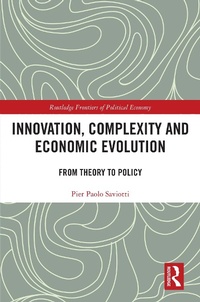
Innovation, Complexity and Economic Evolution
From Theory to Policy
1st Edition
Published on 23. March 2023
282 pages
978-1-000-83769-8 (ISBN)
Description

If evolutionary economics is to compete with neoclassical economics as a general-purpose economic theory, it needs to incorporate new aspects of socioeconomic reality, such as institutions of all types, including technical, scientific, and political. Furthermore, evolutionary economics needs to be able to provide policy implications at least as interesting as those of neoclassical economics. Thus, as this book argues, evolutionary economics must become evolutionary political economy.
Innovation plays a central role in the book, but not in the sense of providing a technologically determinist interpretation. Rather, the book argues that innovations do not emerge in isolation from other components of socioeconomic systems but coevolve with institutions, infrastructures and organizational forms. This concept of coevolution is absolutely central in the book and provides a link with theories of complexity. In addition to providing an epistemological basis for evolutionary economics, the link with complexity and coevolution offers the connection with evolutionary political economy. Innovations and technologies do not emerge and develop in an institutional vacuum, but interact with existing institutions and reshape them, in addition to inducing the formation of new institutions. In this process, technologies and institutions reinforce each other providing a potential mechanism to transform socioeconomic systems. The book also explores the policy implications of these innovative societies, where wealth is created but unequally distributed.
The book is addressed to open-minded economists, social scientists who are dissatisfied with the approach of neoclassical economics, technologists and policy makers.
Innovation plays a central role in the book, but not in the sense of providing a technologically determinist interpretation. Rather, the book argues that innovations do not emerge in isolation from other components of socioeconomic systems but coevolve with institutions, infrastructures and organizational forms. This concept of coevolution is absolutely central in the book and provides a link with theories of complexity. In addition to providing an epistemological basis for evolutionary economics, the link with complexity and coevolution offers the connection with evolutionary political economy. Innovations and technologies do not emerge and develop in an institutional vacuum, but interact with existing institutions and reshape them, in addition to inducing the formation of new institutions. In this process, technologies and institutions reinforce each other providing a potential mechanism to transform socioeconomic systems. The book also explores the policy implications of these innovative societies, where wealth is created but unequally distributed.
The book is addressed to open-minded economists, social scientists who are dissatisfied with the approach of neoclassical economics, technologists and policy makers.
More details
Series
Edition
1. Auflage
Language
English
Place of publication
London
United Kingdom
Publishing group
Taylor & Francis Ltd
Target group
College/higher education
Professional and scholarly
Illustrations
6 Tables, black and white; 25 Line drawings, black and white; 1 Halftones, black and white; 26 Illustrations, black and white
ISBN-13
978-1-000-83769-8 (9781000837698)
Copyright in bibliographic data and cover images is held by Nielsen Book Services Limited or by the publishers or by their respective licensors: all rights reserved.
Schweitzer Classification
Other editions
Additional editions
Book
10/2024
1st Edition
Routledge
€63.70
Shipment within 10-20 days
Book
03/2023
1st Edition
Routledge
€186.50
Shipment within 10-20 days
Person
Pier Paolo Saviotti has been Research Professor in the Grenoble unit of INRA (now INRAE), the National Institute of Agricultural Research of France, and in GREDEG CNRS in Sophia Antipolis. He taught in the Departments of Science and Technology Policy and of Economics of Manchester University (1980-1994) and in Universidad del Zulia, Venezuela. He has been Visiting Professor in the University of Jena (2002-2003), in Rand Afrikaans University (now University of Johannesburg) in 2004, in the University of Hohenheim in 2010-2011, in the Technological University of Eindhoven in 2012-2013 Utrecht university (2015-2017). In 2012 he was research fellow in the Institute of Advanced Studies of Durham University. Between January 2015 and December 2017, he has been visiting Professor in Innovation Studies, Copernicus Institute, Utrecht University. He is now Affiliate Professor, Economics Department, St Anna School of Advanced Studies, Pisa, and associate researcher in GREDEG CNRS, Sophia Antipolis. Between July 2008 and July 2012, he has been vice-president of the International Schumpeter Society.
Saviotti is author of several publications about the economics of innovation, of development and the economics of knowledge.
Saviotti is author of several publications about the economics of innovation, of development and the economics of knowledge.
Content
Innovation, Complexity and Economic Evolution: from Theory to Policy *
Pier Paolo Saviotti *
Ch. 1. Manmade artefacts, physical technologies and institutions *
Introduction *
2) Manmade artefacts and structural change in socioeconomic systems *
2.1) MMAs and the twin characteristics representation *
2.2) Generalised production of services. *
2.3) MMAs, wants, needs and basic human functions *
2.4) Analytical implications of the twin characteristic representation *
Fig 1.4. Characteristics representation of pure substitution. T1 = pre-existing technology; T2 = new technology *
Fig 1.5. Twin characteristics representation of partial substitution. T1 = old technology, T2 = new technology *
Box 1.1 *
Examples of different types of substitution *
Box 1.2 *
Examples of technological specialization *
3) Concepts in the economics of innovation. *
3.1) Innovation concepts and the twin characteristics representation *
3.2) General Purpose Technologies (GPTs). *
4) MMAs, physical technologies and the environment *
4.1) Sharing economy *
5) Institutions and organizational forms *
5.1) Transformations and transitions *
6) Summary and conclusions *
ECONOMICS, QUALITATIVE CHANGE AND DISCONTINUITIES *
1) The nature of qualitative change *
2) Qualitative and quantitative change *
2.1) Is it possible to distinguish qualitative and quantitative change? *
2.2) Variety vs differentiation *
2.3) Implications of qualitative and quantitative change *
3) Some analytical implications *
3.1) Competition *
3.2) Complementarity *
3.3 Demand theory *
4) Conclusions *
Ch 3 *
ADAPTIVE BEHAVIOUR AS THE MOST GENERAL FORM OF SOCIOECONOMIC BEHAVIOUR *
Introduction *
2) Adaptation and systems *
2.1) System stability and change *
2.2) System dynamics *
2.4) Closed and open systems *
3) Adaptive Behaviour *
3.1) ADTO and ADOF *
3.2) Collective and individual adaptation *
3.3) Adaptation, stability and change *
3.4) Fitness *
3.5) Barriers to adaptation *
4) Adaptive behaviour vs optimizing rationality *
Summary. *
Ch 4. KNOWLEDGE AND ECONOMICS *
1. INTRODUCTION *
2) Some considerations on the nature of knowledge *
2.2) Two properties of knowledge *
2.2.1) Knowledge as a co-relational structure. *
3. Knowledge in socioeconomic systems *
3.1. The production of knowledge *
3.2. Knowledge and institutions *
4). EMPIRICAL APPLICATIONS *
4.1) The knowledge base of the firm *
4.2) Knowledge properties *
5. Summary and conclusions *
Ch 5 Structural change, Differentiation and Economic Development *
1) From stylized facts to theoretical understanding *
1.1) Stylized facts *
1.2) Efficiency and creativity *
1.3) Structural change, differentiation and economic development *
1.5) Structure, order and change *
2) Structural change and differentiation in the literature on economic growth and development *
2.1) Models *
2.2) Empirical studies of variety and diversification *
3) Present state and future developments *
4) Summary and conclusions *
CH 6. COMPLEXITY AND EVOLUTIONARY THEORIES. *
2) Antecedents and recent developments *
2.1) Evolutionary and constructivist rationalisms as alternative modes of knowledge. *
2. 2). Structure, order and change *
2.1.3) Rules and institutions *
2.3) Complexity and evolutionary theories *
3) Summary *
Ch 7. EVOLUTIONARY POLITICAL ECONOMICS *
Introduction *
2) On the interactions between innovations, technologies and institutions in recent history *
2.1) The rise of manufacturing *
2.2) From manufacturing to services *
2.3) Recent trends: globalization, neoliberalism, AI, Knowledge based economy and society *
3) Human decision-making *
4) Summary and conclusions *
Ch 8 *
POLICY IMPLICATIONS OF EVOLUTIONARY ECONOMICS *
1) Future trends and policy implications *
1.1. World challenges *
1.2) Main points of evolutionary economics *
2) Policy implications *
2.4) Environment *
3) Summary and conclusions of Ch 8 *
REFERENCES *
Pier Paolo Saviotti *
Ch. 1. Manmade artefacts, physical technologies and institutions *
Introduction *
2) Manmade artefacts and structural change in socioeconomic systems *
2.1) MMAs and the twin characteristics representation *
2.2) Generalised production of services. *
2.3) MMAs, wants, needs and basic human functions *
2.4) Analytical implications of the twin characteristic representation *
Fig 1.4. Characteristics representation of pure substitution. T1 = pre-existing technology; T2 = new technology *
Fig 1.5. Twin characteristics representation of partial substitution. T1 = old technology, T2 = new technology *
Box 1.1 *
Examples of different types of substitution *
Box 1.2 *
Examples of technological specialization *
3) Concepts in the economics of innovation. *
3.1) Innovation concepts and the twin characteristics representation *
3.2) General Purpose Technologies (GPTs). *
4) MMAs, physical technologies and the environment *
4.1) Sharing economy *
5) Institutions and organizational forms *
5.1) Transformations and transitions *
6) Summary and conclusions *
ECONOMICS, QUALITATIVE CHANGE AND DISCONTINUITIES *
1) The nature of qualitative change *
2) Qualitative and quantitative change *
2.1) Is it possible to distinguish qualitative and quantitative change? *
2.2) Variety vs differentiation *
2.3) Implications of qualitative and quantitative change *
3) Some analytical implications *
3.1) Competition *
3.2) Complementarity *
3.3 Demand theory *
4) Conclusions *
Ch 3 *
ADAPTIVE BEHAVIOUR AS THE MOST GENERAL FORM OF SOCIOECONOMIC BEHAVIOUR *
Introduction *
2) Adaptation and systems *
2.1) System stability and change *
2.2) System dynamics *
2.4) Closed and open systems *
3) Adaptive Behaviour *
3.1) ADTO and ADOF *
3.2) Collective and individual adaptation *
3.3) Adaptation, stability and change *
3.4) Fitness *
3.5) Barriers to adaptation *
4) Adaptive behaviour vs optimizing rationality *
Summary. *
Ch 4. KNOWLEDGE AND ECONOMICS *
1. INTRODUCTION *
2) Some considerations on the nature of knowledge *
2.2) Two properties of knowledge *
2.2.1) Knowledge as a co-relational structure. *
3. Knowledge in socioeconomic systems *
3.1. The production of knowledge *
3.2. Knowledge and institutions *
4). EMPIRICAL APPLICATIONS *
4.1) The knowledge base of the firm *
4.2) Knowledge properties *
5. Summary and conclusions *
Ch 5 Structural change, Differentiation and Economic Development *
1) From stylized facts to theoretical understanding *
1.1) Stylized facts *
1.2) Efficiency and creativity *
1.3) Structural change, differentiation and economic development *
1.5) Structure, order and change *
2) Structural change and differentiation in the literature on economic growth and development *
2.1) Models *
2.2) Empirical studies of variety and diversification *
3) Present state and future developments *
4) Summary and conclusions *
CH 6. COMPLEXITY AND EVOLUTIONARY THEORIES. *
2) Antecedents and recent developments *
2.1) Evolutionary and constructivist rationalisms as alternative modes of knowledge. *
2. 2). Structure, order and change *
2.1.3) Rules and institutions *
2.3) Complexity and evolutionary theories *
3) Summary *
Ch 7. EVOLUTIONARY POLITICAL ECONOMICS *
Introduction *
2) On the interactions between innovations, technologies and institutions in recent history *
2.1) The rise of manufacturing *
2.2) From manufacturing to services *
2.3) Recent trends: globalization, neoliberalism, AI, Knowledge based economy and society *
3) Human decision-making *
4) Summary and conclusions *
Ch 8 *
POLICY IMPLICATIONS OF EVOLUTIONARY ECONOMICS *
1) Future trends and policy implications *
1.1. World challenges *
1.2) Main points of evolutionary economics *
2) Policy implications *
2.4) Environment *
3) Summary and conclusions of Ch 8 *
REFERENCES *
