

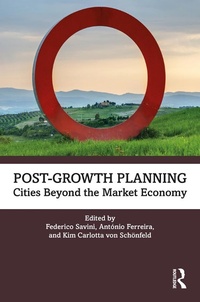
Post-Growth Planning
Cities Beyond the Market Economy
1st Edition
Published on 18. May 2022
254 pages
978-1-000-58403-5 (ISBN)
Description

This book draws on a wide range of conceptual and empirical materials to identify and examine planning and policy approaches that move beyond the imperative of perpetual economic growth. It sketches out a path towards planning theories and practices that can break the cyclical process of urban expansion, crises, and recovery that negatively affect ecosystems and human lives.
To reduce the dramatic social and environmental impact of urbanization, this book offers both a critique of growth-led urban development and a prefiguration of ecologically regenerative and socially just ways of organizing cities and regions. It uncovers emerging possibilities for post-growth planning in the fields of collective housing, mobility, urban commoning, ecological land-use, urban-rural symbiosis, and alternative planning worldviews. It provides a toolkit of concepts and real-life examples for urban scholars, urbanists, activists, architects, and designers seeking to make cities prosper within planetary boundaries.
This book speaks to both experts and beginners in post-growth thinking. It concludes with a manifesto and glossary of key terms for urban scholars, students, and practitioners.
To reduce the dramatic social and environmental impact of urbanization, this book offers both a critique of growth-led urban development and a prefiguration of ecologically regenerative and socially just ways of organizing cities and regions. It uncovers emerging possibilities for post-growth planning in the fields of collective housing, mobility, urban commoning, ecological land-use, urban-rural symbiosis, and alternative planning worldviews. It provides a toolkit of concepts and real-life examples for urban scholars, urbanists, activists, architects, and designers seeking to make cities prosper within planetary boundaries.
This book speaks to both experts and beginners in post-growth thinking. It concludes with a manifesto and glossary of key terms for urban scholars, students, and practitioners.
Reviews / Votes
"How do we plan for cities that no longer grow, and do not need to? That's a hard question and the people in this collective volume are the best out there to answer it!"-Giorgos Kallis, ICREA Professor, ICTA-UAB, Barcelona, Spain
"Transitioning the deeply entrenched economic growth paradigm is increasingly considered to be a central axis in achieving a socially inclusive and environmentally sensible world. Nonetheless, this is easier said than done! The exquisite collection of papers in this book sets out a roadmap by carefully examining and proposing a series of pathways that can nurture such vital change towards a more sustainable post-growth urbanity. A must-read for anyone who cares about our future cities and their environment."
-Erik Swyngedouw, Professor of Human Geography, The University of Manchester, UK
"Post-Growth Planning addresses the urgent question of the equitable distribution of costs and benefits in places where ecological balance replaces growth as the aim of planning. Investigating the policies and politics of dealing with climate change in both wealthy and poor countries, this book is essential reading for planners seeking to achieve a just, environmentally sensitive path."
-Susan Fainstein, Senior Research Fellow, Harvard Graduate School of Design, USA
"What if urban economies were shaped so that widely shared social well-being within ecological limits always took precedence? What strategic concepts would inform urban policies? What regulatory practices would emerge? How would planning systems be designed and practised? This book contains many fine chapters exploring ways of displacing an urban politics dominated by catching a share of global capitalism's unstable movements, and reaching towards a more just and environmentally sustainable world."
-Patsy Healey, Emeritus Professor of Town & Country Planning, Newcastle University, UK
"This is a thought-provoking book, and one of the very first to "translate" post-growth thinking to the field of urban planning....Savini, Ferreira, and von Schoenfeld instill in the reader a sense of urgency that is typical of postgrowth thinkers. They sketch the outlines of the massive transition of current planning to become detached from the dominant growth paradigms, but they do not lose the connection with reality."
-Reinout Kleinhans, Delft University of Technology, for the Journal of Urban Affairs
More details
Edition
1. Auflage
Language
English
Place of publication
London
United Kingdom
Publishing group
Taylor & Francis Ltd
Target group
Professional and scholarly
College/higher education
Illustrations
3 Tables, black and white; 5 Line drawings, black and white; 1 Halftones, black and white; 6 Illustrations, black and white
ISBN-13
978-1-000-58403-5 (9781000584035)
Copyright in bibliographic data and cover images is held by Nielsen Book Services Limited or by the publishers or by their respective licensors: all rights reserved.
Schweitzer Classification
Other editions
Additional editions
Federico Savini | Antonio Ferreira | Kim von Schoenfeld
Post-Growth Planning
Cities Beyond the Market Economy
Book
05/2022
1st Edition
Routledge
€206.50
Shipment within 15-20 days
Federico Savini | Antonio Ferreira | Kim von Schoenfeld
Post-Growth Planning
Cities Beyond the Market Economy
Book
05/2022
1st Edition
Routledge
€61.00
Shipment within 15-20 days
Persons
Federico Savini is associate professor in environmental planning, institutions, and politics at the University of Amsterdam, Center for Urban Studies. His research focuses on the interaction between regulations, politics, and urban transformations. As a degrowth scholar and activist, he studies, and experiments with, how cities can reduce their material footprint across different sectors, from housing commons to regenerative metabolism, from waste reuse to energy infrastructures. His most recent publications are "Towards an urban degrowth" (in Environment and Planning A, 2021) and the book Planning and Knowledge: How New Forms of Technocracy Are Shaping Contemporary Cities (2019, with Mike Raco). He is co-initiator of the housing cooperative de Nieuwe Meent in Amsterdam.
Antonio Ferreira is deeply concerned with the environmental, social, and economic crisis the world is currently facing, and what that crisis means for our children and future generations. He hopes to contribute to addressing this crisis through the development of a deeper and ethically informed understanding of the world around us. He works as a Principal Researcher at CITTA: Research Centre for Territory, Transports and Environment, University of Porto, Portugal. His research interests cover a variety of themes, namely urban and transport policy, worldview theory, emotions in planning, and planning education.
Kim Carlotta von Schoenfeld is a research fellow at the Centre for Transdisciplinary Research on Culture, Space and Memory at the University of Porto, Portugal. She is an interdisciplinarily oriented academic, critically but constructively bridging the fields of urban and regional planning, mobility, geography, governance, post-growth economics, psychology, critical innovation studies, international development, futuring, and third cultures. Her PhD thesis - defended at Wageningen University in 2021 - explored the benefits and drawbacks of social learning in co-creative planning processes, engaging a psychology-based lens. She holds a BSc in Human Geography and Planning and a Research Master's in Urban Studies from the University of Amsterdam, The Netherlands.
Antonio Ferreira is deeply concerned with the environmental, social, and economic crisis the world is currently facing, and what that crisis means for our children and future generations. He hopes to contribute to addressing this crisis through the development of a deeper and ethically informed understanding of the world around us. He works as a Principal Researcher at CITTA: Research Centre for Territory, Transports and Environment, University of Porto, Portugal. His research interests cover a variety of themes, namely urban and transport policy, worldview theory, emotions in planning, and planning education.
Kim Carlotta von Schoenfeld is a research fellow at the Centre for Transdisciplinary Research on Culture, Space and Memory at the University of Porto, Portugal. She is an interdisciplinarily oriented academic, critically but constructively bridging the fields of urban and regional planning, mobility, geography, governance, post-growth economics, psychology, critical innovation studies, international development, futuring, and third cultures. Her PhD thesis - defended at Wageningen University in 2021 - explored the benefits and drawbacks of social learning in co-creative planning processes, engaging a psychology-based lens. She holds a BSc in Human Geography and Planning and a Research Master's in Urban Studies from the University of Amsterdam, The Netherlands.
Content
Part 1 Beginning 1 Uncoupling Planning and Economic Growth: Towards Post-Growth Urban Principles: An Introduction 2 When Greening is Not Degrowth: Cost-Shifting Insights Part 2 Dwelling 3 Housing Commons as a Degrowth Planning Practice: Learning from Amsterdam's De Nieuwe Meent 4 Dwelling Beyond Growth: Negotiating the State, Mutualism and Commons Part 3 Moving 5 Individual Well-Being beyond Mobility Growth? 6 Beyond the Rule of Growth in the Transport Sector: Towards "Clumsy Mobility Solutions"? Part 4 Governing 7 The City as a Commons: Diffused Governance for Social and Ecological Reproduction 8 Hacking the Legal: The Commons between the Governance Paradigm and Inspirations Drawn from the "Living History" of Collective Land Use Part 5 Regulating 9 Planning beyond the Backwash of a Growth Node: Old and New Thinking in Cambridgeshire, England and Skane, Sweden 10 Planning Law and Post-Growth Transformation Part 6 Nurturing 11 Nurturing the Post-Growth City: Bringing the Rural Back in 12 Towards a Post-Growth Food System: The Community as a Cornerstone? Lessons from Two Amsterdam Community-Led Food Initiatives Part 7 Being 13 Becoming a Post-Growth Planner: Inner Obstacles to Changing Roles 14 Once Upon a Planet: Planning for Transition from Ego-Driven to Eco-Driven Economies Part 8 Envisioning 15 A Manifesto for Post-Growth Planning 16 A Glossary of and for Post-Growth Planning
