

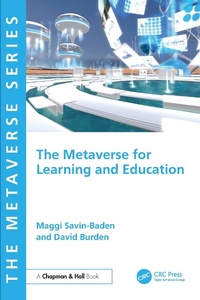
The Metaverse for Learning and Education
1st Edition
Published on 11. September 2024
124 pages
978-1-040-11201-4 (ISBN)
Description

Accompanying The Metaverse: A Critical Introduction in CRC Press' new The Metaverse Series, this book explores the ways in which the Metaverse can be used for education and learning, as well as how it is different from virtual reality (VR) application development. For example, institutions and tutors can make use of the Metaverse space to represent themselves in it or create their own content and share experiences, whilst students can access a wider range of material, learn within appropriate settings and create content to support their own and others' learning.
Key Features:
* Provides practical advice from the authors' collective three decades of work and experience in VR and Metaverse learning and education.
* Examines different approaches to learning that are relevant in a VR and Metaverse context, including theoretical and practical approaches to pedagogy.
* Suggests different approaches to learning that might be used and explores learning in practice in the metaverse - from early versions such as computer-supported collaborative learning and action learning through to more recent practices such as games and gamification and the use of problem-based learning in virtual worlds.
* Examines a number of advantages of learning in the metaverse such as the opportunity to be inclusive towards different approaches to learning, the value of affordances, peer-to-peer learning and genres of participation.
This book is aimed primarily at practitioners in the learning and education field, and those who set policy and commission work. It may also be of interest to parents, managers, other interested professionals, students, researchers and lay readers.
Key Features:
* Provides practical advice from the authors' collective three decades of work and experience in VR and Metaverse learning and education.
* Examines different approaches to learning that are relevant in a VR and Metaverse context, including theoretical and practical approaches to pedagogy.
* Suggests different approaches to learning that might be used and explores learning in practice in the metaverse - from early versions such as computer-supported collaborative learning and action learning through to more recent practices such as games and gamification and the use of problem-based learning in virtual worlds.
* Examines a number of advantages of learning in the metaverse such as the opportunity to be inclusive towards different approaches to learning, the value of affordances, peer-to-peer learning and genres of participation.
This book is aimed primarily at practitioners in the learning and education field, and those who set policy and commission work. It may also be of interest to parents, managers, other interested professionals, students, researchers and lay readers.
More details
Edition
1. Auflage
Language
English
Place of publication
London
United Kingdom
Publishing group
Taylor & Francis Ltd
Target group
Professional and scholarly
Illustrations
2 Line drawings, color; 5 Line drawings, black and white; 2 Illustrations, color; 5 Illustrations, black and white
ISBN-13
978-1-040-11201-4 (9781040112014)
Copyright in bibliographic data and cover images is held by Nielsen Book Services Limited or by the publishers or by their respective licensors: all rights reserved.
Schweitzer Classification
Other editions
Additional editions

Maggi Savin-Baden | David Burden
The Metaverse for Learning and Education
Book
09/2024
1st Edition
Chapman & Hall/CRC
€154.90
Shipment within 10-20 days
Maggi Savin-Baden | David Burden
The Metaverse for Learning and Education
Book
09/2024
1st Edition
Chapman & Hall/CRC
€60.40
Shipment within 10-20 days
Persons
Maggi Savin-Baden is a research Professor at Blackfriars Hall, University of Oxford. She has researched and evaluated staff and student experience of learning for over 20 years and gained funding. Maggi has a strong publication record of over 70 research publications and has completed 25 books. Her research and writing reflect her interests on the impact of innovative learning, digital fluency, digital afterlife and the postdigital and she has worked with David on a number of research projects since 2008
David Burden created his first virtual world in 1996 and has spent most of the time since working in virtual spaces and with virtual humans for a variety of clients through his company Daden Limited. His first presentation on the Metaverse was in 2008. David and Maggi co-wrote the book Virtual Humans for Routledge in 2019, and also worked together on the book Digital Afterlife in 2020.
David Burden created his first virtual world in 1996 and has spent most of the time since working in virtual spaces and with virtual humans for a variety of clients through his company Daden Limited. His first presentation on the Metaverse was in 2008. David and Maggi co-wrote the book Virtual Humans for Routledge in 2019, and also worked together on the book Digital Afterlife in 2020.
Content
Introduction, 1. The Metaverse for Learning and Education, 2. Approaches to Learning, 3. Applied Models for Learning, 4. Rethinking Pedagogy for the Metaverse, 5. Tech, Platforms and Wearables in the Postdigital Metaverse, 6. Pros and Cons of Learning in the Metaverse, 7. Learning Assemblages for the Metaverse
