

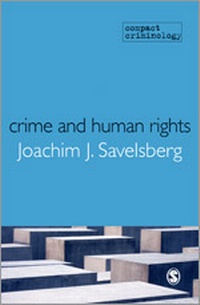
Crime and Human Rights
Criminology of Genocide and Atrocities
1st Edition
Published on 19. April 2010
144 pages
978-1-4462-4832-4 (ISBN)
Description

Crimes against humanity are amongst the most shocking violations imaginable. Savelsberg's text provides a much-needed criminological insight to the topic, exploring explanations of and responses to human rights abuses. Linking human rights scholarship with criminological theory, the book is divided into three parts:
Part 1: Examines the legal and historical approach to the topic within a criminological framework
Part 2: Unpicks the aetiology of human rights offending with real and detailed case studies
Part 3: Explores institutional responses to crimes and uses criminological theory to offer solutions.
Seminal yet concise, Crime and Human Rights is written for advanced students, postgraduates and scholars of crime, crime control and human rights. With its fresh and original approach to a complex topic, the book's appeal will span across disciplines from politics and sociology to development studies, law, and philosophy.
Compact Criminology is an exciting series that invigorates and challenges the international field of criminology.
Books in the series are short, authoritative, innovative assessments of emerging issues in criminology and criminal justice - offering critical, accessible introductions to important topics. They take a global rather than a narrowly national approach. Eminently readable and first-rate in quality, each book is written by a leading specialist.
Compact Criminology provides a new type of tool for teaching, learning and research, one that is flexible and light on its feet. The series addresses fundamental needs in the growing and increasingly differentiated field of criminology.
Part 1: Examines the legal and historical approach to the topic within a criminological framework
Part 2: Unpicks the aetiology of human rights offending with real and detailed case studies
Part 3: Explores institutional responses to crimes and uses criminological theory to offer solutions.
Seminal yet concise, Crime and Human Rights is written for advanced students, postgraduates and scholars of crime, crime control and human rights. With its fresh and original approach to a complex topic, the book's appeal will span across disciplines from politics and sociology to development studies, law, and philosophy.
Compact Criminology is an exciting series that invigorates and challenges the international field of criminology.
Books in the series are short, authoritative, innovative assessments of emerging issues in criminology and criminal justice - offering critical, accessible introductions to important topics. They take a global rather than a narrowly national approach. Eminently readable and first-rate in quality, each book is written by a leading specialist.
Compact Criminology provides a new type of tool for teaching, learning and research, one that is flexible and light on its feet. The series addresses fundamental needs in the growing and increasingly differentiated field of criminology.
Reviews / Votes
In this concise book... Joachim J. Savelsberg provides further illumination on a topic affecting the wellbeing and future of humanity, specifically through the lenses of criminology...Savelsberg's book effectively achieves a number of objectives. Firstly, and perhaps importantly, this concise reading provides a meaningful contribution to the growing branches of critical and contemporary criminology, while providing original ideas to further enrich literature on genocide and atrocities. In writing on these crimes, Savelsberg adopts an international approach with the inclusion of case studies, research findings, laws and legal institutions from around the globe. Many opportunities for both theoretical and empirical research are also exposed, thus helping to encourage further research in this area and to facilitate multidisciplinary scholarly collaboration. Titles for each thematic section, chapter, and subsection headers are all posed as questions as a creative way to engage the reader in a conversation with Savelsberg. This makes the book all the more clear and lively, similar to attending a lectureMichael J. Puniskis
Crime, Law and Social Change
Joachim Savelsberg brings a unique perspective and research background to the topic of crime and human rights. The book provides a succinct and penetrating analysis that persuasively explains why contemporary criminology must widen its boundaries to make human rights crimes a priority for our field. This book is essential reading for scholars and students
John Hagan
MacArthur Professor, Northwestern University "Joachim Savelsberg is one of the world's finest sociologists of crime and the institutions through which it is constituted and controlled. In this brief but path-breaking study he shows how the tools of criminological analysis can deepen our understanding of the processes that produce genocide and crimes against humanity - and why an engagement with human rights is essential for a 21st century criminology that aspires to depth and relevance." -- David Garland
All prices
More details
Series
Language
English
Place of publication
London
United Kingdom
Target group
College/higher education
Professional and scholarly
ISBN-13
978-1-4462-4832-4 (9781446248324)
Copyright in bibliographic data and cover images is held by Nielsen Book Services Limited or by the publishers or by their respective licensors: all rights reserved.
Schweitzer Classification
Other editions
Additional editions
Book
04/2010
1st Edition
SAGE Publications Ltd
€172.33
Shipment within 15-20 days
Book
04/2010
1st Edition
SAGE Publications Ltd
€62.08
Shipment within 15-20 days
Person
Joachim J. Savelsberg is a Professor of Sociology and Law and the Arsham and Charlotte Ohanessian Chair at the University of Minnesota. Recent writings address issues of law regarding hate, genocide and atrocities, especially their public representations and collective memories. They include "Writing biography in the face of cultural trauma: Nazi descent and the management of spoiled identities" (American Journal of Cultural Sociology 2022), Knowing about Genocide: Armenian Suffering and Epistemic Struggles (University of California Press, 2021), Representing Mass Violence: Conflicting Responses to Human Rights Violations in Darfur (University of California Press, 2015), "Representing Human Rights Violations in Darfur: Global Justice, National Distinctions" (with Hollie Nyseth Brehm; American Journal of Sociology [AJS] 2015); American Memories: Atrocities and the Law (with Ryan D. King; Russell Sage Foundation, 2011); Crime and Human Rights: Criminology of Genocide and Atrocities (Sage, 2010); "Law and Collective Memory" (with King; Annual Review of Law & Social Science 2007); and "Institutionalizing Collective Memories of Hate: Law and Law Enforcement in Germany and the United States" (with King; AJS 2005).
Savelsberg is a past candidate for President of the American Society of Criminology (ASC), an ASC Fellow, and a recipient of the Freda Adler Scholarship Award. He held fellowships and Visiting Professorships at Johns Hopkins, Harvard, the universities of Graz, Munich, and Humboldt (Berlin), the Kaete Hamburger Center "Law as Culture" (Bonn), the Rockefeller Center at Bellagio, the Stellenbosch Institute for Advanced Study (South Africa) and the Paris Institute for Advanced Studies. Savelsberg is a past co-editor of the Law & Society Review), a past chair of the ASA Section for Sociology of Law, the ASA Section for Human Rights, and the SSSP Theory Division.
Savelsberg is a past candidate for President of the American Society of Criminology (ASC), an ASC Fellow, and a recipient of the Freda Adler Scholarship Award. He held fellowships and Visiting Professorships at Johns Hopkins, Harvard, the universities of Graz, Munich, and Humboldt (Berlin), the Kaete Hamburger Center "Law as Culture" (Bonn), the Rockefeller Center at Bellagio, the Stellenbosch Institute for Advanced Study (South Africa) and the Paris Institute for Advanced Studies. Savelsberg is a past co-editor of the Law & Society Review), a past chair of the ASA Section for Sociology of Law, the ASA Section for Human Rights, and the SSSP Theory Division.
Content
Introduction
How Have Governments Responded to Atrocities and Human Rights Violations?
PART ONE: ARE THERE TRENDS IN CONTROLLING HUMAN RIGHTS VIOLATIONS?
When Are Atrocities Crimes?
How and Why Have States and Governments Been Constrained?
PART TWO: WHAT CAN CRIMINOLOGY CONTRIBUTE TO (AND LEARN FROM)THE STUDY OF SERIOUS HUMAN RIGHTS VIOLATIONS?
Introduction
How Does Genocide Unfold? The Case of the Holocaust
Can Genocide Studies and Criminology Enrich Each Other?
How Can Criminology Address Contemporary Atrocities?
PART THREE: HOW CAN HUMAN RIGHTS VIOLATIONS BE FOUGHT?
What Is the Role of Criminal Courts?
How Effective Can Courts Be and What Can Help Them?
How Have Governments Responded to Atrocities and Human Rights Violations?
PART ONE: ARE THERE TRENDS IN CONTROLLING HUMAN RIGHTS VIOLATIONS?
When Are Atrocities Crimes?
How and Why Have States and Governments Been Constrained?
PART TWO: WHAT CAN CRIMINOLOGY CONTRIBUTE TO (AND LEARN FROM)THE STUDY OF SERIOUS HUMAN RIGHTS VIOLATIONS?
Introduction
How Does Genocide Unfold? The Case of the Holocaust
Can Genocide Studies and Criminology Enrich Each Other?
How Can Criminology Address Contemporary Atrocities?
PART THREE: HOW CAN HUMAN RIGHTS VIOLATIONS BE FOUGHT?
What Is the Role of Criminal Courts?
How Effective Can Courts Be and What Can Help Them?
