

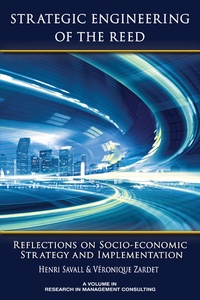
Strategic Engineering of the Reed
Reflections on Socio-Economic Strategy and Implementation
1st Edition
Published on 6. January 2017
383 pages
978-1-68123-953-8 (ISBN)
Description

This volume is part of an on-going partnership between the Research in Management Consulting book series and the Socio-Economic Institute for Firms and Organizations (ISEOR), located in Ecully, France, on the outskirts of Lyon. The socioeconomic approach to management (SEAM) provides a pathway to creating more engaged, more responsible and responsive, and more productive organizations. In many respects this volume reflects a culmination of ISEOR's work, drawing together Henri Savall and Veronique Zardet's insights and framing them in the context of strategy creation and, just as if not more important, strategy implementation.
This volume casts SEAM in the context of strategy development and implementation. Reflecting on the changing nature of work and the workplace, the potential power of-and need to develop and build on-human potential has never been greater. Savall and Zardet have always thought that the Western concept of human resources was misguided, that people are not a resource to use up but rather a source of potential to invest in, develop, and nurture. People bring their potential to the organizations in which they work-and it is their choice as to whether they will apply it in their jobs. Thus, a core managerial challenge is to create an environment in which that potential can be maximized.
SEAMbased strategy builds on this premise, developing an approach to economic and social performance, providing direction as to how managers can create and implement strategies that enhance organizational effectiveness and efficiency. As Savall and Zardet argue, strategic vision does not have to be limited by constraints in the external environment-companies "are not compelled to enter in a 'strategic' tunnel" that mimics the competition and the market. Instead, companies can experience breakthroughs, turning constraints into opportunities by unleashing their internal energy, power, and cohesion, working and succeeding as a team. The SEAM approach to strategy is grounded in innovation and creation far more than imitation-and, as convincingly illustrated in the volume, that creativity can be selffinanced through the valueadded created by the elimination of organizational dysfunctions and the hidden costs they generate. The volume provides an insightful guide for enhancing economic and social performance, with a useful mixture of specific tools and techniques-grounded in a conceptual view of organizational life-interspersed throughout that illustrate how it can be done.
This volume casts SEAM in the context of strategy development and implementation. Reflecting on the changing nature of work and the workplace, the potential power of-and need to develop and build on-human potential has never been greater. Savall and Zardet have always thought that the Western concept of human resources was misguided, that people are not a resource to use up but rather a source of potential to invest in, develop, and nurture. People bring their potential to the organizations in which they work-and it is their choice as to whether they will apply it in their jobs. Thus, a core managerial challenge is to create an environment in which that potential can be maximized.
SEAMbased strategy builds on this premise, developing an approach to economic and social performance, providing direction as to how managers can create and implement strategies that enhance organizational effectiveness and efficiency. As Savall and Zardet argue, strategic vision does not have to be limited by constraints in the external environment-companies "are not compelled to enter in a 'strategic' tunnel" that mimics the competition and the market. Instead, companies can experience breakthroughs, turning constraints into opportunities by unleashing their internal energy, power, and cohesion, working and succeeding as a team. The SEAM approach to strategy is grounded in innovation and creation far more than imitation-and, as convincingly illustrated in the volume, that creativity can be selffinanced through the valueadded created by the elimination of organizational dysfunctions and the hidden costs they generate. The volume provides an insightful guide for enhancing economic and social performance, with a useful mixture of specific tools and techniques-grounded in a conceptual view of organizational life-interspersed throughout that illustrate how it can be done.
All prices
More details
Other editions
Additional editions
Henri Savall | Veronique Zardet
Strategic Engineering of the Reed
Reflections on Socio-Economic Strategy and Implementation
Book
05/2017
Information Age Publishing
€77.70
Shipment within 3-4 weeks
Content
- Cover
- Strategic Engineering of the Reed: Reflections on Socio-Economic Strategy and Implementation
- Research in Management Consulting
- Strategic Engineering of the Reed: Reflections on Socio-Economic Strategy and Implementation
- Copyright Page
- Contents
- Preface
- REFERENCES
- Foreword
- NOTE
- Introduction
- CREATION OF POTENTIAL STRATEGIC INDICATORS
- Framing the SEAM Methodology
- THE CHOICE OF TOOLS FOR THE WORK OF SCIENTIFIC INTENTION
- The Researcher's Position Choice
- Knowledge and Concept Development Processes
- Towards "Generic Contingency"
- The Role of Company Actors
- CONCLUSION
- I: RENEWAL OF STRATEGIC ANALYSIS AND DECISION
- 1: The Micro- and Macroeconomic Stakes of Strategy
- PROFITABILITY AND PRODUCTIVITY GAINS
- Productivity Gains
- The Limits of Technology as a Source of Productivity Gains
- HUMAN RESOURCE MANAGEMENT FAILURE
- Trends in Human Potential Development in Industrialized Countries
- The Intangible Investment in Organizations
- The Need to Develop Socio-Economic Strategies
- Development of Socio-Economic Strategies
- 2: The Visible and Hidden Phenomena in Strategic Analysis
- THE ENVIRONMENT AND CONSUMER NEEDS: PARTIALLY HIDDEN OBJECTS
- Two Environments: Internal and External
- Superstructure and Infrastructure: The Visible and Hidden
- Innovative Strategies are Based on Discovering the Hidden
- SOCIO-ECONOMIC STRATEGY AND NEW CHALLENGES
- Retaining Employees
- Fighting Against Resource and Internal Potential Evaporation
- Rebalancing the Distribution Between Immediate Results and Potential Creation
- Developing Strategic Ambition
- Integrating Strategic Warning Indicators
- CONCLUSION
- II: THE SOCIO-ECONOMIC STRATEGY CONCEPT
- 3: Socio-Economic Strategy Foundations
- HUMAN POTENTIAL AND INTERNAL DEVELOPMENT: AN ESSENTIAL STRATEGIC VARIABLE
- Activating Human Resources: A Complex Reality
- THE INTERACTION BETWEEN THE COMPANY AND ITS ENVIRONMENT
- 4: Socio-Economic Strategy
- RETHINKING STRATEGY
- CLOSING CONSIDERATIONS
- 5: Strategic Socio-Economic Diagnosis: Indicators
- NURTURING STRATEGIC DECISIONS
- Hidden Costs
- Cost Externalization
- Investment and Creation of Potential
- Saving Time for Intangible Investment
- Creation of Potential Indirectly Productive Time
- The Deep Roots of Effective and Efficient Management Quality
- CASE STUDY OF SOCIO-ECONOMIC STRATEGY
- Brioche Pasquier
- Major Strategic Adjustments
- An Innovative Strategy, Weakly Imitative, Creator of Socio-Economic Performance
- Price Competition
- Battle for Market Share
- A Strategy Grounded in the Company "Reed"
- Choices of General Management
- Use of Simple and Flexible Tools for the Management Team
- Feedback from Strategy Implementation on Strategy
- MANAGERIAL DECISION SOCIO-ECONOMIC THEORY
- CONCLUSION: ACTION LEVERS FOR DEVELOPING SOCIO-ECONOMIC STRATEGY
- 6: Developing Socio-Economic Strategy
- THE STEPS OF FLEXIBLE AND ROOTED STRATEGIC PLANNING PROCESSES
- THE USE OF A SIMPLE MEDIUM: THE STRATEGIC PLAN AND THE INTERNAL-EXTERNAL STRATEGIC ACTION PLAN
- Strategic Plan
- The Internal-External Strategic Action Plan
- Triannual Strategic Objectives Scheduling
- Strategic Objectives Break Down Synoptic Table (Simple, Educational, Reportable)
- Priority Actions Break Down Grids
- The Strategic Plan and IESAP Dynamic Functioning
- SOCIO-ECONOMIC STRATEGIC IMPLEMENTATION PROCEDURES
- First Step: An intervention to Improve Strategy Implementation
- The Second Step: An Intervention on the Company's Strategy
- Filtering
- Enriching
- Initial Strategic Boost
- CONCLUSION TO PART II
- III: THE STRATEGY LITMUS TEST: IMPLEMENTATION, ASSESSMENT, ADJUSTMENT
- 7: Implementing Socio-Economic Strategy
- MANAGEMENT PRINCIPLES FOR APPLYING SOCIO-ECONOMIC STRATEGY
- Structuring Periodically and Synchronizing Regularly
- Communication-Coordination-Cooperation
- Better Strategy Implementation
- Pedagogic Dissemination by Managers
- Developing Contractual Practices Between Both Internal and External Stakeholders
- Transparent Information and Communication Systems
- Integrating Hidden Costs and Externalized Costs
- Measuring Strategic Actions Immediate and Delayed Effects
- Economic Balance as an Aid to the Intangible Investment Decision Tool
- Synthesis on the Evolution of Information Systems
- Develop Practical and More Heuristic Procedures: Flexible, Simple, Iterative and Effective
- The Refusal of Illusory Maximization
- 8: Strategy Implementation
- THE INSTRUMENTS OF STRATEGY IMPLEMENTATION
- Priority Action Plans and Time Management
- Priority Action Plan Definition
- The Second Source of the PAP: The Updated Dysfunctions Diagnosis
- Time Management: Imperative Base for Strategy Implementation
- Piloting the PAP During the Semester
- The Relationship Between the PAPs of Two Successive Semesters
- The Periodically Negotiable Activity Contracts
- The Link Between the PAP and PNAC
- The Financing and Economic Efficiency Principle of the PNAC
- The PNAC Guideline
- Cleaning Up and Synchronizing Through PNAC
- The Strategic and Operational Piloting Logbooks
- The Key Features of the Piloting Logbook
- The Two Linked Modes of the Piloting Logbook: Individual and Collective
- The Piloting Logbook and Decision Making
- The Competency Grid and the Assessment of Skills
- Definition of the Competency Grid
- Strategic Diagnosis Function of the Competency Grid
- The Help Function in Strategy Implementation: Competency
- ARTICULATING THE INSTRUMENTS OF STRATEGY IMPLEMENTATION
- 9: The Assessment of Strategic Achievements
- MINI-ASSESSMENTS OR SHORT-TERM CONTROL OF THE STRATEGIC ACTION
- The Use of Piloting Logbooks
- Periodical Appointments of Collaborative Strategic Management
- THE SIX-MONTH REVIEW OF STRATEGIC ACHIEVEMENTS
- The Implementation Report of the PAP
- The Six-Month Periodically Negotiable Activity Contract Assessment
- THE ANNUAL ASSESSMENT
- The Assessment of Financial Performance
- Budget Preparation
- Updating the Strategic Plan
- CONCLUSION
- 10: Strategic Bedrock Theory and the Cohesion Leverage Effect
- COHESION: A KEY-FACTOR OF SUSTAINABLE SOCIO-ECONOMIC PERFORMANCE
- Connections Between Traditional Organization, Steering Intensity and Cohesion
- The TFW Virus Metaphor
- STRATEGIC BEDROCK THEORY
- Positioning in Relation to the Socio-Economic Strategy Concept
- Sequencing of the Metamorphosis Action
- CONCLUSION
- 11: General Conclusions
- AN INTERACTIVE STRATEGIC VISION
- Strategic Engineering
- STRATEGY AND STRATEGIC MANAGEMENT: A STRONG INTERDEPENDENCE
- Appendix I: History of the Socio-Economic Strategy Concept
- 1973-1974
- 1974-1975
- 1976
- From 1976 to 1981
- 1977
- 1978-1979
- 1979-1980
- 1979-1981
- 1980-1981
- 1981
- 1982
- 1983-1984
- 1985-1987
- 1987
- 1993-1994
- 1994
- 1994-1998
- 1995
- Looking Back
- NOTES
- Appendix II: Socio-Economic Strategy of Companies
- EMPLOYMENT, PRODUCTIVITY, AND WORKING CONDITIONS
- INDICATORS OF THE SOCIO-ECONOMIC STRATEGY OF THE COMPANY
- STRUCTURING THE WHOLE COMPANY
- COMPANY AXES OF DEVELOPMENT OF THE SOCIO-ECONOMIC STRATEGY: A DEVICE FOR STRUCTURING
- NOTES
- Appendix III: Assessment Scale of the Socio-Economic (SEAM) Strategy Criteria
- References
- About the Authors

