

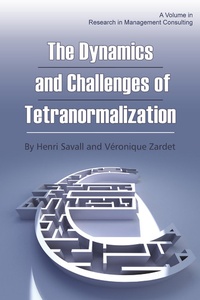
Dynamics and Challenges of Tetranormalization
1st Edition
Published on 3. January 2013
251 pages
978-1-62396-282-1 (ISBN)
Description

This volume continues the collaboration between the RMC book series and the French management research think tank ISEOR (Socio-Economic Institute for Firms and Organizations). Those familiar with Henri Savall's and his colleague Veronique Zardet's earlier work on the socio-economic theory of organizations will recognize their assessments of organizational dysfunctions and hidden costs - but in a different context. In their current work, the emphasis is on the tensions created by the wider environment - the idea of tetranormalization - and how those tensions shape and influence organizational life. Drawing on a wide range of examples from the news media and popular press, Savall and Zardet paint a disturbing picture of the underlying dynamics and challenges posed by a literal avalanche of standards and norms - which are often ambiguous and conflicting - that literally encompasses all that we do.Their analytic framework is composed of four "e;poles"e; - two social dimensions and two economic dimensions - that capture social norms and quality, safety and environment standards (the social dimension), and trade-related norms and accounting and financial standards (the economic dimension). Throughout the volume, Savall and Zardet's analysis captures the myriad ways in which these dimensions interact, shaping the "e;rules of the game"e; that dictate how organizations compete and collaborate. Differentiating the "e;rules of the game"e; from "e;playing with"e; those rules, they delve into the subtleties and nuances that underlie these "e;poles,"e; providing further insight into how these forces are manipulated through lobbying and the seemingly 24/7 cycle of exposing, publicizing and rule-making surrounding social and economic as well as scientific and technological controversies.As Savall and Zardet argue, we are in the midst of a profound upheaval that will play havoc with our economic and social lives for some time to come. If we are going to exert influence on that reality, the challenges that we face moving forward must be conceptualized, constructed and implemented today, for, as they argue, "e;the road to durable prosperity will be a long haul."e; Yet, moving beyond these challenges per se, they underscore that we are also presented with an exceptional opportunity - the very real opportunity to create a sustainable commitment to responsible and responsive organizational performance, one that can be fuelled and financed by our ability to translate the hidden costs that exist in all our organizations into productive, value-added activities and true wealth creation. Their analysis presents an intriguing challenge to traditional notions of corporate social responsibility, delving into the idea of "e;durably acceptable"e; responsibility, ways to facilitate greater stakeholder engagement, and how we can capture ongoing and sustainable improvement in organizational performance.
All prices
More details
Other editions
Additional editions
Henri Savall | Veronique Zardet
The Dynamics and Challenges of Tetranormalization
Book
03/2013
Information Age Publishing
€62.80
Shipment within 3-4 weeks
Content
1 - Front Cover [Seite 1]
2 - The Dynamics and Challenges of Tetranormalization [Seite 2]
3 - A Volume in Research in Management Consulting [Seite 2]
3.1 - Series Editor: Anthony F. Buono, Bentley University [Seite 2]
4 - CONTENTS [Seite 8]
4.1 - 1. Tetranormalization: Phenomena, Observations, and Theory 1 [Seite 8]
4.2 - 2. The Landscape of the Tetranormalized Environment: Seven Phenomena Describing the Problems 25 [Seite 8]
4.3 - 3. The Six Fields of Tetranormalization 73 [Seite 8]
4.4 - 4. Emergence of Innovative Solutions and Good Practices in Gestation 91 [Seite 8]
4.5 - 5. Future Organization in a Tetranormalized Universe: Choices of Strategy 99 [Seite 8]
4.6 - 6. Understanding Tetranormalization- And Doing Something About It! 127 [Seite 8]
4.7 - 7. Reflections on Tetranormalization: The Current Intensification of Tetranormalization, Market Disruption and Strategic Steering 163 [Seite 8]
4.8 - Research in Management Consulting [Seite 3]
4.9 - The Dynamics and Challenges of Tetranormalization [Seite 6]
4.9.1 - by [Seite 6]
4.9.2 - Henri Savall and Véronique Zardet [Seite 6]
4.9.2.1 - Information Age Publishing, Inc. [Seite 6]
4.9.2.2 - Charlotte, North Carolina www.infoagepub.com [Seite 6]
4.9.2.3 - Acknowledgments [Seite 10]
4.9.2.4 - Preface [Seite 14]
4.9.2.4.1 - Anthony F. Buono [Seite 14]
4.9.2.4.2 - REFERENCES [Seite 16]
4.9.2.5 - Introduction to the 2013 English Edition [Seite 18]
4.9.2.5.1 - Origin, Scientific Itinerary, and Scope of the Tetranormalization Concept [Seite 18]
4.9.2.5.1.1 - Henri Savall and Véronique Zardet [Seite 18]
4.9.2.5.2 - UNDERSTANDING THE CRISIS AND RETURNING TO PROSPERITY [Seite 20]
4.9.2.5.2.1 - The Influence of Bernácer on Our Work in Economics and Management Science [Seite 25]
4.9.2.5.2.2 - The Influence of François Perroux [Seite 28]
4.9.2.5.3 - NOTES [Seite 30]
4.9.2.5.4 - REFERENCES [Seite 30]
4.9.2.6 - Introduction to the 2005 First Edition [Seite 32]
4.9.2.6.1 - THE NORMATIVE ENVIRONMENT OF COMPANIES AND ORGANIZATIONS [Seite 33]
4.9.2.6.1.1 - The Rules of the Game and Playing With the Game Rules: What Standards and Norms Mean [Seite 35]
4.9.2.6.2 - The Hidden face of standards AND NORMS [Seite 38]
4.9.2.6.2.1 - Standards and Strategic and Operational Decisions [Seite 40]
4.9.2.6.2.2 - Internal Convergence and Strategic and Operational Decisions [Seite 42]
4.9.2.6.2.3 - Reactive or Proactive Strategies? [Seite 43]
4.9.2.6.2.3.1 - 1. How can we change the dominant behavior pattern-the propensity to reject corporate social responsibility-and promote wider internalization of the inclusion of responsibility in managerial decisions and practices, which is in their own organiza... [Seite 44]
4.9.2.6.2.3.2 - 2. How can we finance the risks associated with a company's social responsibility without compromising its survival-development capacity, particularly in an increasingly competitive world? [Seite 44]
4.9.2.6.3 - WHAT SOCIAL RESPONSIBILITY ARE WE TALKING ABOUT? [Seite 45]
4.9.2.6.3.1 - 1. Transient, short-lived social responsibility leads to the disappearance (disappearance or loss of autonomy by absorption) of the company and the destruction of productive employment. [Seite 45]
4.9.2.6.3.2 - 2. Sustainable social responsibility addresses performance in the short-, medium-, and long-term continuum of the organization's strategic horizon. [Seite 45]
4.9.2.6.3.3 - 3. Acceptable social responsibility refers to a level of responsibility compatible with an organization's cash flow (self-financing capacity) and source of its viability-its relative strategic autonomy and, therefore, of its raison d'être (see... [Seite 45]
4.9.2.6.4 - NOTES [Seite 47]
4.9.2.6.5 - REFERENCE [Seite 48]
4.9.2.6.5.1 - Figure 2. The acceleration of international standard and norm obsolescence. [Seite 35]
4.9.2.6.5.2 - Figure 1. The current state of tetranormalization: Disjointed and dislocated. [Seite 34]
4.9.2.6.5.3 - Figure 3. Illusion-perversion of economic and social activity game rules. [Seite 39]
4.9.2.6.5.4 - Figure 4. The hidden face of disintegrated tetranormalization. [Seite 39]
4.9.2.6.5.5 - Figure 5. Fast-developing labeling. [Seite 40]
4.9.2.6.5.6 - Figure 6. The strategic dilemma of organizations: Give in or get out? [Seite 41]
4.9.2.6.5.7 - Figure 7. Problems of corporate social responsibility. [Seite 44]
4.9.2.6.5.8 - Figure 8. The different corporate social responsibility concepts. [Seite 46]
4.9.2.6.5.9 - Figure 9. The sustainable and acceptable corporate social responsibility concept. [Seite 46]
4.10 - CHAPTER 1 [Seite 50]
4.10.1 - Tetranormalization [Seite 50]
4.10.1.1 - Phenomena, Outcome, Theory [Seite 50]
4.10.1.2 - Characteristics of Tetranormalized Environments [Seite 50]
4.10.1.2.1 - Nature and Dynamics of the Different Levels of Standards [Seite 51]
4.10.1.2.2 - The Tetranormalization Cyclone: A Magnetic Force-Field [Seite 51]
4.10.1.2.3 - The Hidden Face of Standardization: A Trojan Horse of Hidden Interference [Seite 55]
4.10.1.3 - The Impact of Tetranormalized Environments on Companies and Organizations [Seite 56]
4.10.1.3.1 - The Boomerang Effects of Double Externalization [Seite 58]
4.10.1.3.2 - The Hidden Costs of Externalization [Seite 59]
4.10.1.3.3 - Company Social Deresponsibilization Factors [Seite 60]
4.10.1.3.3.1 - Territorial Conflicts [Seite 61]
4.10.1.3.3.2 - The Future of Integrated Corporate Strategies, Standards, and Norms [Seite 61]
4.10.1.4 - The Overall Sustainable Performance of Companies and Organizations [Seite 64]
4.10.1.4.1 - Why is the Question of Global Performance Raised by All Stakeholders? [Seite 65]
4.10.1.4.2 - Advantages of Proactive Strategies [Seite 68]
4.10.1.5 - CONCLUSION [Seite 69]
4.10.1.5.1 - 1. Human resources are the only factor in the creation of value added -technical and financial capital are essentially inert until activated by human resources [Seite 71]
4.10.1.5.2 - 2. It is possible to reduce the imperfections of the mainstream accounting model to improve decision-making. [Seite 71]
4.10.1.6 - NOTES [Seite 71]
4.10.1.7 - REFERENCES [Seite 72]
4.10.1.7.1 - Figure 1. 3. Economic impacts of the integration of tetranormalization. [Seite 54]
4.10.1.7.2 - Figure 1. 1. Tetranormalization integrated tomorrow? [Seite 53]
4.10.1.7.3 - Figure 1. 2. Illustrative trends observed in standards and norms integration. [Seite 53]
4.10.1.7.4 - Figure 1. 4. Examples of differences between French and Anglo-Saxon accounting frames of reference. [Seite 54]
4.10.2 - Table 1.1. Illustration of Hidden Costs [Seite 63]
4.10.2.1 - Figure 1. 5. Examples of standards and norms used in interference. [Seite 56]
4.10.2.2 - Figure 1. 6. The generic contingency principle for the integration of standards. [Seite 57]
4.10.2.3 - Figure 1. .7. The boomerang effects of double externalization. [Seite 59]
4.10.2.4 - Figure 1. 8. Consequences of the boomerang effect. [Seite 60]
4.10.2.5 - Figure 1. 9. The development of corporate strategic energy. [Seite 62]
4.10.2.6 - Figure 1. 10. Reactive versus proactive strategies. [Seite 64]
4.10.3 - Table 1.2 Conversion of Hidden Costs Into Value Added at Brioche Pasquier (Per Person Per Year) [Seite 70]
4.10.3.1 - Figure 1. 11. Conditions of integration: Adoption of standards. [Seite 65]
4.10.3.2 - Figure 1. 12. The "stock-in-trade" theory. [Seite 71]
4.10.3.3 - Figure 1. 13. The socioeconomic theory of organizations. [Seite 72]
4.11 - CHAPTER 2 [Seite 74]
4.11.1 - The Landscape of the Tetranormalized Environment [Seite 74]
4.11.1.1 - Seven Phenomena Describing the Problem [Seite 74]
4.11.1.2 - The Seven Tetranormalization Phenomena Problem Sets [Seite 74]
4.11.1.2.1 - Tetranormalization: Exploratory and Illustrative Cases [Seite 82]
4.11.1.2.2 - Problems of Production and Proliferation of Standards and Norms [Seite 88]
4.11.1.2.3 - Problem Subgroup 1.1: Articulation of Private and Public Sectors [Seite 88]
4.11.1.2.4 - Problem Subgroup 1.2: IFRS (International Financial Reporting Standards) Compatible Standards [Seite 90]
4.11.1.2.5 - Problem Subgroup 1.3: The Standards and Norms Versus No Standards and Norms Dilemma [Seite 91]
4.11.1.2.5.1 - Proliferation of Institutions [Seite 94]
4.11.1.2.6 - Problem Subgroup 2.1: Control and Audit Institutions [Seite 94]
4.11.1.2.7 - Problem Subgroup 2.2: Research as a Source of Standards and Norms [Seite 95]
4.11.1.2.8 - Problem Subgroup 2.3: Notation Agencies [Seite 97]
4.11.1.2.9 - Problem Subgroup 2.5: Transfer of State-owned Institutions and Organizations to the Private Sector [Seite 98]
4.11.1.2.9.1 - Conflict and Competition Between Standards and Norms [Seite 98]
4.11.1.2.10 - Problem Subgroup 3.1: Concentration of Companies [Seite 98]
4.11.1.2.11 - Problem Subgroup 3.2: Languages (Expansion, Hegemony) [Seite 100]
4.11.1.2.12 - Problem Subgroup 3.3: Internal Contradictions of Political Regimes and Economic Transition [Seite 101]
4.11.1.2.13 - Problem Subgroup 3.4: Technological Change and Productivity [Seite 102]
4.11.1.2.13.1 - Conflict and Hierarchy of Laws and Legal Standards and Norms [Seite 103]
4.11.1.2.14 - Problem Subgroup 4.1: Territoriality of Standards and Norms [Seite 103]
4.11.1.2.15 - Problem Subgroup 4.2: Articulation of Private and Public Sectors [Seite 107]
4.11.1.2.15.1 - Real Application of Standards and Norms [Seite 108]
4.11.1.2.16 - Problem Subgroup 5.0: Compliance With Economic and Commercial Rules [Seite 108]
4.11.1.2.17 - Problem Subgroup 5.1: Safety and Transport [Seite 110]
4.11.1.2.18 - Problem Subgroup 5.2: Respect of Employee Rights [Seite 110]
4.11.1.2.19 - Problem Subgroup 5.3: Borderline Legal Practices [Seite 111]
4.11.1.2.20 - Problem Subgroup 5.5: Control of Social Legislation (Laws, Conventions, Agreements, etc.) [Seite 112]
4.11.1.2.20.1 - Fraud [Seite 112]
4.11.1.2.21 - Problem Subgroup 6.1: Refusal to Submit to Political Power and Law [Seite 114]
4.11.1.2.22 - Problem Subgroup 6.2: Swindling [Seite 115]
4.11.1.2.23 - Problem Subgroup 6.3: Respect of Copyright and Patents [Seite 116]
4.11.1.2.24 - Problem Subgroup 6.4: Doping [Seite 117]
4.11.1.2.25 - Problem Subgroup 6.6: Fraud in Public Services [Seite 117]
4.11.1.2.25.1 - Sanctions for Not Applying Standards and Norms [Seite 117]
4.11.1.2.26 - Problem Subgroup 7.1: Taxes [Seite 117]
4.11.1.2.27 - Problem Subgroup 7.2: Application of Sanctions [Seite 118]
4.11.1.2.28 - Problem Subgroup 7.3: Resources Available [Seite 119]
4.11.1.3 - CONCLUSION [Seite 120]
4.11.1.4 - NOTES [Seite 120]
4.11.1.4.1 - 1. In the examples that follow, the italicized quotes reflect the headline of the summarized article. [Seite 120]
4.11.1.4.2 - 2. In this context, "social" refers to the relations between the members of a group and within that group, which is perceived as a distinct reality. "Societal" refers to relations with the larger society, especially in consideration of its va... [Seite 120]
4.11.1.4.3 - 3. These figures were reported in Le Figaro, on December 17, 2010. [Seite 120]
4.11.1.5 - REFERENCES [Seite 121]
4.11.2 - Table 2.1. Breakdown of Tetranormalization Problems Within the Sample of the Cases Under Study [Seite 83]
4.11.3 - Table 2.1. Continued [Seite 85]
4.11.3.1 - Figure 2. 1. The seven tetranormalization phenomena problem sets and their impacts. [Seite 76]
4.11.3.2 - Figure 2. 2. Tetranormalization problem set tree structures. [Seite 77]
4.11.4 - Table 2.2. Breakdown by Fields of the Sample Cases Under Study [Seite 87]
4.11.5 - Table 2.2. Continued [Seite 88]
4.11.6 - Table 3.1. Provisional Nomenclature of Tetranormalization Fields [Seite 125]
4.12 - CHAPTER 3 [Seite 122]
4.12.1 - The Six Fields of Tetranormalization [Seite 122]
4.12.1.1 - Criteria for the Determination of the Six Fields [Seite 122]
4.12.1.1.1 - 1. competition between different internationally allied networks, such as South-South trade (AB), Latin America, Mercosur1 (considered as the Common Market of South America), as compared with other allied networks with partners that partially share a... [Seite 123]
4.12.1.1.2 - 2. international alliances and concentrations such as South-South trade (AB), Alena2 (AG), and the European Union extended to 25 countries3 (AJ) [Seite 123]
4.12.1.1.3 - 3. systems for international dialogue and negotiation: the G84 (AE), the G205 (AF), and the enlarged European Union (AJ) [Seite 123]
4.12.1.1.4 - 4. the exacerbated competitive battlefield, over the next decade, resulting either from competition between different allied networks, supplemented by international negotiations, or the recent, dynamic and spectacular emergence of countries entering ... [Seite 123]
4.12.1.1.5 - Content of the Six Tetranormalization Fields [Seite 124]
4.12.1.1.6 - Trade and Trade Volume (A) [Seite 126]
4.12.1.1.7 - Accounting and Finance (B) [Seite 127]
4.12.1.1.8 - Quality and Ecology (C) [Seite 133]
4.12.1.1.9 - The Social Domain (D) [Seite 135]
4.12.1.1.10 - Health Care (E) [Seite 136]
4.12.1.1.11 - Public Institutions (F) [Seite 138]
4.12.1.2 - Notes [Seite 139]
4.12.1.3 - REFERENCE [Seite 139]
4.12.2 - Table 3.2. Relationships Between Hidden and Visible Costs [Seite 132]
4.13 - CHAPTER 4 [Seite 140]
4.13.1 - Emergence of Innovative Solutions and Good Practices in Gestation [Seite 140]
4.13.1.1 - Interinstitutional cooperation [Seite 141]
4.13.1.2 - Interorganizational cooperation Between Public and Private Sectors [Seite 142]
4.13.1.3 - Performance and motivation [Seite 144]
4.13.1.4 - Toward the Certification of Public Accounts [Seite 146]
4.13.1.5 - NOTE [Seite 147]
4.14 - CHAPTER 5 [Seite 148]
4.14.1 - Future Organization in a Tetranormalized Universe [Seite 148]
4.14.1.1 - Choices of Strategy [Seite 148]
4.14.1.2 - The "stock in trade" theory: Competitive dynamics of public and private organizations and territories [Seite 148]
4.14.1.2.1 - Awakening a Global Threat [Seite 151]
4.14.1.3 - DURABLY ACCEPTABLE (SUSTAINABLE) CORPORATE SOCIAL RESPONSIBILITY [Seite 152]
4.14.1.3.1 - Financing Durably Acceptable Social Responsibility [Seite 152]
4.14.1.3.2 - Maintaining Intangible Investment Levels [Seite 152]
4.14.1.3.3 - Act on Human Behavior-The Source of Risk [Seite 153]
4.14.1.3.3.1 - Reducing Hidden Costs and Financing Sustainable Social Responsibility Policies [Seite 155]
4.14.1.3.3.2 - Exploratory Inventory of Durably Acceptable Social Responsibility [Seite 156]
4.14.1.3.4 - Problem Subgroup 9.1: Government Insolvency [Seite 156]
4.14.1.3.5 - Problem Subgroup 9.2: The Social Responsibility of Public Organizations [Seite 157]
4.14.1.3.6 - Problem Subgroup 9.3: Corporate Social Responsibility [Seite 160]
4.14.1.4 - MULTIDIMENSIONAL MEASUREMENT OF GLOBAL SUSTAINABLE CORPORATE PERFORMANCE [Seite 163]
4.14.1.4.1 - Assessing Hidden Costs [Seite 163]
4.14.1.4.2 - The Identification and Measurement of the Creation of Intangible Potential [Seite 165]
4.14.1.4.3 - Strategic Alarm and Vigilance Indicators [Seite 165]
4.14.1.4.4 - Hidden Costs/Visible Costs Ratio [Seite 166]
4.14.1.4.5 - Externalized Costs on Internal Costs Ratio [Seite 168]
4.14.1.4.6 - Creation of Potential Time on Directly Productive Time Ratio [Seite 171]
4.14.1.5 - AN ACCOUNTING AND FINANCIAL INFORMATION MEASUREMENT SYSTEM FOR THE EVOLUTION OF TOTAL SUSTAINABLE PERFORMANCE [Seite 171]
4.14.1.6 - NOTES [Seite 173]
4.14.1.7 - REFERENCES [Seite 175]
4.14.1.7.1 - Figure 5. 2. Financing sustainable social responsibility. [Seite 153]
4.14.1.7.2 - Figure 5. 1. Territory conflicts. [Seite 153]
4.14.1.7.3 - Figure 5. 3. Act on the human behavior patterns. [Seite 154]
4.14.1.7.4 - Figure 5. 4. Financing sustainable social responsibility policies. [Seite 156]
4.14.1.7.5 - Figure 5. 5. Economic balance of an automation project. [Seite 156]
4.14.1.7.6 - Figure 5. 6. Indicators and components of hidden costs. [Seite 164]
4.14.2 - Table 5.1. Brioche Pasquier: Turnover, Net Profit, and Staff Developed Over 16 Years [Seite 168]
4.14.2.1 - Figure 5. 7. The three dynamic forces of change: Three piloting axes. [Seite 172]
4.14.3 - Table 5.2. Evolution of Brioche Pasquier's Economic and Financial Performance [Seite 169]
4.14.4 - Table 5.3. Economic Balance of Socioeconomic Innovation in a Factory Employing 1,000 People [Seite 174]
4.14.4.1 - Figure 5. 8. Evolution of the hourly contribution to value added on variable cost (HCVAVC) of a factory producing emergency vehicle bodies and equipment. [Seite 174]
4.15 - CHAPTER 6 [Seite 176]
4.15.1 - Understanding Tetranormalization- and Doing Something About It! [Seite 176]
4.15.1.1 - The Challenge: The Dangers of the Lack of Visibility [Seite 176]
4.15.1.1.1 - Traditional Accountancy: A Distorted "Lens" [Seite 178]
4.15.1.2 - Total Sustainable Organizatonal Performance: Short-, Medium-, and Long-Term Socioeconomic Decision Model [Seite 180]
4.15.1.2.1 - Why Measure Sustainable Total Corporate Performance? [Seite 181]
4.15.1.3 - The Socioeconomic Theory of Organizations: The SEAM model [Seite 186]
4.15.1.3.1 - The Origin of the Socioeconomic Theory of Organizations [Seite 188]
4.15.1.3.2 - The Theory [Seite 189]
4.15.1.3.3 - Socioeconomic Intervention [Seite 191]
4.15.1.3.3.1 - Introduction of a Management Structure and Motivational Tools [Seite 192]
4.15.1.3.4 - Implementation of the Method and Results Obtained [Seite 193]
4.15.1.3.4.1 - Theories Encompassed by the Socioeconomic Metatheory of Organizations [Seite 193]
4.15.1.3.5 - The Theory of Human Behavior [Seite 194]
4.15.1.3.6 - The Theory of the Strategic Operation of Organizations [Seite 198]
4.15.1.3.6.1 - 1. In the short-, medium-, and long-term continuum, human resources are the only factor that actively creates durable economic value. This is a basic critique of the production function. Indeed, 19th century neoclassic and Marxist economic philosophi... [Seite 206]
4.15.1.3.6.2 - 2. In addition, the "residual" factor of the production function, accounting for approximately 50% of the value to be explained, is regarded as a kind of third factor, with capital and labor. The level of hidden costs in a company contributes to ... [Seite 206]
4.15.1.3.6.3 - 3. Any professional or extraprofessional organization spontaneously tends to generate hidden costs, resulting from generated or imposed dysfunctions. [Seite 206]
4.15.1.3.6.4 - 4. The productivity of labor presents a hyperelasticity, given the higher or lower level of hidden costs [Seite 207]
4.15.1.3.6.5 - 5. Obtaining a voluntary reduction of hidden costs and generate extra performance requires contractualization between all stakeholders and the negotiation of compensation for employees who agree to increase their performances [Seite 207]
4.15.1.3.6.6 - 6. Intangible investments lead to more "hyperprofitability" than tangible investments, which take 3 to 4 years to pay back, whereas intangible investments are written off after 4 to 6 months. [Seite 207]
4.15.1.3.6.7 - 1. The quality of human resource and activity management is the essential source of total sustainable performance, much more than strategic or organizational choices. [Seite 207]
4.15.1.3.6.8 - 2. Value added is produced by teams more than individuals, which is why it is essential to build cooperation. [Seite 207]
4.15.1.3.6.9 - 3. The interaction between internal and external stakeholders generates total sustainable performance, by the social link generated and the identification of customer expectations. [Seite 207]
4.15.1.3.6.10 - 4. Every organization must simultaneously satisfy two kinds of customers: internal (e.g., personnel) and external (e.g., clients, other stakeholders). Human resource management becomes internal marketing. Managers listen to their in-house customers (... [Seite 207]
4.15.1.3.6.11 - 5. The "stock in trade" or intangible assets can generate resources. [Seite 207]
4.15.1.3.6.12 - 6. Finally, to improve and maintain total sustainable performance, companies and organizations should adopt structured socioeconomic interventions to help detect lodes of hidden costs and the levers needed to exploit them. Successful change processes... [Seite 207]
4.15.1.4 - Conclusion [Seite 207]
4.15.1.5 - NOTES [Seite 209]
4.15.1.6 - REFERENCES [Seite 210]
4.15.1.6.1 - Figure 6.1. Transformation of the structure of visible and hidden costs. [Seite 179]
4.15.1.6.2 - Figure 6.2. The theory of human behavior. [Seite 182]
4.15.1.6.3 - Figure 6.3. Corporate strategic management. [Seite 183]
4.15.1.6.4 - Figure 6.4. The theory of human behavior. [Seite 195]
4.15.1.6.5 - Figure 6.5. The anthropological theory of the multidimensional needs of people at work. [Seite 196]
4.15.1.6.6 - Figure 6.6. Erosion of the quality of behavior overtime. [Seite 197]
4.15.1.6.7 - Figure 6.7. Synchronized decentralization. [Seite 198]
4.15.1.6.8 - Figure 6.8. Configuration and internal operation. [Seite 199]
4.15.1.6.9 - Figure 6.9. The person of many parts. [Seite 200]
4.15.1.6.10 - Figure 6.10. The two management paradigms. [Seite 201]
4.15.1.6.11 - Figure 6.11. The product as the corporate core. [Seite 203]
4.15.1.6.12 - Figure 6.12. Interface with the external environment and strategic decision. [Seite 204]
4.15.1.6.13 - Figure 6.13. The standards and norms integration process. [Seite 205]
4.15.1.6.14 - Figure 6.14. The total sustainable corporate performance theory. [Seite 205]
4.15.1.6.15 - Figure 6.15. The theory of the creation of economic value. [Seite 206]
4.15.1.6.16 - Figure 6.16. The theory of total sustainable performance factors and levers. [Seite 208]
4.15.1.6.17 - Figure 7. 1. Four poles of key issues. [Seite 213]
4.16 - CHAPTER 7 [Seite 212]
4.16.1 - Reflections on Tetranormalization [Seite 212]
4.16.1.1 - The Current Intensification of Tetranormalization, Market Disruption, and Strategic Steering [Seite 212]
4.16.1.2 - INTENSIFICATION OF TETRANORMALIZATION: RISKS AND EMERGING GOOD PRACTICE [Seite 213]
4.16.1.2.1 - Tetranormalization and Strategic Management [Seite 214]
4.16.1.2.2 - An Observation: Proliferation and Incompatibility of Different Norms and Standards [Seite 214]
4.16.1.2.3 - High Risk for Business: A Loss of Dynamism [Seite 215]
4.16.1.2.4 - Origin of the Problem: The Competitive and Anarchic Market for Norms and Standards [Seite 220]
4.16.1.2.4.1 - Disruption of Markets and Strategic Steering: Threats and Opportunities [Seite 220]
4.16.1.2.5 - Speculation and Aggressive Competitive Games on Disrupted Markets: Risks and Emerging Innovations [Seite 221]
4.16.1.2.6 - Business Ethics: Paralyzing Fluctuations and Reprehensible Practices [Seite 221]
4.16.1.2.7 - Unprecedented Government Intervention [Seite 222]
4.16.1.2.8 - Destabilizing Factors in Markets and Aggressive Competition Policies [Seite 223]
4.16.1.2.9 - Corporate Social Responsibility and Awareness of New Opportunities [Seite 224]
4.16.1.2.9.1 - Strategies for Integrating Standards and Norms [Seite 224]
4.16.1.2.10 - Actions Within Companies and Organizations [Seite 225]
4.16.1.2.11 - Responsibility and Proactive Public Authorities [Seite 226]
4.16.1.3 - CONCLUSION [Seite 228]
4.16.1.4 - REFERENCES [Seite 228]
4.16.2 - Table 7.1. Updated Reading Grid of Tetranormalized Environment (ISEOR 2004, 2012) [Seite 216]
4.16.3 - Table 7.1. Continued [Seite 217]
4.16.4 - Table 7.1. Continued [Seite 218]
4.16.5 - Table 7.1. Continued [Seite 219]
4.16.5.1 - Bibliography [Seite 230]
4.16.5.2 - About the Authors [Seite 248]
4.16.5.2.1 - SERIES EDITOR [Seite 249]
4.17 - Bibliography [Seite 230]
4.18 - About the Authors [Seite 248]
4.19 - Back Cover [Seite 250]
2 - The Dynamics and Challenges of Tetranormalization [Seite 2]
3 - A Volume in Research in Management Consulting [Seite 2]
3.1 - Series Editor: Anthony F. Buono, Bentley University [Seite 2]
4 - CONTENTS [Seite 8]
4.1 - 1. Tetranormalization: Phenomena, Observations, and Theory 1 [Seite 8]
4.2 - 2. The Landscape of the Tetranormalized Environment: Seven Phenomena Describing the Problems 25 [Seite 8]
4.3 - 3. The Six Fields of Tetranormalization 73 [Seite 8]
4.4 - 4. Emergence of Innovative Solutions and Good Practices in Gestation 91 [Seite 8]
4.5 - 5. Future Organization in a Tetranormalized Universe: Choices of Strategy 99 [Seite 8]
4.6 - 6. Understanding Tetranormalization- And Doing Something About It! 127 [Seite 8]
4.7 - 7. Reflections on Tetranormalization: The Current Intensification of Tetranormalization, Market Disruption and Strategic Steering 163 [Seite 8]
4.8 - Research in Management Consulting [Seite 3]
4.9 - The Dynamics and Challenges of Tetranormalization [Seite 6]
4.9.1 - by [Seite 6]
4.9.2 - Henri Savall and Véronique Zardet [Seite 6]
4.9.2.1 - Information Age Publishing, Inc. [Seite 6]
4.9.2.2 - Charlotte, North Carolina www.infoagepub.com [Seite 6]
4.9.2.3 - Acknowledgments [Seite 10]
4.9.2.4 - Preface [Seite 14]
4.9.2.4.1 - Anthony F. Buono [Seite 14]
4.9.2.4.2 - REFERENCES [Seite 16]
4.9.2.5 - Introduction to the 2013 English Edition [Seite 18]
4.9.2.5.1 - Origin, Scientific Itinerary, and Scope of the Tetranormalization Concept [Seite 18]
4.9.2.5.1.1 - Henri Savall and Véronique Zardet [Seite 18]
4.9.2.5.2 - UNDERSTANDING THE CRISIS AND RETURNING TO PROSPERITY [Seite 20]
4.9.2.5.2.1 - The Influence of Bernácer on Our Work in Economics and Management Science [Seite 25]
4.9.2.5.2.2 - The Influence of François Perroux [Seite 28]
4.9.2.5.3 - NOTES [Seite 30]
4.9.2.5.4 - REFERENCES [Seite 30]
4.9.2.6 - Introduction to the 2005 First Edition [Seite 32]
4.9.2.6.1 - THE NORMATIVE ENVIRONMENT OF COMPANIES AND ORGANIZATIONS [Seite 33]
4.9.2.6.1.1 - The Rules of the Game and Playing With the Game Rules: What Standards and Norms Mean [Seite 35]
4.9.2.6.2 - The Hidden face of standards AND NORMS [Seite 38]
4.9.2.6.2.1 - Standards and Strategic and Operational Decisions [Seite 40]
4.9.2.6.2.2 - Internal Convergence and Strategic and Operational Decisions [Seite 42]
4.9.2.6.2.3 - Reactive or Proactive Strategies? [Seite 43]
4.9.2.6.2.3.1 - 1. How can we change the dominant behavior pattern-the propensity to reject corporate social responsibility-and promote wider internalization of the inclusion of responsibility in managerial decisions and practices, which is in their own organiza... [Seite 44]
4.9.2.6.2.3.2 - 2. How can we finance the risks associated with a company's social responsibility without compromising its survival-development capacity, particularly in an increasingly competitive world? [Seite 44]
4.9.2.6.3 - WHAT SOCIAL RESPONSIBILITY ARE WE TALKING ABOUT? [Seite 45]
4.9.2.6.3.1 - 1. Transient, short-lived social responsibility leads to the disappearance (disappearance or loss of autonomy by absorption) of the company and the destruction of productive employment. [Seite 45]
4.9.2.6.3.2 - 2. Sustainable social responsibility addresses performance in the short-, medium-, and long-term continuum of the organization's strategic horizon. [Seite 45]
4.9.2.6.3.3 - 3. Acceptable social responsibility refers to a level of responsibility compatible with an organization's cash flow (self-financing capacity) and source of its viability-its relative strategic autonomy and, therefore, of its raison d'être (see... [Seite 45]
4.9.2.6.4 - NOTES [Seite 47]
4.9.2.6.5 - REFERENCE [Seite 48]
4.9.2.6.5.1 - Figure 2. The acceleration of international standard and norm obsolescence. [Seite 35]
4.9.2.6.5.2 - Figure 1. The current state of tetranormalization: Disjointed and dislocated. [Seite 34]
4.9.2.6.5.3 - Figure 3. Illusion-perversion of economic and social activity game rules. [Seite 39]
4.9.2.6.5.4 - Figure 4. The hidden face of disintegrated tetranormalization. [Seite 39]
4.9.2.6.5.5 - Figure 5. Fast-developing labeling. [Seite 40]
4.9.2.6.5.6 - Figure 6. The strategic dilemma of organizations: Give in or get out? [Seite 41]
4.9.2.6.5.7 - Figure 7. Problems of corporate social responsibility. [Seite 44]
4.9.2.6.5.8 - Figure 8. The different corporate social responsibility concepts. [Seite 46]
4.9.2.6.5.9 - Figure 9. The sustainable and acceptable corporate social responsibility concept. [Seite 46]
4.10 - CHAPTER 1 [Seite 50]
4.10.1 - Tetranormalization [Seite 50]
4.10.1.1 - Phenomena, Outcome, Theory [Seite 50]
4.10.1.2 - Characteristics of Tetranormalized Environments [Seite 50]
4.10.1.2.1 - Nature and Dynamics of the Different Levels of Standards [Seite 51]
4.10.1.2.2 - The Tetranormalization Cyclone: A Magnetic Force-Field [Seite 51]
4.10.1.2.3 - The Hidden Face of Standardization: A Trojan Horse of Hidden Interference [Seite 55]
4.10.1.3 - The Impact of Tetranormalized Environments on Companies and Organizations [Seite 56]
4.10.1.3.1 - The Boomerang Effects of Double Externalization [Seite 58]
4.10.1.3.2 - The Hidden Costs of Externalization [Seite 59]
4.10.1.3.3 - Company Social Deresponsibilization Factors [Seite 60]
4.10.1.3.3.1 - Territorial Conflicts [Seite 61]
4.10.1.3.3.2 - The Future of Integrated Corporate Strategies, Standards, and Norms [Seite 61]
4.10.1.4 - The Overall Sustainable Performance of Companies and Organizations [Seite 64]
4.10.1.4.1 - Why is the Question of Global Performance Raised by All Stakeholders? [Seite 65]
4.10.1.4.2 - Advantages of Proactive Strategies [Seite 68]
4.10.1.5 - CONCLUSION [Seite 69]
4.10.1.5.1 - 1. Human resources are the only factor in the creation of value added -technical and financial capital are essentially inert until activated by human resources [Seite 71]
4.10.1.5.2 - 2. It is possible to reduce the imperfections of the mainstream accounting model to improve decision-making. [Seite 71]
4.10.1.6 - NOTES [Seite 71]
4.10.1.7 - REFERENCES [Seite 72]
4.10.1.7.1 - Figure 1. 3. Economic impacts of the integration of tetranormalization. [Seite 54]
4.10.1.7.2 - Figure 1. 1. Tetranormalization integrated tomorrow? [Seite 53]
4.10.1.7.3 - Figure 1. 2. Illustrative trends observed in standards and norms integration. [Seite 53]
4.10.1.7.4 - Figure 1. 4. Examples of differences between French and Anglo-Saxon accounting frames of reference. [Seite 54]
4.10.2 - Table 1.1. Illustration of Hidden Costs [Seite 63]
4.10.2.1 - Figure 1. 5. Examples of standards and norms used in interference. [Seite 56]
4.10.2.2 - Figure 1. 6. The generic contingency principle for the integration of standards. [Seite 57]
4.10.2.3 - Figure 1. .7. The boomerang effects of double externalization. [Seite 59]
4.10.2.4 - Figure 1. 8. Consequences of the boomerang effect. [Seite 60]
4.10.2.5 - Figure 1. 9. The development of corporate strategic energy. [Seite 62]
4.10.2.6 - Figure 1. 10. Reactive versus proactive strategies. [Seite 64]
4.10.3 - Table 1.2 Conversion of Hidden Costs Into Value Added at Brioche Pasquier (Per Person Per Year) [Seite 70]
4.10.3.1 - Figure 1. 11. Conditions of integration: Adoption of standards. [Seite 65]
4.10.3.2 - Figure 1. 12. The "stock-in-trade" theory. [Seite 71]
4.10.3.3 - Figure 1. 13. The socioeconomic theory of organizations. [Seite 72]
4.11 - CHAPTER 2 [Seite 74]
4.11.1 - The Landscape of the Tetranormalized Environment [Seite 74]
4.11.1.1 - Seven Phenomena Describing the Problem [Seite 74]
4.11.1.2 - The Seven Tetranormalization Phenomena Problem Sets [Seite 74]
4.11.1.2.1 - Tetranormalization: Exploratory and Illustrative Cases [Seite 82]
4.11.1.2.2 - Problems of Production and Proliferation of Standards and Norms [Seite 88]
4.11.1.2.3 - Problem Subgroup 1.1: Articulation of Private and Public Sectors [Seite 88]
4.11.1.2.4 - Problem Subgroup 1.2: IFRS (International Financial Reporting Standards) Compatible Standards [Seite 90]
4.11.1.2.5 - Problem Subgroup 1.3: The Standards and Norms Versus No Standards and Norms Dilemma [Seite 91]
4.11.1.2.5.1 - Proliferation of Institutions [Seite 94]
4.11.1.2.6 - Problem Subgroup 2.1: Control and Audit Institutions [Seite 94]
4.11.1.2.7 - Problem Subgroup 2.2: Research as a Source of Standards and Norms [Seite 95]
4.11.1.2.8 - Problem Subgroup 2.3: Notation Agencies [Seite 97]
4.11.1.2.9 - Problem Subgroup 2.5: Transfer of State-owned Institutions and Organizations to the Private Sector [Seite 98]
4.11.1.2.9.1 - Conflict and Competition Between Standards and Norms [Seite 98]
4.11.1.2.10 - Problem Subgroup 3.1: Concentration of Companies [Seite 98]
4.11.1.2.11 - Problem Subgroup 3.2: Languages (Expansion, Hegemony) [Seite 100]
4.11.1.2.12 - Problem Subgroup 3.3: Internal Contradictions of Political Regimes and Economic Transition [Seite 101]
4.11.1.2.13 - Problem Subgroup 3.4: Technological Change and Productivity [Seite 102]
4.11.1.2.13.1 - Conflict and Hierarchy of Laws and Legal Standards and Norms [Seite 103]
4.11.1.2.14 - Problem Subgroup 4.1: Territoriality of Standards and Norms [Seite 103]
4.11.1.2.15 - Problem Subgroup 4.2: Articulation of Private and Public Sectors [Seite 107]
4.11.1.2.15.1 - Real Application of Standards and Norms [Seite 108]
4.11.1.2.16 - Problem Subgroup 5.0: Compliance With Economic and Commercial Rules [Seite 108]
4.11.1.2.17 - Problem Subgroup 5.1: Safety and Transport [Seite 110]
4.11.1.2.18 - Problem Subgroup 5.2: Respect of Employee Rights [Seite 110]
4.11.1.2.19 - Problem Subgroup 5.3: Borderline Legal Practices [Seite 111]
4.11.1.2.20 - Problem Subgroup 5.5: Control of Social Legislation (Laws, Conventions, Agreements, etc.) [Seite 112]
4.11.1.2.20.1 - Fraud [Seite 112]
4.11.1.2.21 - Problem Subgroup 6.1: Refusal to Submit to Political Power and Law [Seite 114]
4.11.1.2.22 - Problem Subgroup 6.2: Swindling [Seite 115]
4.11.1.2.23 - Problem Subgroup 6.3: Respect of Copyright and Patents [Seite 116]
4.11.1.2.24 - Problem Subgroup 6.4: Doping [Seite 117]
4.11.1.2.25 - Problem Subgroup 6.6: Fraud in Public Services [Seite 117]
4.11.1.2.25.1 - Sanctions for Not Applying Standards and Norms [Seite 117]
4.11.1.2.26 - Problem Subgroup 7.1: Taxes [Seite 117]
4.11.1.2.27 - Problem Subgroup 7.2: Application of Sanctions [Seite 118]
4.11.1.2.28 - Problem Subgroup 7.3: Resources Available [Seite 119]
4.11.1.3 - CONCLUSION [Seite 120]
4.11.1.4 - NOTES [Seite 120]
4.11.1.4.1 - 1. In the examples that follow, the italicized quotes reflect the headline of the summarized article. [Seite 120]
4.11.1.4.2 - 2. In this context, "social" refers to the relations between the members of a group and within that group, which is perceived as a distinct reality. "Societal" refers to relations with the larger society, especially in consideration of its va... [Seite 120]
4.11.1.4.3 - 3. These figures were reported in Le Figaro, on December 17, 2010. [Seite 120]
4.11.1.5 - REFERENCES [Seite 121]
4.11.2 - Table 2.1. Breakdown of Tetranormalization Problems Within the Sample of the Cases Under Study [Seite 83]
4.11.3 - Table 2.1. Continued [Seite 85]
4.11.3.1 - Figure 2. 1. The seven tetranormalization phenomena problem sets and their impacts. [Seite 76]
4.11.3.2 - Figure 2. 2. Tetranormalization problem set tree structures. [Seite 77]
4.11.4 - Table 2.2. Breakdown by Fields of the Sample Cases Under Study [Seite 87]
4.11.5 - Table 2.2. Continued [Seite 88]
4.11.6 - Table 3.1. Provisional Nomenclature of Tetranormalization Fields [Seite 125]
4.12 - CHAPTER 3 [Seite 122]
4.12.1 - The Six Fields of Tetranormalization [Seite 122]
4.12.1.1 - Criteria for the Determination of the Six Fields [Seite 122]
4.12.1.1.1 - 1. competition between different internationally allied networks, such as South-South trade (AB), Latin America, Mercosur1 (considered as the Common Market of South America), as compared with other allied networks with partners that partially share a... [Seite 123]
4.12.1.1.2 - 2. international alliances and concentrations such as South-South trade (AB), Alena2 (AG), and the European Union extended to 25 countries3 (AJ) [Seite 123]
4.12.1.1.3 - 3. systems for international dialogue and negotiation: the G84 (AE), the G205 (AF), and the enlarged European Union (AJ) [Seite 123]
4.12.1.1.4 - 4. the exacerbated competitive battlefield, over the next decade, resulting either from competition between different allied networks, supplemented by international negotiations, or the recent, dynamic and spectacular emergence of countries entering ... [Seite 123]
4.12.1.1.5 - Content of the Six Tetranormalization Fields [Seite 124]
4.12.1.1.6 - Trade and Trade Volume (A) [Seite 126]
4.12.1.1.7 - Accounting and Finance (B) [Seite 127]
4.12.1.1.8 - Quality and Ecology (C) [Seite 133]
4.12.1.1.9 - The Social Domain (D) [Seite 135]
4.12.1.1.10 - Health Care (E) [Seite 136]
4.12.1.1.11 - Public Institutions (F) [Seite 138]
4.12.1.2 - Notes [Seite 139]
4.12.1.3 - REFERENCE [Seite 139]
4.12.2 - Table 3.2. Relationships Between Hidden and Visible Costs [Seite 132]
4.13 - CHAPTER 4 [Seite 140]
4.13.1 - Emergence of Innovative Solutions and Good Practices in Gestation [Seite 140]
4.13.1.1 - Interinstitutional cooperation [Seite 141]
4.13.1.2 - Interorganizational cooperation Between Public and Private Sectors [Seite 142]
4.13.1.3 - Performance and motivation [Seite 144]
4.13.1.4 - Toward the Certification of Public Accounts [Seite 146]
4.13.1.5 - NOTE [Seite 147]
4.14 - CHAPTER 5 [Seite 148]
4.14.1 - Future Organization in a Tetranormalized Universe [Seite 148]
4.14.1.1 - Choices of Strategy [Seite 148]
4.14.1.2 - The "stock in trade" theory: Competitive dynamics of public and private organizations and territories [Seite 148]
4.14.1.2.1 - Awakening a Global Threat [Seite 151]
4.14.1.3 - DURABLY ACCEPTABLE (SUSTAINABLE) CORPORATE SOCIAL RESPONSIBILITY [Seite 152]
4.14.1.3.1 - Financing Durably Acceptable Social Responsibility [Seite 152]
4.14.1.3.2 - Maintaining Intangible Investment Levels [Seite 152]
4.14.1.3.3 - Act on Human Behavior-The Source of Risk [Seite 153]
4.14.1.3.3.1 - Reducing Hidden Costs and Financing Sustainable Social Responsibility Policies [Seite 155]
4.14.1.3.3.2 - Exploratory Inventory of Durably Acceptable Social Responsibility [Seite 156]
4.14.1.3.4 - Problem Subgroup 9.1: Government Insolvency [Seite 156]
4.14.1.3.5 - Problem Subgroup 9.2: The Social Responsibility of Public Organizations [Seite 157]
4.14.1.3.6 - Problem Subgroup 9.3: Corporate Social Responsibility [Seite 160]
4.14.1.4 - MULTIDIMENSIONAL MEASUREMENT OF GLOBAL SUSTAINABLE CORPORATE PERFORMANCE [Seite 163]
4.14.1.4.1 - Assessing Hidden Costs [Seite 163]
4.14.1.4.2 - The Identification and Measurement of the Creation of Intangible Potential [Seite 165]
4.14.1.4.3 - Strategic Alarm and Vigilance Indicators [Seite 165]
4.14.1.4.4 - Hidden Costs/Visible Costs Ratio [Seite 166]
4.14.1.4.5 - Externalized Costs on Internal Costs Ratio [Seite 168]
4.14.1.4.6 - Creation of Potential Time on Directly Productive Time Ratio [Seite 171]
4.14.1.5 - AN ACCOUNTING AND FINANCIAL INFORMATION MEASUREMENT SYSTEM FOR THE EVOLUTION OF TOTAL SUSTAINABLE PERFORMANCE [Seite 171]
4.14.1.6 - NOTES [Seite 173]
4.14.1.7 - REFERENCES [Seite 175]
4.14.1.7.1 - Figure 5. 2. Financing sustainable social responsibility. [Seite 153]
4.14.1.7.2 - Figure 5. 1. Territory conflicts. [Seite 153]
4.14.1.7.3 - Figure 5. 3. Act on the human behavior patterns. [Seite 154]
4.14.1.7.4 - Figure 5. 4. Financing sustainable social responsibility policies. [Seite 156]
4.14.1.7.5 - Figure 5. 5. Economic balance of an automation project. [Seite 156]
4.14.1.7.6 - Figure 5. 6. Indicators and components of hidden costs. [Seite 164]
4.14.2 - Table 5.1. Brioche Pasquier: Turnover, Net Profit, and Staff Developed Over 16 Years [Seite 168]
4.14.2.1 - Figure 5. 7. The three dynamic forces of change: Three piloting axes. [Seite 172]
4.14.3 - Table 5.2. Evolution of Brioche Pasquier's Economic and Financial Performance [Seite 169]
4.14.4 - Table 5.3. Economic Balance of Socioeconomic Innovation in a Factory Employing 1,000 People [Seite 174]
4.14.4.1 - Figure 5. 8. Evolution of the hourly contribution to value added on variable cost (HCVAVC) of a factory producing emergency vehicle bodies and equipment. [Seite 174]
4.15 - CHAPTER 6 [Seite 176]
4.15.1 - Understanding Tetranormalization- and Doing Something About It! [Seite 176]
4.15.1.1 - The Challenge: The Dangers of the Lack of Visibility [Seite 176]
4.15.1.1.1 - Traditional Accountancy: A Distorted "Lens" [Seite 178]
4.15.1.2 - Total Sustainable Organizatonal Performance: Short-, Medium-, and Long-Term Socioeconomic Decision Model [Seite 180]
4.15.1.2.1 - Why Measure Sustainable Total Corporate Performance? [Seite 181]
4.15.1.3 - The Socioeconomic Theory of Organizations: The SEAM model [Seite 186]
4.15.1.3.1 - The Origin of the Socioeconomic Theory of Organizations [Seite 188]
4.15.1.3.2 - The Theory [Seite 189]
4.15.1.3.3 - Socioeconomic Intervention [Seite 191]
4.15.1.3.3.1 - Introduction of a Management Structure and Motivational Tools [Seite 192]
4.15.1.3.4 - Implementation of the Method and Results Obtained [Seite 193]
4.15.1.3.4.1 - Theories Encompassed by the Socioeconomic Metatheory of Organizations [Seite 193]
4.15.1.3.5 - The Theory of Human Behavior [Seite 194]
4.15.1.3.6 - The Theory of the Strategic Operation of Organizations [Seite 198]
4.15.1.3.6.1 - 1. In the short-, medium-, and long-term continuum, human resources are the only factor that actively creates durable economic value. This is a basic critique of the production function. Indeed, 19th century neoclassic and Marxist economic philosophi... [Seite 206]
4.15.1.3.6.2 - 2. In addition, the "residual" factor of the production function, accounting for approximately 50% of the value to be explained, is regarded as a kind of third factor, with capital and labor. The level of hidden costs in a company contributes to ... [Seite 206]
4.15.1.3.6.3 - 3. Any professional or extraprofessional organization spontaneously tends to generate hidden costs, resulting from generated or imposed dysfunctions. [Seite 206]
4.15.1.3.6.4 - 4. The productivity of labor presents a hyperelasticity, given the higher or lower level of hidden costs [Seite 207]
4.15.1.3.6.5 - 5. Obtaining a voluntary reduction of hidden costs and generate extra performance requires contractualization between all stakeholders and the negotiation of compensation for employees who agree to increase their performances [Seite 207]
4.15.1.3.6.6 - 6. Intangible investments lead to more "hyperprofitability" than tangible investments, which take 3 to 4 years to pay back, whereas intangible investments are written off after 4 to 6 months. [Seite 207]
4.15.1.3.6.7 - 1. The quality of human resource and activity management is the essential source of total sustainable performance, much more than strategic or organizational choices. [Seite 207]
4.15.1.3.6.8 - 2. Value added is produced by teams more than individuals, which is why it is essential to build cooperation. [Seite 207]
4.15.1.3.6.9 - 3. The interaction between internal and external stakeholders generates total sustainable performance, by the social link generated and the identification of customer expectations. [Seite 207]
4.15.1.3.6.10 - 4. Every organization must simultaneously satisfy two kinds of customers: internal (e.g., personnel) and external (e.g., clients, other stakeholders). Human resource management becomes internal marketing. Managers listen to their in-house customers (... [Seite 207]
4.15.1.3.6.11 - 5. The "stock in trade" or intangible assets can generate resources. [Seite 207]
4.15.1.3.6.12 - 6. Finally, to improve and maintain total sustainable performance, companies and organizations should adopt structured socioeconomic interventions to help detect lodes of hidden costs and the levers needed to exploit them. Successful change processes... [Seite 207]
4.15.1.4 - Conclusion [Seite 207]
4.15.1.5 - NOTES [Seite 209]
4.15.1.6 - REFERENCES [Seite 210]
4.15.1.6.1 - Figure 6.1. Transformation of the structure of visible and hidden costs. [Seite 179]
4.15.1.6.2 - Figure 6.2. The theory of human behavior. [Seite 182]
4.15.1.6.3 - Figure 6.3. Corporate strategic management. [Seite 183]
4.15.1.6.4 - Figure 6.4. The theory of human behavior. [Seite 195]
4.15.1.6.5 - Figure 6.5. The anthropological theory of the multidimensional needs of people at work. [Seite 196]
4.15.1.6.6 - Figure 6.6. Erosion of the quality of behavior overtime. [Seite 197]
4.15.1.6.7 - Figure 6.7. Synchronized decentralization. [Seite 198]
4.15.1.6.8 - Figure 6.8. Configuration and internal operation. [Seite 199]
4.15.1.6.9 - Figure 6.9. The person of many parts. [Seite 200]
4.15.1.6.10 - Figure 6.10. The two management paradigms. [Seite 201]
4.15.1.6.11 - Figure 6.11. The product as the corporate core. [Seite 203]
4.15.1.6.12 - Figure 6.12. Interface with the external environment and strategic decision. [Seite 204]
4.15.1.6.13 - Figure 6.13. The standards and norms integration process. [Seite 205]
4.15.1.6.14 - Figure 6.14. The total sustainable corporate performance theory. [Seite 205]
4.15.1.6.15 - Figure 6.15. The theory of the creation of economic value. [Seite 206]
4.15.1.6.16 - Figure 6.16. The theory of total sustainable performance factors and levers. [Seite 208]
4.15.1.6.17 - Figure 7. 1. Four poles of key issues. [Seite 213]
4.16 - CHAPTER 7 [Seite 212]
4.16.1 - Reflections on Tetranormalization [Seite 212]
4.16.1.1 - The Current Intensification of Tetranormalization, Market Disruption, and Strategic Steering [Seite 212]
4.16.1.2 - INTENSIFICATION OF TETRANORMALIZATION: RISKS AND EMERGING GOOD PRACTICE [Seite 213]
4.16.1.2.1 - Tetranormalization and Strategic Management [Seite 214]
4.16.1.2.2 - An Observation: Proliferation and Incompatibility of Different Norms and Standards [Seite 214]
4.16.1.2.3 - High Risk for Business: A Loss of Dynamism [Seite 215]
4.16.1.2.4 - Origin of the Problem: The Competitive and Anarchic Market for Norms and Standards [Seite 220]
4.16.1.2.4.1 - Disruption of Markets and Strategic Steering: Threats and Opportunities [Seite 220]
4.16.1.2.5 - Speculation and Aggressive Competitive Games on Disrupted Markets: Risks and Emerging Innovations [Seite 221]
4.16.1.2.6 - Business Ethics: Paralyzing Fluctuations and Reprehensible Practices [Seite 221]
4.16.1.2.7 - Unprecedented Government Intervention [Seite 222]
4.16.1.2.8 - Destabilizing Factors in Markets and Aggressive Competition Policies [Seite 223]
4.16.1.2.9 - Corporate Social Responsibility and Awareness of New Opportunities [Seite 224]
4.16.1.2.9.1 - Strategies for Integrating Standards and Norms [Seite 224]
4.16.1.2.10 - Actions Within Companies and Organizations [Seite 225]
4.16.1.2.11 - Responsibility and Proactive Public Authorities [Seite 226]
4.16.1.3 - CONCLUSION [Seite 228]
4.16.1.4 - REFERENCES [Seite 228]
4.16.2 - Table 7.1. Updated Reading Grid of Tetranormalized Environment (ISEOR 2004, 2012) [Seite 216]
4.16.3 - Table 7.1. Continued [Seite 217]
4.16.4 - Table 7.1. Continued [Seite 218]
4.16.5 - Table 7.1. Continued [Seite 219]
4.16.5.1 - Bibliography [Seite 230]
4.16.5.2 - About the Authors [Seite 248]
4.16.5.2.1 - SERIES EDITOR [Seite 249]
4.17 - Bibliography [Seite 230]
4.18 - About the Authors [Seite 248]
4.19 - Back Cover [Seite 250]

