

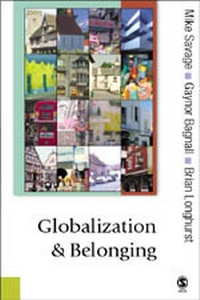
Globalization and Belonging
1st Edition
Published on 9. November 2004
248 pages
978-1-4129-3337-7 (ISBN)
Description

'Globalization and Belonging's headline message - that place matters, that locality remains vital to people, is arresting' - Frank Webster, Professor of Sociology, City University, London
Drawing on long-term empirical research into cultural practices, lifestyles and identities, Globalization and Belonging explores how far-reaching global changes are articulated locally.
The authors address key sociological issues of stratification as analysis alongside 'cultural' issues of identity, difference, choice and lifestyle. Their original argument:
" Shows how globalisation theory conceives of the 'local'
" Reveals that people have a sense of elective belonging based on where they choose to put down roots
" Suggests that the feel of a place is much more strongly influenced by the values and lifestyles of those migrating to it
" reinvigorates debates in urban and community studies by recovering the 'local' as an intrinsic aspect of globalisation
Theoretically rigorous, the book is brought to life with direct quotations from the authors' research, and appeals to students in urban sociology, urban geography, media studies and cultural studies.
Drawing on long-term empirical research into cultural practices, lifestyles and identities, Globalization and Belonging explores how far-reaching global changes are articulated locally.
The authors address key sociological issues of stratification as analysis alongside 'cultural' issues of identity, difference, choice and lifestyle. Their original argument:
" Shows how globalisation theory conceives of the 'local'
" Reveals that people have a sense of elective belonging based on where they choose to put down roots
" Suggests that the feel of a place is much more strongly influenced by the values and lifestyles of those migrating to it
" reinvigorates debates in urban and community studies by recovering the 'local' as an intrinsic aspect of globalisation
Theoretically rigorous, the book is brought to life with direct quotations from the authors' research, and appeals to students in urban sociology, urban geography, media studies and cultural studies.
All prices
More details
Series
Edition
First Edition
Language
English
Place of publication
London
United Kingdom
Publishing group
Sage Publications Ltd (Digital)
Target group
Professional and scholarly
ISBN-13
978-1-4129-3337-7 (9781412933377)
Copyright in bibliographic data and cover images is held by Nielsen Book Services Limited or by the publishers or by their respective licensors: all rights reserved.
Schweitzer Classification
Other editions
Additional editions
Michael Savage | Gaynor Bagnall | Brian Longhurst
Globalization and Belonging
Book
11/2004
1st Edition
SAGE Publications Inc
€135.20
Shipment within 15-20 days
Michael Savage | Gaynor Bagnall | Brian Longhurst
Globalization and Belonging
Book
11/2004
1st Edition
SAGE Publications Inc
€213.80
Shipment within 15-20 days
Persons
I studied originally as a historian (BA at York and MA at Lancaster). I became a sociologist partly by design, since I was interested in the grand theoretical questions which sociologists tend to pose, and partly by luck (the Department of Sociology at Lancaster happened to have a PhD grant available!). My doctoral work, which became my first book, was on the history of the local Labour movement in Preston, Lancashire between 1880 and 1940. Although this was a specific case study, it contains many issues of enduring interest to me: the changing role of place, space, locality; the significance of time; and social inequality and social movements. I have been unable to shake off an enduring enthusiasm for geography (my favourite subject at school) and history.
My research tries to develop a sociology of stratification which is adequate to 21st century complexities and fluidities. This has involved me in thinking about the sociology of the middle classes which now makes up a large proportion of the labour force; in exploring the nature of changing gender relations; in thinking about how people's sense of attachment to place and locale is being reconfigured; and in thinking about new and under-utilised conceptual and methodological tools for understanding social inequality, social protest and social mobility. I have pursued these interests through jobs at the Universities of Lancaster, Sussex, Surrey, Keele, North Carolina at Chapel Hill, and since 1995 I have been here at Manchester (where I was head of Department between 1999-2001). My concerns have crystallized since 2004 in my role as Director of the ESRC Centre for Research on Socio-Cultural Change (CRESC), which brings together anthropologists, media researchers, geographers, historians, political economists, and sociologists from the University of Manchester and the Open University.
I was elected a member of the Academy of Social Sciences (2003), elected Fellow-Designate of the British Academy (2007), and I am a member of HEFCE's Sociology sub-panel assessing the quality of research in the 2008 Research Assessment exercise. I have been visiting professor at the Universities of North Carolina at Chapel Hill (where I was a Fulbright Scholar) and at Sciences-Po in Paris. I was managing editor of The Sociological Review between 2001 and 2007. Gaynor Bagnall is a Senior Lecturer in the Sociology of Culture. Her research and teaching focus primarily on culture, consumption, social class and identity, and in particular social and cultural capital, culture-led regeneration, social and cultural life in cities, and audiences, museums, memory and heritage. She has researched and published widely on these topics, with work ranging from an investigation into the performativity of museum audiences, to an exploration of what it means to belong 'locally' in a global world. Currently, she is working on two research projects, Writing Lives: 'Engaging Communities through Arts' is funded by HEFCE and aims to examine the use of creative writing workshops as a form of culture-led regeneration. It explores their role as a means for the expression of identities, and as a facilitator of community cohesion and belonging. 'Experiencing: The Imperial War Museum North' is an examination of visitor responses to IWMN that looks at how people articulate their experience of the museum by drawing on particular biographical resources and narrative strategies. Professor Brian Longhurst is a sociologist who has long standing interests in cultural studies, media studies and the sociology of culture. His books include Popular Music and Society (Polity Press, 1995, 2007), The Penguin Dictionary of Media Studies (co-authored, 2007), Globalization and Belonging (co-authored, Sage, 2005), Introducing Cultural Studies (co-authored, Pearson, 1999, 2004) and Audiences: A Sociological Theory of Performance and Imagination (co-authored 1998). He has held research grants from various bodies including ESRC and EPSRC and has published widely in a range of journals and edited collections.
He was formerly Head of the School of English, Sociology, Politics & Contemporary History (ESPaCH), Associate Dean for Research and Director of the Institute for Social Research, all at the University of Salford. He has been a Director of Salford's prize winning initiative, Community Finance Solutions and was the founding Chair of the Board of East Lancs Moneyline (ELM), a successful Community Reinvestment Trust.
My research tries to develop a sociology of stratification which is adequate to 21st century complexities and fluidities. This has involved me in thinking about the sociology of the middle classes which now makes up a large proportion of the labour force; in exploring the nature of changing gender relations; in thinking about how people's sense of attachment to place and locale is being reconfigured; and in thinking about new and under-utilised conceptual and methodological tools for understanding social inequality, social protest and social mobility. I have pursued these interests through jobs at the Universities of Lancaster, Sussex, Surrey, Keele, North Carolina at Chapel Hill, and since 1995 I have been here at Manchester (where I was head of Department between 1999-2001). My concerns have crystallized since 2004 in my role as Director of the ESRC Centre for Research on Socio-Cultural Change (CRESC), which brings together anthropologists, media researchers, geographers, historians, political economists, and sociologists from the University of Manchester and the Open University.
I was elected a member of the Academy of Social Sciences (2003), elected Fellow-Designate of the British Academy (2007), and I am a member of HEFCE's Sociology sub-panel assessing the quality of research in the 2008 Research Assessment exercise. I have been visiting professor at the Universities of North Carolina at Chapel Hill (where I was a Fulbright Scholar) and at Sciences-Po in Paris. I was managing editor of The Sociological Review between 2001 and 2007. Gaynor Bagnall is a Senior Lecturer in the Sociology of Culture. Her research and teaching focus primarily on culture, consumption, social class and identity, and in particular social and cultural capital, culture-led regeneration, social and cultural life in cities, and audiences, museums, memory and heritage. She has researched and published widely on these topics, with work ranging from an investigation into the performativity of museum audiences, to an exploration of what it means to belong 'locally' in a global world. Currently, she is working on two research projects, Writing Lives: 'Engaging Communities through Arts' is funded by HEFCE and aims to examine the use of creative writing workshops as a form of culture-led regeneration. It explores their role as a means for the expression of identities, and as a facilitator of community cohesion and belonging. 'Experiencing: The Imperial War Museum North' is an examination of visitor responses to IWMN that looks at how people articulate their experience of the museum by drawing on particular biographical resources and narrative strategies. Professor Brian Longhurst is a sociologist who has long standing interests in cultural studies, media studies and the sociology of culture. His books include Popular Music and Society (Polity Press, 1995, 2007), The Penguin Dictionary of Media Studies (co-authored, 2007), Globalization and Belonging (co-authored, Sage, 2005), Introducing Cultural Studies (co-authored, Pearson, 1999, 2004) and Audiences: A Sociological Theory of Performance and Imagination (co-authored 1998). He has held research grants from various bodies including ESRC and EPSRC and has published widely in a range of journals and edited collections.
He was formerly Head of the School of English, Sociology, Politics & Contemporary History (ESPaCH), Associate Dean for Research and Director of the Institute for Social Research, all at the University of Salford. He has been a Director of Salford's prize winning initiative, Community Finance Solutions and was the founding Chair of the Board of East Lancs Moneyline (ELM), a successful Community Reinvestment Trust.
Content
Global Change and Local Belonging
The Limits of Local Attachment
Parenting, Education and Elective Belonging
Suburbia and the Aura of Place
The Ambivalence of Urban Identity
'Manchester, So Much to Answer For'
Work Cultures and Social Ties
Mediascapes in the Mediation of the Local and the Global
Cosmopolitanism, Diaspora and Global Reflexivity
The Limits of Local Attachment
Parenting, Education and Elective Belonging
Suburbia and the Aura of Place
The Ambivalence of Urban Identity
'Manchester, So Much to Answer For'
Work Cultures and Social Ties
Mediascapes in the Mediation of the Local and the Global
Cosmopolitanism, Diaspora and Global Reflexivity
