

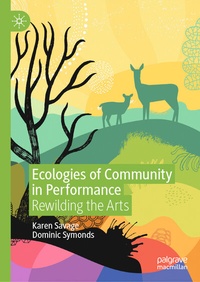
Ecologies of Community in Performance
Description

In their previous book, Economies of Collaboration in Performance , Savage and Symonds explored the economy as a metaphor for understanding collaborative practices in the arts. This book, Ecologies of Community in Performance , continues to explore arts practices, focusing on communities and turning to the language of ecology to understand the complexities and working dynamics of arts communities. The book provides a thoughtful analysis of how communities work as ecologies, offering case studies of community processes by way of illustrating the main discussion. In doing so it reveals how the triangulation of ecology, community, and performance allows for a deeper understanding of dynamic relations in the arts, enabling scholars, practitioners and policy-makers to better conceptualise ecological thinking in relation to 21 st century arts practices.
Reviews / Votes
"Building on the foundations of Economies of Collaboration in Performance, which used natural systems such as bees and pollination as frameworks to examine human collaboration in arts practices, this important interdisciplinary study makes an urgent case for 'rewilding the arts'. Drawing an analogy between trees and diverse arts communities, this book develops a persuasive argument that much can be learned about the activities of humans by recognising the comparable and often hidden dynamics operating in natural ecosystems. With care, the authors unearth the shortcomings of existing 'ecological perspectives', scrutinizing and maturing the language of ecological thought. At a significant moment when ecological crisis is met with misinformation campaigns online and climate change denial, the authors' provocation to rethink and reconnect the activity of arts communities to the environment makes for vital reading." (Dr Liam Jarvis, Royal Central School of Speech and Drama, UK)
More details
Other editions
Additional editions
Persons
Karen Savage is Professor of Creative and Collaborative Arts at the University of Lincoln, UK. She is a Climate Reality Project Leader. Publications include Postdigital Performances of Care: Technology and Pandemic (2023), 'TechNO-fixes?: Performances within Ecological Emergencies' (2022), and Avatars, Activism and Postdigital Performance: Precarious Intermedial Identities (2021), all with Liam Jarvis; and Economies of Collaboration in Performance: More than the Sum of the Parts (2018), with Dominic Symonds.
Dominic Symonds is Professor of Musical Theatre at the University of Lincoln, UK. He was a founding editor of Studies in Musical Theatre , and his publications include We'll Have Manhattan: The Early Work of Rodgers and Hart (2015), Broadway Rhythm: Imaging the City in Song (2017), and, with Karen Savage, Economies of Collaboration in Performance: More than the Sum of the Parts (2018).
Content
Chapter 1: Plant a seed.- Chapter 2: Ecology.- Chapter 3: Community.- Chapter 4: Performance.- Chapter 5: Succession.- Chapter 6: Charismatic Species.- Chapter 7: Seedbank.- Chapter 8: Mycorrhizae.- Chapter 9: Disturbance.- Chapter 10: Rewilding.
