

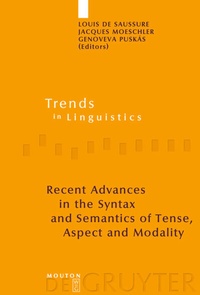
Recent Advances in the Syntax and Semantics of Tense, Aspect and Modality
Description

It is a fact that tense, aspect and modality together form one of the most recurring and active areas of research in contemporary syntax and semantics, as well as in other disciplines of linguistics. A large number of syntactic and semantic phenomena are concerned by the temporal-aspectual-modal level of representation: information about time, aspect and modality is part of virtually all sentences; inflexion is quite widely considered as the core of syntactic projections. Because of this very crucial situation and role in the sentence structure, temporal-aspectual and modal information concerns virtually any part of the sentence and this information has scope over the whole characterization of the eventuality denoted by the sentence.
This book is an up-to-date milestone for the studies of temporality and language, in particular regarding syntax and semantics, but with incidental hints to pragmatics and theories of human natural language understanding. Through this very tight selection of 15 papers (originally delivered during the 6th Chronos colloquium), tenses, aspect and modality are investigated both at the descriptive and theoretical levels, involving many different Indo-European and non-Indo-European languages. The volume sheds light on a wide array of phenomena that remained too little explored until now. These include the following: modal subordination in Japanese, epistemic modals in Dutch and English in Free Indirect Speech contexts, aspectual readings of idioms, adverb-licensing with the German perfect, French imperfective past compared with English progressive past, infinitival perfect in English, Adult Root Infinitives, economy constraints on temporal subordinations, future modality, past interpretation of present tense in embedded clauses, and time without tenses in Mandarin and Navajo.
The book is of interest to scholars and advanced students in the fields of linguistics (general linguistics, semantics, syntax) as well as philosophy and logic.
More details
Other editions
Additional editions
Persons
Content
2 - Table of contents [Seite 7]
3 - Introduction [Seite 9]
4 - Modals, emotives, and modal subordination [Seite 19]
5 - The past and perfect of epistemic modals [Seite 55]
6 - Aspectual composition in idioms [Seite 79]
7 - A modified ExtendedNow for the present perfect [Seite 97]
8 - The passé simple / imparfait of French vs the simple past / past progressive of English [Seite 117]
9 - Sequence of perfect [Seite 131]
10 - Temporal and aspectual variation in ARIs [Seite 155]
11 - Economy constraints on temporal subordination [Seite 177]
12 - Future time reference: Truth-conditional pragmatics or semantics of acts of communication? [Seite 201]
13 - When the Present is all in the Past [Seite 217]
14 - Reference time without tense [Seite 237]
15 - Backmatter [Seite 259]
