

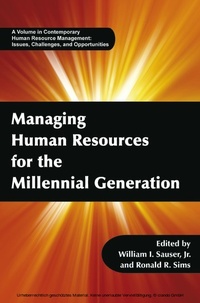
Managing Human Resources for the Millennial Generation
1st Edition
Published on 2. January 2013
479 pages
978-1-62396-054-4 (ISBN)
Description

The purpose of this book is to explore the talents, work styles, attitudes, and issues that members of the Millennial generation are bringing with them as they enter the workforce. The Millennial generation is a roughly 20-year cohort of young people whose 'leading edge' members were born in 1982 and graduated high school in 2000. These are the young adults who began entering college, the military, and the workplace during the present decade, and who will continue to do so for perhaps another decade more. The Millennial generation has been exposed during their formative years to a unique variety of historical, cultural, economic, and technological changes that have shaped their particular attitudes and values, preferred social interaction styles, beliefs about what is proper in the workplace, and personal concerns and desires. Millennials are bringing their unique perspectives into their places of employment, where at times they clash with those of the older generations who are already established there.
All prices
More details
Other editions
Additional editions
William I. Sauser | Ronald R. Sims
Managing Human Resources for the Millennial Generation
Book
10/2012
Information Age Publishing
€76.70
Shipment within 3-4 weeks
Content
- Front Cover
- Managing Human Resources for the Millennial Generation
- A Volume in
- Contemporary Human Resource Management: Issues, Challenges, and Opportunities
- Series Editor
- Ronald R. Sims, College of William and Mary
- CONTENTS
- 1. Who Are the Millennials and How Are They Challenging Modern Human Resources Management?
- Part I: Characteristics and Values of the Millennial Generation
- 2. Millennials Break Out as the Me Generation: Their Attitudes, Expectations and Fears
- 3. Millennial Work Expectations and Organizational Incentive Systems: "Carrots" for the New Millennium
- 4. Just What Is Important to Millennial Job Candidates: It's Not What We Assumed
- 5. Giving Voice to Values: Engaging Millennials and Managing Multigenerational Cultures
- Part II: Millennials and the Traditional Functions of Human Resource Management
- 6. Leveraging Web 2.0 Technologies in the Recruitment of Millennial Job Candidates
- 7. New Selection Methods for a New Generation
- 8. Considering Generational Differences in Assessing Work Values . A Unifying Approach
- 9. Employee-Friendly Policies and Development Benefits for Millennials
- 10. Texts, E-mails, and Google Searches: Training in a Multigenerational Workplace
- Part III: Best Practices for Managing Human Resources from the Millennial Generation
- 11. Best Practices for Managing Generation Y
- 12. A New Talent Agenda
- 13. Implications of Values of the Millennial Generation on HR Infrastructure
- 14. Millennial-Centric Strategic HR: Key Practices for Attracting, Developing, and Retaining Millennials
- Part IV: Special Issues and Contexts
- 15. Promises of Telecommuting and Preferences of Millennials: Exploring the Nexus
- 16. Millennials in the Workforce: Unions and Management Battle for the Soul of a Generation
- 17. Small Businesses, Value Added, and the Millennials
- Part V: Concluding Thoughts
- 18. Building Bridges Between the Millennials and Other Generations
- Contemporary Human Resource Management: Issues, Challenges, and Opportunities
- Ronald R. Sims, Series Editor
- Managing Human Resources for the Millennial Generation
- Edited by
- William I. Sauser, Jr. Auburn University
- Ronald R. Sims College of William and Mary
- Information Age Publishing, Inc.
- Charlotte, North Carolina www.infoagepub.com
- LIST OF TABLES AND FIGURES
- Tables
- figures
- Acknowledgments
- Sims Acknowledgment
- Sauser Acknowledgement
- CHAPTER 1
- Who are the Millennials and how are They Challenging Modern Human Resources Management?
- Ronald R. Sims and William I. Sauser, Jr.
- Introduction
- The Millennial Generation
- Living Generations
- Characteristics of Millennials
- Millennial Values
- Ideal Job Characteristics for Millennials
- Personal Observations
- The Chapters That Follow
- Characteristics and Values of the Millennial Generation
- Millennials and the Traditional Functions of Human Resource Management
- Best Practices for Managing Human Resources for the Millennial Generation
- Special Issues and Contexts
- Concluding Thoughts
- References
- Figure 2. 1. I think of my own age group as unique and distinct from other generations.
- CHAPTER 2
- Millennials Break Out as the Me Generation
- Their Attitudes, Expectations and Fears
- Daniel D. Butler and William I. Sauser, Jr.
- INTRODUCTION
- Research Process
- General Attitudes
- We are Different-but are we Really?
- In Their Own Words-Generational Differences
- GenMe's Priorities
- In Their Own Words-Attitudes
- Training
- In Their Own Words-Training
- COMMUNICATION AND FEEDBACK
- Managerial Concern
- Performance Feedback
- In Their Own Words: Communication and Feedback
- THE WORK ENVIRONMENT AND ETHICS
- In Their Own Words-The Work Environment:
- In Their Own Words-Physical Environment:
- Loyalty to the Company
- In Their Own Words-Work Ethic
- COMPENSATION
- Expectations of Compensation and Rewards for Efforts
- In Their Own Words-Treatment On The Job
- USE OF SOCIAL MEDIA
- Use of Information Obtained Using Social Media and Technology
- The Extent to Which GenMe Is Connected
- In Their Own Words-Social Media and Technology
- OVERALL FEARS AND CONCERNS: THE FIRST 6 MONTHS
- In Their Own Words-Concerns
- INSIGHT
- REFERENCES
- Table 2.1. Life's Priorities
- Figure 2. 2. Having a personally rewarding job I enjoy-making less money
- Table 2.2. What do you Want out of Life Your First 3 Years After Graduation?
- Figure 2. 4. I expect..
- Figure 2. 3. How likely are you to be able to earn enough money in the future to lead the kind of lifestyle you want?
- Figure 2. 5. I prefer..
- Figure 2. 6. I prefer the company..
- Figure 2. 13. I would prefer..
- Figure 2. 7. If I have a question for my supervisor, I would prefer to..
- Figure 2. 8. I expect my supervisor to..
- Figure 2. 9. When responding to supervisors, I should respond to them..
- Figure 2. 10. My supervisor should respond to any communication initiated by me..
- Figure 2. 11. I expect my supervisor will assess my performance/provide feedback..
- Figure 2. 12. I would prefer feedback from my supervisor..
- Figure 2. 14. Given the choice..
- Figure 2. 15. It is important to give back to the community I work in through unpaid community service.
- Figure 2. 16. Which statement most closely reflects your opinion?
- Figure 2. 17. Given the choice..
- Figure 2. 18. I view my first job out of university as..
- Figure 2. 19. How likely is it that you will switch careers (not jobs) sometime during your working life
- Figure 2. 21. I believe companies should allow employees to set up their own retirement accounts.
- Table 2.3 GenMe's Expectations
- Figure 2. 20. Companies should only provide employees a minimal level of financial support for healthcare.
- Table 2.4. Use of Technology
- Figure 2. 24. How often do you visit the social networking site you use most often?
- Figure 2. 22. I use _____ to make daily decisions.
- Figure 2. 23. To what extent do you connect to the internet wirelessly?
- Figure 2. 25. How often do you use Twitter?
- Figure 2. 26 New technology allows people to use their time more efficiently.
- Table 2.5. What Fears or Concerns do you Have for the First 6 Months After Leaving University?
- Part I
- Characteristics and Values of the Millennial Generation
- CHAPTER 3
- Millennial Work Expectations and Organizational Incentive Systems
- "Carrots" for the New Millennium
- Daniel J. Svyantek, Kristin L. Cullen, and Frances L. H. Svyantek
- INTRODUCTION
- The Millennial Generation
- HIGH EXPECTATIONS
- REWARDS
- FEEDBACK
- STANDARDS
- "TEAMNESS"
- Work Motivation Theories
- Millennial ATTITUDES and Motivation Theories
- Need Theories and Millennial Attitudes Toward Rewards
- Cognitive Theories and Millennial Expectations and Reward and Feedback Beliefs
- Expectancy Theory
- Equity Theory
- Organizational Reward Systems and the Millennial Generation: One Example
- Gainsharing
- Gainsharing and The Millennial Generation
- Organizational Citizenship and the Millennial Generation
- Conclusion
- REFERENCES
- Table 4.1. Means and Standard Deviations for Gen Y Applicant Reactions
- CHAPTER 4
- Just What is Important to Millennial Job Candidates
- It's Not What We Assumed
- Kyra Leigh Sutton
- INTRODUCTION
- Relevant Literature
- Objectives of the Study
- METHOD
- Participants and Procedures
- MEASURES
- RESULTS-RESEARCH QUESTION 1
- RESULTS-RESEARCH QUESTION 2
- Results-Research Question 3
- Results-Research Question 4
- Major Theme 1: Good Employees-Friendly Environments, The People Make The Place
- Major Theme 2: Laid Back Environment, A Desire for Stress-Free Work Environment
- Minor Theme: Perks Desired at Work
- Results-Research Question 5
- Theme 1: My Age is an Advantage During the Recruitment/Selection Process
- Technical Expertise
- Innovative Ideas
- Trainable/Willingness to Learn
- Career Growth Opportunities
- Flexible Schedules
- Willingness to Work for Lower Salaries
- Less Likely to Turnover
- Theme 2: My Age is a Disadvantage During the Recruitment/Selection Process
- My age is a Disadvantage due to Less Work Experience
- My Age is a Disadvantage Because my Opinions/Suggestions are not Taken Seriously
- My Age is a Disadvantage Because I am Perceived as Overly Confident
- Limitations and Future Research
- Implications
- Research Question 1-Implications
- Research Question 2-Implications
- Research Question 3-Implications
- Research Question 4-Implications
- Research Question 5-Implications
- Conclusion
- REFERENCES
- Table 4.2.-Reported Occurrences of Gen Y Recruitment Experiences
- Table 4.3.-Building a Connection Through Social Media
- Table 4.5. Reasons That Gen Y Job Seekers Perceive Their age is an Advantage During the Recruitment/Selection Process
- CHAPTER 5
- Giving Voice to Values
- Engaging Millennials and Managing Multigenerational Cultures
- Jessica McManus Warnell
- INTRODUCTION
- MILLENNIALS AND MULTIGENERATIONAL CULTURES
- EXPLORING CONTEXT
- GIVING VOICE TO VALUES FOR ORGANIZATIONAL DEVELOPMENT WITH MILLENNIALS
- CAPACITIES AND OPPORTUNITIES
- PURPOSE, SELF-KNOWLEDGE AND ALIGNMENT
- NORMALITY
- BARRIERS TO ETHICAL ACTION
- CONCLUSION
- Notes
- Acknowledgment
- REFERENCES
- Part II
- Millennials and the Traditional Functions of Human Resource Management
- CHAPTER 6
- Leveraging WEB 2.0 Technologies in the Recruitment of Millennial job Candidates
- Jared J. Llorens and Alexandrea Wilson
- INTRODUCTION
- The Challenge of Attracting Millennial job Candidates
- LEVERAGING E-RECRUITMENT TECHNOLOGIES
- WEB 2.0 RECRITING AT A GLANCE
- Social Networking Media
- Video- and Photo-Sharing Media
- Blogs
- Podcasts
- Web-Based Gaming
- WEB 2.0 in Practice: Evidence From the Private, Public, and Nonprofit Sectors
- CONCLUDING THOUGHTS
- Notes
- REFERENCES
- Figure 6. 1. Interactive recruitment in a Web 2.0 environment.
- Figure 6. 2. IRS careers-Web-based recruitment game "Show me the money."
- CHAPTER 7
- New Selection Methods for a New Generation
- Jeffrey Crenshaw and Kyle Brink
- INTRODUCTION
- THE MILLENNIAL GENERATION
- EMPLOYEE SELECTION AND THE MILLENNIAL GENERATION
- Multimedia/Video-Based Selection Tests as Hiring Instruments
- Multimedia/Video-Based Selection Tests as Recruiting and Signaling Instruments
- A NEXT GENERATION SELECTION PROCESS-A CASE STUDY
- The Organization
- A Revamped Selection Process
- The Technology-Enhanced Testing Facility
- The Administration and Assessment Process
- The Results
- Better Tests
- Greater Standardization
- Greater Efficiency and Lower Costs
- Reduced Demographic Test Performance Differences
- Improved Organizational Image
- Legal Compliance
- SUMMARY
- REFERENCES
- Figure 7. 1. Physical layout of the technology-enhanced testing facility.
- Figure 7. 2. Photographs of technology-enhanced testing facility.
- CHAPTER 8
- Considering Generational Differences in Assessing Work Values . A Unifying Approach
- Kenneth P. Yusko and Brian L. Bellenger
- INTRODUCTION
- Traditionalists
- Baby Boomers
- Generation Xers
- Generation Yers/Millennials
- ASSESSING WORK VALUES ACROSSS ALL GENERATIONS
- Step 1: Assess the Organization's Culture
- Step 2: Obtain Candidate Cultural Profiles
- Sample Organizational Culture Profile Work Value-Culture Match Items
- 1. I prefer a work environment with
- (a) Team-based work assignments
- (b) Individual work assignments
- 2. I prefer a work environment that is
- (a) More structured
- (b) Less structured
- 3. I prefer a work environment that is
- (a) Formal
- (b) Informal
- 4. I prefer a work environment that is
- (a) Cooperative
- (b) Competitive
- 5. I prefer a work environment where I can
- (a) Express my individuality
- (b) Fit in with the group
- 6. I prefer a work environment where
- (a) There are standard procedures to follow
- (b) There are few rules and regulations
- 7. I prefer a work environment where we
- (a) Embrace change
- (b) Respect precedent
- 8. I prefer a work environment that is
- (a) Big picture oriented
- (b) Detail oriented
- 9. I prefer a work environment that
- (a) Uses tried-and-true solutions
- (b) Experiments with new ideas
- 10. I prefer a work environment where
- (a) Results are rewarded
- (b) Effort is rewarded
- 11. I prefer a work environment where
- (a) My supervisor is involved in my day-to-day work
- (b) My supervisor leaves me alone to do my work
- 12. I prefer a work environment with
- (a) High job security
- (b) Opportunities for quick advancement
- 13. I prefer a work environment that has lots of
- (a) Structure
- (b) Flexibility
- 14. I prefer a work environment that is
- (a) Goal oriented
- (b) Process oriented
- 15. I prefer a work environment where I am rewarded for
- (a) Working hard
- (b) Results
- 16. I prefer a work environment that is focused on
- (a) Innovation
- (b) Implementation
- 17. I prefer a work environment that has
- (a) Ambiguity
- (b) Cut and dry answers
- 18. I prefer a work environment where I receive
- (a) Constant feedback about how I am doing
- (b) Intermittent feedback about how I am doing
- 19. I prefer I work environment that
- (a) Values loyalty
- (b) Values performance
- 20. I prefer a work environment where
- (a) My role is well-defined
- (b) My role is what I make of it
- Legal Requirements3
- Capitalizing on Recruiting Channels
- Preliminary Screening Tools
- Recruiting Strategies
- Phase I: Generating Applicants
- Phase II: Maintaining Applicant Interest in the Organization
- Phase III: Influencing Job Choice
- CONCLUSIONS
- Notes
- REFERENCES
- CHAPTER 9
- Employee-Friendly Policies and Development Benefits for Millennials
- Jonathan P. West
- INTRODUCTION
- BACKGROUND AND DEVELOPMENTS
- Job Insecurity and Changing Psychological Contract
- FLEXIBLE AND ALTERNATIVE WORK SCHEDULES
- Flex Options
- Telecommuting
- WORK-LIFE PROGRAMS
- Child Care
- Adoption Assistance
- Lifestyle-Friendly Policies
- Parental and Military Leave
- STRESS REDUCTION AND WELLNESS PROGRAMS
- Stress Reduction
- Wellness Programs
- TRADITIONAL ECONOMIC BENEFITS
- Pensions and Health Care
- Competing HR Perspectives
- REVERSE MENTORING FOR DEVELOPMENT
- SUMMARY AND CONCLUSIONS
- NOTE
- REFERENCES
- Figure 9. 1.-Transition in work-life relations 1950 to the present.
- Figure 10. 2. A comparison of delivery options by the facilitator's degree of control and the participant's access to them.
- CHAPTER 10
- Texts, E-mails, and Google Searches
- Training in a Multigenerational Workplace
- Patrick Deery
- INTRODUCTION
- WHO ARE THE FOUR GENERATIONS
- HOW LIKELY ARE WE TO CONTINUE TO SEE FOUR GENERATIONS IN THE WORKPLACE?
- TECHNOLOGY'S IMPACT ON THE 21st CENTURY DELIVERY OPTIONS AND PARTICIPANTS
- GENERATIONS AND TECHNOLOGY
- LEARNER CLASSIFICATION PATTERNS
- FOUR GENERATIONS IN THE CLASSROOM: SOME HELPFUL MEANS OF PREDICTING HOW THEY LEARN
- ADVICE FOR THE CLASSROOM AND BEYOND
- General, Four Generations
- Specific, Millennials
- A FEW CONCLUDING THOUGHTS
- REFERENCES
- Figure 10. 1. The relationship of delivery methods to technology.
- Table 10.1. Learner Assessments
- Table 11.1. Hiring Managers and HR Professionals Report Expectations and Changes, 2007
- part III
- Best Practices for Managing Human Resources for the Millennial Generation
- CHAPTER 11
- Best Practices for Managing Generation Y
- Susan Eisner
- INTRODUCTION
- WHAT GEN Y SEEKS AT WORK
- WHAT BEST LISTED COMPANIES DO
- RECOMMENDED BEST PRACTICES
- Create a Contemporary Culture
- Flatten and Wire the Organization
- Trigger High Performance
- Stimulate and Support Innovation
- Lead by Example and Transparency
- Create Career Paths and Opportunity to Advance
- Mentor, Coach, and Train
- Operationalize Work-Life Balance
- Deliver Perks
- Acknowledge and Celebrate
- Facilitate Making a Difference
- LOOKING FORWARD
- Notes
- References
- Table 11.3. Generations of Workers Report Importance, 2010
- Table 11.2. Gen Y Workers Report Importance, 2008
- Table 11.4. Benefits at Companies Fortune Lists as Best to Work For, 2011
- Table 11.5. Work-Life Balance Practices in Silicon Valley, 2011
- Table 11.6. Perks at These Silicon Valley Companies, 2011
- Table 11.7. Recommended Best Practices for Managing Generation Y
- Table 12.1. Focus Group Discussion Guide
- Table 12.1. (continued)
- CHAPTER 12
- A New Talent Agenda
- Milano Reyna and Rishap Malhotra
- THE Challenge: Inspiring our Future
- WHO ARE WE?
- GETTING OUR NOTES TOGETHER
- OUR FIRST OBSERVATIONS: SIMILARITIES BETWEEN GENERATIONS
- THE SIX E's TO INSPIRING MILLENNIALS AND BEYOND
- 1. Explore. We invited and continue to involve our highest performing Millennials to walk in our shoes and us in theirs. We encourage them to join and participate in our business meetings, leadership sessions, and reviews, and to create new tools and...
- 2. Engage. Now this seems like a no-brainer. Leaders should be engaged with their people. There is nothing new here. What we learned in our practice and study is that engagement is now a valued currency in the workplace, over the traditional journey ...
- 3. Excite. Joy is an expectation in our industry. In the last decade or so, we also saw the birth of the psychology of joy. Much of what we refer to as Joy is similar to Mark Seligman's (2011) work on Flourishing. "Employer of the Year," "CEO...
- 4. Eliminate. One of the biggest revelations we had on our talent journey is the need to eliminate what is no longer relevant. We used the Blue Ocean Strategy (Kim & Mauborgne, 2005), as a starter. We put all our Talent Practices on a four-block grid...
- 5. Educate. Our Global Talent Agenda is built on Four Pillars: Responsibility, Learning, Recognition, and Joy. While much has been shared in the literature about not investing in Millennials because they are viewed as less loyal, we decided to increa...
- 6. Empower. Millennials want meaningful work and challenges
- high performers across generations expect the same. We will talk later about our Four Pillars in more detail. We refer to this empowerment as "Responsibility." Like many companies, we s...
- OUR TALENT STRATEGY AND THE MILLENNIALS' VOICE
- 1. Responsibility. We view this through many lenses: mobility, assignment, being given an opportunity to own a part or whole of the idea (or in your case it may be the product or service your company provides). Ownership is key. The best way we find ...
- From our Millennials' Perspective
- 2. Learning. As digital natives, Millennials want to keep developing their skills and knowledge. They thrive for challenges and expect opportunities to work across more geographic borders than their parents, which supports much of the research we als...
- From our Millennials' Perspective
- 3. Recognition. Millennials are conditioned to expect and get instant feedback. The Age of Now is pervasive. This includes anything to let employees know their contribution is valued or what they can be doing better. It can be monetary, or it could b...
- From our Millennials' Perspective
- 4. Joy. Psychologists over the last decade increased research in the area of happiness. This is a relief, since during previous decades most analyses were spent on what is wrong with people. Our Company's most simple manifestation of Joy is through...
- From our Millennials' Perspective
- Implications for Our Talent Agenda
- Talent Practices From Earlier Generations is the new Base Camp
- We are Competing for the Same Talent
- Small Things Matter as Much as the Big Things
- It is Okay to Admit you are Learning too
- Eight Millennial Ideas for Talent Practitioners
- TALENT CHALLENGES FOR MILLENNIALS AND BEYOND
- One Last Anecdote
- REFERENCES
- Table 12.2. Common Themes Across Generations
- Table 12.3. Six Es to Inspiring Millennials
- 1. Explore
- 2. Engage
- 3. Excite
- 4. Eliminate
- 5. Educate
- 6. Empower
- Table 12.4. Four Pillars of Talent
- Figure 12. 1. Worker's plea.
- 1. Coach
- 2. Infuse Experiences and Global Connections
- 3. Communicate and Engage
- 4. Encourage Bottom Up Innovation
- 5. Tell Me Like It Is - Feedback
- 6. Recognize and Reward Effort As Well As Achievement
- 7. Enable Opportunities To Develop Personal Interests
- 8. Bring Fun Into The Workplace - Make Everyday Feel Like Saturday
- Figure 12. 2. Top 8 talent millennial ideas.
- CHAPTER 13
- Implications of Values of the Millennial Generation on HR Infrastructure
- Sheri K. Bias and Donna L. Phillips
- INTRODUCTION
- VALUES DEFINED
- Immediacy
- Teaming
- Recognition
- ORGANIZATIONAL CONTEXT
- National Aeronautics and Space Administration (NASA)
- Jaderlund Casting
- CONNECTING MILLENNIAL VALUES TO HR PRACTICES
- Immediacy
- NASA
- Jaderlund Casting
- Teaming
- NASA
- Jaderlund Casting
- Recognition
- NASA
- Jaderlund Casting
- IDEAS FOR FUTURE HR PRACTICES TO TAP INTO MILLENNIALS
- NASA
- Jaderlund Casting
- CONCLUSION
- REFERENCES
- Table 14.1. Comparing Four Generations of U.S. Employees as of 2012
- CHAPTER 14
- Millennial-Centric Strategic HR
- Key Practices for Attracting, Developing, and Retaining Millennials
- Scott A. Quatro
- The Generational Culture Revolution is Underway!
- MILLENNIALS ARE DIFFERENT
- ATTRACTING, DEVELOPING, AND RETAINING MILLENNIALS
- Employer Branding Versus Job Advertising
- Organizational Purpose Versus Shareholder Wealth Maximization
- Personal and Peer Coaching Versus Performance Appraisal
- Work-Life Integration Versus Work-Life Balance
- Build an Employer Brand
- 1. Dedicate budgetary resources to employer branding and related marketing activities. This is a must for employers in order to attract Millennials into their workforce. Google's corporate website is dominated by employer branding content and messa...
- 2. Commit to continuous recruitment. Just as PepsiCo never stops advertising Mountain Dew, employers must never stop selling their employer brand. The lack of current openings must never be an excuse for pulling out of the employment market. Google...
- 3. Maintain an active presence on college campuses. Aggressively seek to build brand equity with Millennials before they ever enter the workforce. Tailor the brand messaging and positioning to a college student demographic. Google's current brand c...
- 4. Sell the employer brand, not the job. Millennials are less compelled by the specifics of the job than the purpose and meaningfulness of the employer as conveyed via the employer brand. The job posting area of Google's corporate website focuses p...
- Emphasize Higher Order Organizational Purpose
- Continuously Coach for Performance
- 1. Build Relationship First. For Millennials, the old adage holds particularly true-"they don't care how much you know until they know how much you care." Authentic relationship must serve as the platform from which to provide on-going perfor...
- 2. Foster Dialogue. Millennials want to investigate meaning, share and explore perceptions, and clarify expectations. In short, they want to engage in dialogue, and not simply discussion. Dialogue is motivated by building shared meaning. Discussion i...
- 3. Continuously Assess and Celebrate. For the Millennial Generation, having a continuous sense of performance effectiveness and reinforcement of successes is critical to their work satisfaction. You almost can't provide too much feedback, or celebr...
- 4. Be Primarily Forward-Looking. Millennials want to know what's next, and then move forward with optimism. This is especially true when the past did not go so well. Their primary objective when faced with a negative critical incident relative to p...
- Foster Work-Life Integration
- 1. Lose the time clock. There is no real sense of "on the clock" time versus "personal time" with Millennials. They are comfortable with never really putting work aside. Rather, they want to deliver on work expectations when and where it make...
- 2. Embrace mobile technology. Losing the time clock requires employers to embrace the technology that enables virtual contribution and participation on the part of Millennials. Allowing Millennials to Skype into a client meeting or to work from home ...
- 3. Make the workplace their home away from home. Millennials embrace hard, meaningful work. Especially when the physical context allows them to feel at home, and even to take care of some basic daily needs. In this vein, the Googleplex (Google's co...
- THE MILLENNIALS WILL SAVE THE DAY!
- REFERENCES
- Figure 15. 1.-Telecommuting typologies.
- Part IV
- Special Issues and Contexts
- CHAPTER 15
- Promises of Telecommuting and Preferences of Millennials
- Exploring the Nexus
- Ajantha S. Dharmasiri, Danielle Beu Ammeter, John E. Baur and M. Ronald Buckley
- INTRODUCTION
- Millennials in Focus
- THE NATURE OF TELECOMMUTING
- Critical Success Factors for Telecommuting
- Factors Influencing Ability and Desire for Telecommuting
- Employee and Employer Responsibilities With Telecommuting
- Telecommuting and Social Interaction
- 1. The temporal synchrony bias: Since employees are working at different times, when a misunderstanding occurs, it is accompanied by an inability to correct these misunderstandings in a timely fashion. A misunderstanding uncorrected may result in the...
- 2. The squeaky wheel bias: People have a tendency to become rude and impulsive when communicating electronically, becoming more adversarial than when communicating face-to-face. Factors that usually suppress negative emotions in person are absent whe...
- 3. The sinister attribution bias: Individuals have a tendency to misattribute the behavior of others and this is exacerbated when the only communication with individuals is via computer. Similarly, some are likely to ascribe diabolical intentions to ...
- 4. The burned bridge bias: When interacting over a computer, individuals have a tendency to engage in more risky behavior in terms of threats and demands. They neglect many of the "politeness rituals" that are so important from a business perspec...
- Repercussions
- WHERE WE STAND NOW: THE NECESSITY OF TELECOMMUTING FOR MILLENNIALS
- CONCLUSION
- REFERENCES
- CHAPTER 16
- Millennials in the Workforce
- Unions and Management Battle for the Soul of a Generation
- Marcia A. Beck and Jonathan P. West
- INTRODUCTION
- DEMOGRAPHICS, WORKPLACE ORIENTATIONS, EMPLOYMENT TRENDS
- Millennial Employment Trends
- The Declining Power of Unions
- UNION STRATEGIES TO ATTRACT GENERATION Y WORKERS
- HUMAN RESOURCE MANAGEMENT STRATEGIES: THE "RULES OF ENGAGEMENT"
- THE TRUCE: MILLENIALS AND LABOR-MANAGEMENT PARTNERSHIPS
- Concession Truces
- Variable Pay Systems
- Partnership Truce: Labor-Management Cooperation Based on Interest-Based Bargaining
- Private Sector Partnership: Kaiser Permanente
- Local Public Sector Partnerships
- Federal Public Sector Partnerships
- CONCLUSION
- REFERENCES
- Table 16.1. Millennial Generation Workplace Values
- Table 16.3. Union Strategies to Attract Millennial Generation Workers
- 1. Outreach through social networking to inform and energize non-union and union Millennials
- 2. Merge union culture with Millennials' culture
- 3. Offer training and educational programs geared to union and non-union Millennial workers and students
- 4. Apply "diversity unionism" to incorporate diverse Millennial members into existing union structures
- 5. Re-structure unions to appeal to Millennials' financial and social interests
- 6. Appeal to the movement, class struggle, and solidarity nature of unionism
- 7. Organize low-wage service workers and high-tech freelancers across workplaces
- 8. Use "community unionism" based on social justice, environmental, and political activism
- 9. Promote tangible benefits of union membership, such as higher wages and better health care
- 10. Work with foreign unions to organize Millennial employees of global companies that do business in the United States.
- Table 16.2. 2009/2010 Union Membership/Union Representation in Two Millennial Age Groups
- Table 16.4. Employee Engagement Strategies
- 1. Involve employers and managers in teamwork activities
- 2. Generate collective knowledge, as in "cloud computing
- "
- 3. Base regular individual and team performance evaluations on interactive feedback
- 4. Establish regular communication between managers and employees and among colleagues
- 5. Eliminate "command and control" decisionmaking
- encourage employee input into all aspects of company policy
- 6. Encourage employees to act as company advocates for products, service, and talent recruitment
- 7. Encourage employee networking for ideas and contacts
- 8. Remove communication, technology, and generational barriers to create an integrated workforce
- 9. Introduce reverse mentoring between Millennials and older workers
- 10. Reward creativity, risk, and innovation to enhance performance
- 11. Provide opportunities for portable training and professional development
- 12. Coordinate organizational mission and goals with employee beliefs
- 13. Integrate state-of-the-art technology into workplace activities
- 14. Support employee volunteer activities to highlight organizational values
- 15. Institutionalize transparency in pay, policies, and performance
- 16. Create an organizational culture that fosters mutual trust and support.
- Figure 17. 1. The three characteristic spectrums that impact employment situations.
- CHAPTER 17
- Small Businesses, Value Added, and the Millennials
- Jackie A. DiPofi and Margaret Fitch-Hauser
- INTRODUCTION
- UNDERSTANDING THE MILLENNIAL GENERATION
- Technology
- Work Ethics
- Personalities
- Locus of Control
- Trophy Kids and Praise
- Subsegments of the Millennial Generation
- 1. Micro-Multi spectrum: "Microworkers" have the ability to focus on a single task, whereas "multitaskers" perform a number of value-added tasks simultaneously with the capacity to juggle the various tasks in order to reach goals.
- 2. Solitary-Social spectrum: "Solitary Players" are those individuals who have the desire and self-discipline to work alone, whereas "Social Players" desire personal interaction with others, and seek social opportunities within the work place.
- 3. New school-Old school spectrum. New school communicators are also known as "Emerging Media Communicators" who actively embrace a lifestyle that incorporates current and future technology, whereas "Old School Communicators" hold on to pas...
- Microworkers and Multitaskers
- Solitary Players and Social Players
- New Media Communicators and Old School Communicators
- ACTIVITY CHAIN OF A SMALL BUSINESS
- INCORPORATING MILLENNIALS INTO AN ORGANIZATION
- Maximizing Value Added Work
- RECOMMENDATIONS
- 1. Determine value added tasks performed by the owner that can be transferred to another individual.
- 2. Write a job description and activity tests for skills, knowledge and abilities needed to perform those tasks identified as transferrable. For industry specific ideas, see Small Business Example 6 Test for Value Added Activities.
- 3. Prepare digital "How to Guides" including templates saved on Shared Drives detailing how the tasks are performed as the tasks are transferred from owner to employee.
- 4. Develop a digital employee weekly reporting procedure giving key benchmarks of activity.
- 5. Review digital employee weekly reports to determine if desired tasks have been transferred effectively and efficiently, acknowledging receipt of the employee report, commenting on level or quality of output with digital communication feedback.
- 6. Fine tune the process over time, transferring additional tasks to employee, or removing tasks, as necessary. Communicate changes digitally.
- 7. Revise procedures and update the electronic version as each value added activity is clearly defined.
- 8. Review the job description quarterly in the first year.
- 9. Make changes when necessary. Reward as possible.
- 10. Stay focused on the goal of an effective and efficient workforce to share the burden of the small business owner.
- REFERENCES
- Figure 17. 2. Activity chain of a small business.
- Figure 17. 3. Activity chain of a small business incorporating technology.
- Part V
- Concluding Thoughts
- CHAPTER 18
- Building Bridges Between the Millennials and Other Generations
- Ronald R. Sims
- INTRODUCTION
- A BRIEF LOOK AT THE DIFFERENT GENERATIONS AT WORK
- GENERATIONALISM AND GENERATIONAL CONSCIOUSNESS
- 1. The word "generations" can provide some context and scope of individual motivations for those in a particular cohort. And the goodness of such information can be used to help test and better understand the individuals within a cohort and to be...
- 2. An individual and generation's sense of awareness has got to be broadened beyond their immediate generation to include the state of other generations. In a sense HRM professionals must work to help individual employees, like the Millennials, to ...
- 3. Collins Dictionary (2011) also mentions that consciousness is about self-awareness and so therefore consciousness is about identity. The word "generations," as evidenced by the discussions of contributors throughout this book, can better help ...
- BUILDING BRIDGES BETWEEN THE GENERATIONS THROUGH DIALOGUE AND GOOD CONVERSATION
- Dialogue
- Striving for Good Conversation
- 1. an honest effort by all employees to put the organization first
- 2. an acute awareness that we all have biases and blind spots
- 3. an open-mindedness to the possibility of learning something from others in conversation
- 4. a willingness to improve current and future understanding of others
- 5. a conscious effort to refrain from advancing one's own self or views as if they were best
- 6. an inclination to listen intently in order to grasp the meaning of other people's views or means of expressing their opinions (i.e. suggested solutions)
- 7. an agreement that clarifying, questioning, challenging, exemplifying, and applying ideas are activities to be done in a self- and other-respecting way
- 8. a realization that we will frequently get off course in our conversations because a spirit of charity, intellectual curiosity, and even playfulness will characterize many of our discussions, and because, as David Bromwich (1992) says: "The good ...
- 9. an appreciation of the reality that it will take time for us to get to know each other, and a realization that eventually we will find ways to engage in robust, candid, and challenging dialogue and conversation without being so "nice" we bore ...
- CONVERSATIONAL LEARNING
- What Is Conversational Learning?
- ORGANIZATIONAL CULTURE: CULTURE SHOCK AND VALUING
- Culture Shock
- Valuing
- 1. A careful study was done by an outside group with in-house representation to gather demographic or generational data on Millennials and baseline data about its work force.
- 2. The study surfaced data revealing the growth and interest of Millennials, a very small representation of Millennials in the organization, and a large percentage of employees-Baby Boomers and Traditionalists-eligible for retirement within the n...
- 3. The results of the study were shared with the board of directors.
- 4. Management decided to share the study with the employees along with its plans to better understand the changing work force.
- 5. Several in-house and public meetings were held to discuss and to get employee input and suggestions to include in management's eventual plans for action.
- 6. Finally, once input had been received from different stakeholders, the board of directors approved a plan of action and instructed management (and particularly the HRM professionals) to carry it out.
- ASSESSMENT PROCEDURES
- CONCLUSION AND REFLECTIONS
- Some Reflections on the Efforts to Integrate the Millennials
- REFERENCES
- About the authors
- Index
- Back Cover

