

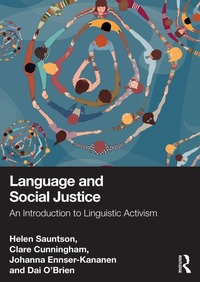
Language and Social Justice
An Introduction to Linguistic Activism
1st Edition
Published on 31. March 2025
250 pages
978-1-040-31175-2 (ISBN)
Description

Language and Social Justice provides readers with the knowledge and analytical skills required to explore why and how social inequalities and injustices are enacted through language, and how they may be challenged.
The expert authors introduce readers to theories, concepts, methods and applications which enable them to become 'activist applied linguists' in the field of language and social justice. Each chapter contains up-to-date information, case studies, study questions and activities, suggestions for activism, and recommended readings relating to a range of topics within the field of language and social justice research.
This innovative and accessible textbook is essential reading for students and scholars engaged in language and social justice research across a range of contexts.
The expert authors introduce readers to theories, concepts, methods and applications which enable them to become 'activist applied linguists' in the field of language and social justice. Each chapter contains up-to-date information, case studies, study questions and activities, suggestions for activism, and recommended readings relating to a range of topics within the field of language and social justice research.
This innovative and accessible textbook is essential reading for students and scholars engaged in language and social justice research across a range of contexts.
Reviews / Votes
This timely and thoughtful volume is a must-read for anyone wishing to engage with language, power and ideology as they play out in human communities. Drawing in their readers with care and insight, the authors demonstrate how linguistic students and scholars can engage with activist practices and disrupt oppressive dynamics.Eric Louis Russell, University of California-Davis
This textbook offers students an invaluable and unique introduction to scholarship on language and social justice, presenting pertinent case studies on a wide range of issues. Readers are supported, through useful activities, in reflecting upon and engaging critically with discourses which reproduce inequalities, and in becoming activists through their research.
Lucy Jones, University of Nottingham
I believe Language and Social Justice: An Introduction to Linguistic Activism is a call to action and a practical book with ingredients necessary for language educators and activist applied linguists doing work with diverse communities who constantly seek to incorporate a more inclusive and equitable approach in their practice.
Yecid Ortega, Queen's University Belfast
More details
Edition
1. Auflage
Language
English
Place of publication
London
United Kingdom
Publishing group
Taylor & Francis Ltd
Target group
College/higher education
Professional and scholarly
Illustrations
5 Tables, black and white; 1 Line drawings, black and white; 6 Halftones, black and white; 7 Illustrations, black and white
File size
20,84 MB
ISBN-13
978-1-040-31175-2 (9781040311752)
Copyright in bibliographic data and cover images is held by Nielsen Book Services Limited or by the publishers or by their respective licensors: all rights reserved.
Schweitzer Classification
Other editions
Additional editions
Helen Sauntson | Clare Cunningham | Johanna Ennser-Kananen
Language and Social Justice
An Introduction to Linguistic Activism
Book
03/2025
1st Edition
Routledge
€63.70
Shipment within 10-20 days
Helen Sauntson | Clare Cunningham | Johanna Ennser-Kananen
Language and Social Justice
An Introduction to Linguistic Activism
Book
03/2025
1st Edition
Routledge
€206.40
Shipment within 10-20 days

Book
03/2025
Routledge
Unfortunately, price unknown
Available (delivery time upon request)
Persons
Helen Sauntson is Professor of English Language and Linguistics and Director of the Centre for Language and Social Justice Research at York St John University, UK. She specialises in teaching and researching sociolinguistics and applied linguistics and has published numerous books, chapters and journal articles.
Clare Cunningham is Associate Professor of English Language and Linguistics and Deputy Director of the Centre for Language and Social Justice Research at York St John University, UK. Her research work focuses on social and ecological justice issues, particularly focusing on education of multilingual children and discourses on climate change.
Johanna Ennser-Kananen is Associate Professor of English and Academy Research Fellow at the University of Jyvaeskylae's Department of Language and Communication Studies. Her work focuses on linguistically and culturally sustaining language and teacher education, particularly on epistemic justice in educational contexts.
Dai O'Brien is Associate Professor of BSL and Deaf Studies at York St John University, UK. Dai's particular research interest lies in how signing deaf people navigate social contexts, and he has written numerous articles and book chapters. He is currently sitting on the Advisory Council of the Journal of Deaf Studies and Deaf Education.
Clare Cunningham is Associate Professor of English Language and Linguistics and Deputy Director of the Centre for Language and Social Justice Research at York St John University, UK. Her research work focuses on social and ecological justice issues, particularly focusing on education of multilingual children and discourses on climate change.
Johanna Ennser-Kananen is Associate Professor of English and Academy Research Fellow at the University of Jyvaeskylae's Department of Language and Communication Studies. Her work focuses on linguistically and culturally sustaining language and teacher education, particularly on epistemic justice in educational contexts.
Dai O'Brien is Associate Professor of BSL and Deaf Studies at York St John University, UK. Dai's particular research interest lies in how signing deaf people navigate social contexts, and he has written numerous articles and book chapters. He is currently sitting on the Advisory Council of the Journal of Deaf Studies and Deaf Education.
Content
List of Illustrations
Acknowledgements
Chapter 1 Introduction: Activist Applied Linguistics and 'Caring for Language'
Chapter 2 Language and Social Justice: Theory, History and Context
Chapter 3 Approaches and Frameworks for Analysing Language and Social Justice
Chapter 4 Language and Social Justice in Families and Communities
Chapter 5 Language and Social Justice in Schools
Chapter 6 Language and Social Justice in Higher Education
Chapter 7 Language and Social Justice at Work
Chapter 8 Language and Social Justice in the Media
Chapter 9 Language and Social Justice in Social Media
Chapter 10 Language and Social Justice in Politics
Chapter 11 Language and Social Justice in Legal Contexts
Chapter 12 Language, Social Justice, Creativity and Embodiment
Chapter 13 The Language of Crisis
Chapter 14 Language in Global Campaigning for Social Justice
Chapter 15 Conclusion: Using Applied Linguistics in Social Justice Activism
Index
Acknowledgements
Chapter 1 Introduction: Activist Applied Linguistics and 'Caring for Language'
Chapter 2 Language and Social Justice: Theory, History and Context
Chapter 3 Approaches and Frameworks for Analysing Language and Social Justice
Chapter 4 Language and Social Justice in Families and Communities
Chapter 5 Language and Social Justice in Schools
Chapter 6 Language and Social Justice in Higher Education
Chapter 7 Language and Social Justice at Work
Chapter 8 Language and Social Justice in the Media
Chapter 9 Language and Social Justice in Social Media
Chapter 10 Language and Social Justice in Politics
Chapter 11 Language and Social Justice in Legal Contexts
Chapter 12 Language, Social Justice, Creativity and Embodiment
Chapter 13 The Language of Crisis
Chapter 14 Language in Global Campaigning for Social Justice
Chapter 15 Conclusion: Using Applied Linguistics in Social Justice Activism
Index
