

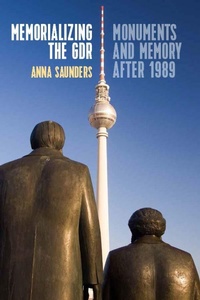
Memorializing the GDR
Monuments and Memory after 1989
1st Edition
Published on 23. May 2018
382 pages
978-1-78533-681-2 (ISBN)
Description

Since unification, eastern Germany has witnessed a rapidly changing memorial landscape, as the fate of former socialist monuments has been hotly debated and new commemorative projects have met with fierce controversy. Memorializing the GDR provides the first in-depth study of this contested arena of public memory, investigating the individuals and groups devoted to the creation or destruction of memorials as well as their broader aesthetic, political, and historical contexts. Emphasizing the interrelationship of built environment, memory and identity, it brings to light the conflicting memories of recent German history, as well as the nuances of national and regional constructions of identity.
Reviews / Votes
"I highly recommend this thoughtful, well-written book for all who are interested in understanding the place of the GDR in contemporary debates about the past and the present and for gaining insight into a certain sense of German national identity by examining lessons Germans draw from this past." * Sehepunkte"The volume, which is based on a solid and extensive bibliography, but also on the examination of daily principles and archival research, offers a very readable, detailed and extensive analysis. The theme of monuments, in its various aspects, offers itself as a useful tool to deepen the process of memorialization of the German Democratic Republic, treasuring the most recent debates." * Richerche di Storia Politica
"All in all, Saunders makes a firm contribution to the field by showing how monuments can be important sites for democratic engagement around which multiple narratives can converge. Her wide-ranging monograph provides a needed update of the classic question about the relationship between monuments and memory and is a welcome addition to the growing literature on the memory of the GDR. Often poignant, sometimes playful, and occasionally provocative, the cases presented here ultimately tell of a grappling with the recent past that is, in its own way, one of the unheralded success stories of unification." * H-Soz-Kult
"Saunders' greatest achievement with this thoroughly researched and persuasively argued book is revealing the catalyzing role monuments have played as vehicles for negotiating new postreunification German identity. Her balanced approach to monuments, which considers them above all 'as processes and social spaces, rather than as fixed spaces or static objects' is unique and should be a model for other researchers." * German Politics and Society
"This is a consistently high-quality monograph, founded on a thorough awareness of memory politics. It reaches persuasive conclusions that challenge established theoretical positions in the field, especially in the way it highlights the dynamic two-way relationship between communicative and cultural memory in the evolution of post-unification memorials." * Dennis Tate, University of Bath
More details
Edition
1. Auflage
Language
English
Place of publication
Oxford
United Kingdom
Target group
Professional and scholarly
Illustrations
Bibliography; Index; 24 Illustrations
ISBN-13
978-1-78533-681-2 (9781785336812)
DOI
10.3167/9781785336805
Copyright in bibliographic data and cover images is held by Nielsen Book Services Limited or by the publishers or by their respective licensors: all rights reserved.
Schweitzer Classification
Other editions
Additional editions
Book
07/2020
1st Edition
Berghahn Books
€47.80
Shipment within 3-4 weeks
Book
05/2018
1st Edition
Berghahn Books
€163.90
Shipment within 3-4 weeks
Person
Anna Saunders is Professor of Modern Languages and Cultures in the School of Histories, Languages and Cultures at the University of Liverpool. Her publications include the monograph Honecker's Children: Youth and Patriotism in Eastern Germany (2007) and the collection Remembering and Rethinking the GDR: Multiple Perspectives and Plural Authenticities (2013, coedited with Debbie Pinfold).
Content
List of Illustrations
Acknowledgements
List of Abbreviations and Key Terms
Introduction
Chapter 1. Memory, Monuments and Memorialization
Chapter 2. Socialist Icons: From Heroes to Villains?
Chapter 3. Soviet Special Camps: Reassessing a Repressed Past
Chapter 4. 17 June 1953 Uprisings: Remembering a Failed Revolution
Chapter 5. The Berlin Wall: Historical Document, Tourist Magnet or Urban Eyesore?
Chapter 6. Remembering the 'Peaceful Revolution' and German Unity
Conclusion: Beyond the Palimpset
Bibliography
Index
Acknowledgements
List of Abbreviations and Key Terms
Introduction
Chapter 1. Memory, Monuments and Memorialization
Chapter 2. Socialist Icons: From Heroes to Villains?
Chapter 3. Soviet Special Camps: Reassessing a Repressed Past
Chapter 4. 17 June 1953 Uprisings: Remembering a Failed Revolution
Chapter 5. The Berlin Wall: Historical Document, Tourist Magnet or Urban Eyesore?
Chapter 6. Remembering the 'Peaceful Revolution' and German Unity
Conclusion: Beyond the Palimpset
Bibliography
Index
