

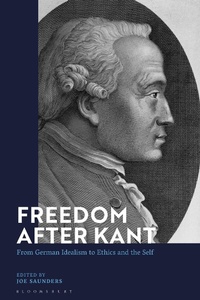
Freedom After Kant
From German Idealism to Ethics and the Self
1st Edition
Published on 18. May 2023
232 pages
978-1-350-18777-1 (ISBN)
Description

Freedom after Kant situates Kant's concept of freedom in relation to leading philosophers of the period to trace a detailed history of philosophical thinking on freedom from the 18th to the 20th century. Beginning with German Idealism, the volume presents Kant's writings on freedom and their reception by contemporaries, successors, followers and critics.
From exchanges of philosophical ideas on freedom between Kant and his contemporaries, Reinhold and Fichte, through to Kant's ideas on rational self-determination in Hegel and Schelling, we see Kant's original arguments transformed through concepts of autonomy, freedom and absolutes. The political aspect of Kant's freedom finds further articulation in chapters on Marx and Mill who developed their own notions of political freedom after Kant. Revealing how Kant's concept of freedom shaped the history of philosophy in the broadest sense, contributors chart the development of an ethics of freedom in the 20th century which brings Kant into conversation with Heidegger, Beauvoir, Sartre, Levinas and Murdoch.
This line of thinking on freedom signals a new departure for Kantian studies which brings his ideas into the present day and traverses major schools of thought including Idealism, Marxism, existentialism and moral philosophy.
From exchanges of philosophical ideas on freedom between Kant and his contemporaries, Reinhold and Fichte, through to Kant's ideas on rational self-determination in Hegel and Schelling, we see Kant's original arguments transformed through concepts of autonomy, freedom and absolutes. The political aspect of Kant's freedom finds further articulation in chapters on Marx and Mill who developed their own notions of political freedom after Kant. Revealing how Kant's concept of freedom shaped the history of philosophy in the broadest sense, contributors chart the development of an ethics of freedom in the 20th century which brings Kant into conversation with Heidegger, Beauvoir, Sartre, Levinas and Murdoch.
This line of thinking on freedom signals a new departure for Kantian studies which brings his ideas into the present day and traverses major schools of thought including Idealism, Marxism, existentialism and moral philosophy.
More details
Edition
1. Auflage
Language
English
Place of publication
London
United Kingdom
Publishing group
Bloomsbury Publishing PLC
Target group
Professional and scholarly
ISBN-13
978-1-350-18777-1 (9781350187771)
Copyright in bibliographic data and cover images is held by Nielsen Book Services Limited or by the publishers or by their respective licensors: all rights reserved.
Schweitzer Classification
Other editions
Additional editions
Book
11/2024
Bloomsbury Academic
€55.95
Shipment within 15-20 days
Book
05/2023
Bloomsbury Academic
€117.10
Shipment within 15-20 days
Person
Joe Saunders is Assistant Professor in Philosophy, Durham University, UK. He is the author of numerous articles on Kant and two co-edited books, Media Ethics, Free Speech, and the Requirements of Democracy (2019) and Wellbeing Economics: The Capabilities Approach to Prosperity (2018).
Content
Acknowledgements
Introduction, Joe Saunders (Durham University, UK)
PART I. The 18th Century: Kant and his Contemporaries; Freedom and Normativity
1. Freedom, Radical Evil and Ought Implies Can: A Problem for Kant, Robert Stern (University of Sheffield, UK)
2. Reinhold on Free Will and Moral Obligation: A Kantian Response, Jochen Bojanowski (University of Illinois, USA)
3. Kant and the Fate of Freedom: 1788-1800, Owen Ware (University of Toronto, Canada)
4. Fichte on Self-Sufficiency and Teleology, Gabriel Gottlieb (Xavier University, USA)
PART II. The 19th Century: The post-Kantians, Idealists and Pragmatists; Nature, Politics and Experience
5. The Feeling of Freedom: Schelling on the Role of Freedom in Grasping Nature, Dalia Nassar (University of Sydney, Australia)
6. Is Autonomy sufficient for Freedom?, Charlotte Alderwick (University of the West of England Bristol, UK)
7. Freedom and Hegel's Theory of the State, Christoph Schuringa (New College of the Humanities, UK)
8. 'In and Through their Association': Freedom and Communism in Marx, Jan Kandiyali (LSE, UK) and Andrew Chitty (University of Sussex, UK)
9. Mill on Freedom, Normativity, and Spontaneity, Christopher Macleod (University of Lancaster, UK)
10. Practical Grounds for Freedom: Kant and James on Freedom, Experience, and an Open Future, Joe Saunders (Durham University, UK) and Neil Williams (University of Roehampton, UK)
PART III. The 20th Century: New Developments: Freedom, The Self, and Others
11. Levinas and "Finite Freedom", James Lewis (University of Birmingham, UK) and Simon Thornton (University of Sheffield, UK):
12. Rethinking Existentialism: From Radical Freedom to Sedimentation, Jon Webber (University of Cardiff, UK)
13. 'Murdoch on Freedom', Ana Barandalla (The Aga Khan University)
Index
Introduction, Joe Saunders (Durham University, UK)
PART I. The 18th Century: Kant and his Contemporaries; Freedom and Normativity
1. Freedom, Radical Evil and Ought Implies Can: A Problem for Kant, Robert Stern (University of Sheffield, UK)
2. Reinhold on Free Will and Moral Obligation: A Kantian Response, Jochen Bojanowski (University of Illinois, USA)
3. Kant and the Fate of Freedom: 1788-1800, Owen Ware (University of Toronto, Canada)
4. Fichte on Self-Sufficiency and Teleology, Gabriel Gottlieb (Xavier University, USA)
PART II. The 19th Century: The post-Kantians, Idealists and Pragmatists; Nature, Politics and Experience
5. The Feeling of Freedom: Schelling on the Role of Freedom in Grasping Nature, Dalia Nassar (University of Sydney, Australia)
6. Is Autonomy sufficient for Freedom?, Charlotte Alderwick (University of the West of England Bristol, UK)
7. Freedom and Hegel's Theory of the State, Christoph Schuringa (New College of the Humanities, UK)
8. 'In and Through their Association': Freedom and Communism in Marx, Jan Kandiyali (LSE, UK) and Andrew Chitty (University of Sussex, UK)
9. Mill on Freedom, Normativity, and Spontaneity, Christopher Macleod (University of Lancaster, UK)
10. Practical Grounds for Freedom: Kant and James on Freedom, Experience, and an Open Future, Joe Saunders (Durham University, UK) and Neil Williams (University of Roehampton, UK)
PART III. The 20th Century: New Developments: Freedom, The Self, and Others
11. Levinas and "Finite Freedom", James Lewis (University of Birmingham, UK) and Simon Thornton (University of Sheffield, UK):
12. Rethinking Existentialism: From Radical Freedom to Sedimentation, Jon Webber (University of Cardiff, UK)
13. 'Murdoch on Freedom', Ana Barandalla (The Aga Khan University)
Index
