

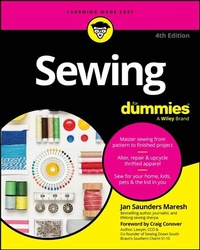
Sewing For Dummies
Description

Learn the basic skills and techniques you need for successful hand and machine sewing
Over the past ten years, interest in sewing has grown. If want to learn how to sew or to improve your skills, Sewing For Dummies is the book you need to get started. This complete guide to sewing basics teaches you basic hand stitches and sewing machine operation, with easy-to-follow instructions and step-by-step illustrations. You'll work your way forward to develop the skills to create or repair clothing and furnishings that fit your personal style, your measurements, and your aesthetic. Find great patterns in stores and online, give thrift store finds new life, and learn about cool new fabrics and sewing trends. You'll also get an overview of common sewing mistakes and how to avoid them, so you can take up this relaxing, creative hobby with confidence. A full-color insert brings the text to life. Enjoy the feeling of accomplishment you'll get when you use your new skills to create wonderful handmade pieces.
- Learn hand and machine sewing skills, starting with the basics and working your way up
- Choose the right sewing machine for your needs and follow step-by-step tutorials to master its use
- Makes repairs and alterations to keep your wardrobe current
- Learn about online sewing resources and get ideas for finding fabric and patterns
This Dummies guide will help anyone who wants to learn basic sewing skills or brush up on what they already know. Sew a button back on your jacket, make pillowcases from an old dress, alter that great vintage dress to fit like a glove, and complete any other sewing projects you can dream up.
More details
Other editions
Additional editions
Person
Jan Saunders Maresh is a nationally recognized sewing authority, educator, and journalist. She has worked as the Education Director for the White Sewing Machine Company and the Director of Consumer Education for JoAnn Fabrics and Crafts. She's the best-selling author of 19 books covering the many aspects of sewing and instruction.
Content
Foreword xiii
Introduction 1
About This Book 1
Foolish Assumptions 3
Icons Used in This Book 3
Beyond the Book 4
Where to Go from Here 4
Part 1: Ready set sew! 5
Chapter 1: The World of Sewing from 30,000 Feet 7
Chapter 2: Tooling Around: Assembling Your Sewing Kit 19
Chapter 3: Fabrics, Findings, and Interfacings ... Oh My! 43
Chapter 4: Pondering Patterns in the 21st Century 61
Part 2: Going to Sewing School: Getting the Hang of the Basic Skills 87
Chapter 5: Taking the First Steps of Your Sewing Adventure 89
Chapter 6: Securing Sensational Seams 117
Chapter 7: Hemming Almost Anything by Hand and Machine 147
Chapter 8: Playing Around: Sewing for Kids, Pets, and the Kid in You 163
Part 3: Strutting the Runway: Fashion Sewing 101 191
Chapter 9: Shaping Your Silhouette 193
Chapter 10: Zip It Button It Close It 213
Chapter 11: What is Up Your Sleeves? 235
Chapter 12: Pockets: More Than Just a Place to Put Your Hands 255
Part 4: Casa Couture: Sewing for Your Home 269
Chapter 13: Decorating on Demand: Home Décor Sewing 271
Chapter 14: Tablescaping with Terrific Table Toppers 279
Chapter 15: Personalizing Praiseworthy Pillows 291
Chapter 16: Brightening Up Your Bedroom 311
Part 5: Makeover Magic: Mending, Alterations, and Quick Fixes for a Sustainable Wardrobe 327
Chapter 17: Fitting Finesse: Altering Clothes for All Shapes and Sizes 329
Chapter 18: Sewing SOS: "Help, I Ripped My ______" 347
Chapter 19: Sustainable Restyling: Giving Existing Garments New Life 365
Part 6: the Part of Tens 385
Chapter 20: Ten Rookie Sewing Mistakes to Avoid 387
Chapter 21: Ten Tips for Buying and Maintaining a Sewing Machine and Serger 393
Chapter 22: Ten ABCs of Sewing 401
Index 407
Chapter 1
The World of Sewing from 30,000 Feet
IN THIS CHAPTER
Prioritizing sewing as your next "Big Thing"
Peeking at the sewing process - stitching, seaming, and finishing touches
Understanding the penny-wise perks and eco-friendly benefits of the craft
Why sew? For starters, it's fun. There's nothing quite like the thrill of making something useful and beautiful and then basking in the "oohs and aahs" from friends and family. Also, what you learn about fabrics, fibers, and fashion helps you in other areas of your life. I talk about this more in the "Understanding fabrics and fibers" section later in this chapter.
Sewing can be a rewarding hobby or a productive pastime. You can sew Halloween costumes, teddy bears, prom dresses, and purses. Think of the fashions in home décor. A tablescape isn't complete without some great-looking linens - that you can make, of course. You can update your house by making a wardrobe of pillows with a set of covers for every season or by sewing a new duvet cover. And gifts? Prepare to be the hero who rolls up with a handmade throw or a basket brimming with hand-stitched napkins.
If you're looking for more of a sewing challenge, you may want to learn about quilting. It's a subset of sewing that's popular and creative, and you end up with a beauty to wrap yourself in or a smaller wall-hanging. Because quilting is such a large part of the world of sewing, it has its own place in the For Dummies library. Check out Quilting For Dummies by Cheryl Fall (Wiley).
My hope is that after you get to know more about this creative endeavor and have some success with the projects in this book, you'll spread your wings and investigate the larger world of sewing.
If you are new to sewing, make sure to read this chapter. It's an overview of what you'll need for any sewing project - the tools and fabrics, plus a bit about your sewing machine. Next I cover the process -like preshrinking the fabric, choosing a pattern, and the importance of pressing as you sew. Finally, I explain the basics of turning a flat piece of fabric into a usable piece for yourself or your home or to upcycle an item that keeps it from the landfill a bit longer.
Sewing isn't just creating; it's adding your signature flair. So grab that thimble. It's time to make the mundane magnificent!
Getting Started: Gathering Tools, Fabric, Pattern, and Your Sewing Machine
You could whip up a five-course meal over an open fire with old, beat-up pots and pans, but let's be honest - it wouldn't be much fun. The same goes for sewing. Trying to tackle a project with dull shears, crooked pins, and a basic hand needle might leave you less than inspired. In this section, I guide you through the essential tools and materials needed to make your sewing experience a success and a lot of fun.
Using good tools
For me, the joy of sewing is having quality tools at my fingertips. Sure, good tools are an investment, but if you're serious about learning to sew, nothing gets you closer to success than the pleasure of using a quality tool that works perfectly every time you use it. Not sure if you'll like sewing but still want to try it? Take a sewing class at your local fabric store or sewing machine dealer where you can use great tools and quality equipment.
Besides the fabric and pattern, here's what will make your sewing experience a real pleasure:
- Measuring tools for small and large areas of a project: I love my 6-inch adjustable sewing gauge, my flexible vinyl tape measure, and the see-through 24-inch and 36-inch T-square rulers with ¼-inch increments.
- Cutting tools for cutting out your project: I use 8-inch bent-handle dressmaking shears, 5-inch scissors for trimming smaller areas, and embroidery scissors for clipping and ripping out unwanted stitches. For long and straight cutting, the pizza cutter-type rotary cutter with a cutting mat to protect the table is the best.
- Marking tools to show you how to turn a flat, shapeless piece of fabric into something useful: You need a marking tool for dark-colored fabrics and one for light-colored fabrics. I have two favorites. For dark fabrics I like the disappearing dressmaker's chalk that washes out with water. For light fabrics, I use an air-soluble marker. Keep in mind that the ink disappears within 24-48 hours, so don't mark your fabric and go on a two-week vacation!
- Pins and pin holders: My favorite pins for 90 percent of the sewing I do are 1¼-inch glass-head pins often referred to as quilting pins. To keep my pins from ending up all over the place, I use two magnetic pin catchers: one for the ironing board and one on the cutting table. I also like a wrist pin cushion with a felt cushion so my pins are portable.
- New hand and machine needles: After some use, needles wear out and need to be discarded. As far as hand needles go, specialty needles are available for just about every hand-sewing task. I most often use self-threading needles for basic hand sewing and easy repairs. I used these even before I needed reading glasses because the thread just clips into place - no squinting and poking thread ends through a microscopic eye required.
- Thread to hold everything together: Be sure not to skimp on the thread - when you see three spools for $1, run away. The quality of that thread isn't worth the spool it's wound on. Read more about choosing quality thread in Chapter 2.
- A good sewing machine to enjoy the sewing experience: I said you need a good machine, not an expensive one - and it doesn't have to be new. Just buy it from a reputable sewing machine dealer that can offer you reliable service and lessons if you need them. Check out Chapter 21 for more information.
- A serger - if you discover that you like to sew and want to take your newfound skill to a new level you might want a serger. You don't need a serger but it makes the sewing process faster and more streamlined, like the microwave oven does for cooking. For more on what a serger can do and why you might want one, see Chapter 5.
- Iron and ironing board: If you want to sew, you must have an ironing board and a steam iron. When looking for a steam iron, find one that does not automatically shut off when you're not using it. If your iron shuts off automatically, then every time you want to press a seam, you must wait until the iron comes up to temperature, which is a real time-waster.
I spend some time in Chapter 2 sharing my favorite tools with you, so check it out.
Understanding fabrics and fibers
Among the perks of learning to sew is gaining more knowledge about fabrics and fibers and how they respond to washing (or not), wearing, and pressing. Ultimately this knowledge makes you a savvier shopper of ready-to-wear garments. So what's the difference between fiber and fabric?
Fabrics are woven or knitted yarns, which are created by twisting fibers together. Whether the fabric is all wool or a cotton-polyester blend, each fiber has its unique advantages and disadvantages, which makes one better than others for a particular project. (See more specific information about the most common types of fibers and fabrics in Chapter 3.)
If you aren't sure about your fabric choice, the sales associate at your local fabric store is a great resource for locating just the right fabric for the project. Most have knowledge it would take you years to learn, so don't be shy. Ask for help, tell them what you want to make, and ask for their best advice. This can save you time and guide you on your way to success.
Your time and effort are worth something. Spend your sewing time wisely by buying the best fabric you can afford and the best fiber for your project and your lifestyle. See Chapter 3 for more on choosing the best fabric for a project.
Getting the sewing notion
Most fabric stores have a notions wall that's full of specialty tools and sewing stuff. Notions range from pins, needles, scissors, shears, and measuring tools to buttons, bra hooks, collar stays, and iron-on knee patches. The notions needed for a particular project are listed on the back of your pattern envelope, so when in doubt, look there to find out what you need. Don't be afraid to ask for help locating things. What you need may be hidden in plain sight.
Pondering the pattern
Fabric stores have over-the-counter displays and catalogs of patterns that you can browse through. The internet brings sewing patterns home and puts the right project just a keystroke away. Type in the project you want to make with sewing pattern after it to find tons of choices. Internet searches also make investigating independent pattern designers easy.
Choose a pattern designed for your skill set. If a pattern says it's easy, the instruction writers often still assume you have some knowledge of sewing, so if you're a true beginner, choose patterns for beginners. If you don't, you may become discouraged and never sew again! Simplicity Pattern Company (https://simplicity.com) is an umbrella for...
