

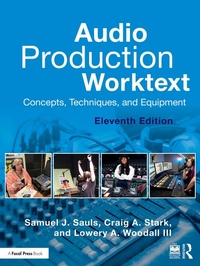
Audio Production Worktext
Concepts, Techniques, and Equipment
11th Edition
Published on 1. April 2025
290 pages
978-1-040-32575-9 (ISBN)
Description

Now in its eleventh edition, Audio Production Worktext offers a comprehensive introduction to audio production in radio, podcasting, television, and film.
This hands-on, student-friendly text demonstrates how to navigate modern radio production studios and utilize the latest equipment and software. Key chapters address production planning, the use of microphones, audio consoles, and sound production for visual media. The reader is shown the reality of audio production both within the studio and on location. In this new edition, chapters have been reorganized to address the growing prominence of podcasting and digital production. Thorough updates have been made to every chapter, including self-study questions and projects, and the authors continue to draw in diverse and international practitioner perspectives to help translate concepts to real-world practice.
This book remains an essential text for audio and media production students seeking a thorough introduction to the field.
The accompanying website for students and instructors has also been updated and includes sample syllabi, lesson plans, further study questions, test questions, and web resources, as well as images by chapter as included in the Worktext.
This hands-on, student-friendly text demonstrates how to navigate modern radio production studios and utilize the latest equipment and software. Key chapters address production planning, the use of microphones, audio consoles, and sound production for visual media. The reader is shown the reality of audio production both within the studio and on location. In this new edition, chapters have been reorganized to address the growing prominence of podcasting and digital production. Thorough updates have been made to every chapter, including self-study questions and projects, and the authors continue to draw in diverse and international practitioner perspectives to help translate concepts to real-world practice.
This book remains an essential text for audio and media production students seeking a thorough introduction to the field.
The accompanying website for students and instructors has also been updated and includes sample syllabi, lesson plans, further study questions, test questions, and web resources, as well as images by chapter as included in the Worktext.
More details
Edition
11th edition
Language
English
Place of publication
London
United Kingdom
Publishing group
Taylor & Francis Ltd
Target group
College/higher education
Illustrations
196 Halftones, color; 196 Illustrations, color
File size
93,54 MB
ISBN-13
978-1-040-32575-9 (9781040325759)
Copyright in bibliographic data and cover images is held by Nielsen Book Services Limited or by the publishers or by their respective licensors: all rights reserved.
Schweitzer Classification
Other editions
Additional editions
Samuel J. Sauls | Craig A. Stark | Lowery A. Woodall III
Audio Production Worktext
Concepts, Techniques, and Equipment
Book
04/2025
11th Edition
Routledge
€110.30
Shipment within 10-20 days
Samuel J. Sauls | Craig A. Stark | Lowery A. Woodall III
Audio Production Worktext
Concepts, Techniques, and Equipment
Book
03/2025
11th Edition
Routledge
€192.50
Shipment within 10-20 days

Book
03/2025
Routledge
Unfortunately, price unknown
Available (delivery time upon request)
Persons
Samuel J. Sauls, PhD, retired as an Associate Professor from the University of North Texas, USA, in August 2013 after 29 years on the faculty in the Department of Radio, Television and Film. From 1984 to 1994, he was the Station Manager of the university radio station, KNTU-FM. During his tenure, he also held the roles of Associate Chair and Director of Graduate Studies in the department. He has a combined total of 18 years' experience in commercial and noncommercial radio and also worked for four years in Saudi Arabia producing soundtracks in English, Arabic, and French. He has served on the Broadcast Education Association board of directors, was BEA President in 2011-2012, and is a former President of the Texas Association of Broadcast Educators. His first book, The Culture of American College Radio, was published in 2000, and his co-authored book, The Sump'n Else Show, was published in 2014. Dr. Sauls has published some 16 academic articles and has made over 65 conference paper and panel presentations, as well as reviewing over 20 journal articles and 15 books for publication consideration. From 2013 until 2020, he was an Adjunct Professor in the Department of Communications at Susquehanna University, Pennsylvania, USA.
Craig A. Stark, PhD, is an Associate Professor in the Department of Communications at Susquehanna University, USA, and serves as the Faculty Advisor for WQSU-FM. He teaches courses in media law, audio production, media theory, intercultural communication, and team communication. He has worked and taught in collegiate broadcasting for over 30 years, and has worked in commercial production as an announcer, editor, reporter, and engineer. He has been active with the Broadcast Education Association, the Pennsylvania Association of Broadcasters, and the Texas Association of Broadcast Educators. He has published several journal articles and book chapters related to emerging media and HD Radio technology.
Lowery A. Woodall III, PhD, is an Associate Professor and Department Chair of Communication & Theatre at Millersville University of Pennsylvania, USA, where he teaches courses in radio and television production, mass communication theory, and public speaking. Dr. Woodall received his BFA from Sam Houston State University, Texas, USA in 2004, and has a Masters and PhD from the University of Southern Mississippi, USA (2007, 2010). He was the faculty advisor to the campus radio station, WIXQ 91.7-FM for almost 10 years. Dr. Woodall published Grappling With Representation: Exploring issues of Diversity and Inclusion in World Wrestling Entertainment through Rowman & Littlefield in 2022. He has also served in several positions including President of the Pro Wrestling Studies Association. Dr. Woodall was a co-editor on Joss Whedon and Race: Critical Essays, which examined the depiction of race and ethnicity in the works of writer/director/producer, Joss Whedon. The book won the Mr. Pointy Award for best long-form academic work in the field of Whedon Studies. Dr. Woodall has also published articles in the areas of superhero comic book representation and popular music.
Craig A. Stark, PhD, is an Associate Professor in the Department of Communications at Susquehanna University, USA, and serves as the Faculty Advisor for WQSU-FM. He teaches courses in media law, audio production, media theory, intercultural communication, and team communication. He has worked and taught in collegiate broadcasting for over 30 years, and has worked in commercial production as an announcer, editor, reporter, and engineer. He has been active with the Broadcast Education Association, the Pennsylvania Association of Broadcasters, and the Texas Association of Broadcast Educators. He has published several journal articles and book chapters related to emerging media and HD Radio technology.
Lowery A. Woodall III, PhD, is an Associate Professor and Department Chair of Communication & Theatre at Millersville University of Pennsylvania, USA, where he teaches courses in radio and television production, mass communication theory, and public speaking. Dr. Woodall received his BFA from Sam Houston State University, Texas, USA in 2004, and has a Masters and PhD from the University of Southern Mississippi, USA (2007, 2010). He was the faculty advisor to the campus radio station, WIXQ 91.7-FM for almost 10 years. Dr. Woodall published Grappling With Representation: Exploring issues of Diversity and Inclusion in World Wrestling Entertainment through Rowman & Littlefield in 2022. He has also served in several positions including President of the Pro Wrestling Studies Association. Dr. Woodall was a co-editor on Joss Whedon and Race: Critical Essays, which examined the depiction of race and ethnicity in the works of writer/director/producer, Joss Whedon. The book won the Mr. Pointy Award for best long-form academic work in the field of Whedon Studies. Dr. Woodall has also published articles in the areas of superhero comic book representation and popular music.
Content
Preface
Acknowledgements
Chapter 1: Production Planning
Chapter 2: The Studio Environment
Chapter 3: Digital Audio Production
Chapter 4: Podcasting and Digital Audio Recording
Chapter 5: The Audio Console
Chapter 6: Microphones
Chapter 7: Monitor Speakers and Studio Accessories
Chapter 8: Signal Processing and Audio Processors
Chapter 9: Production Situations
Chapter 10: Location Sound Recording
Chapter 11: Sound Production for the Visual Media
Chapter 12: Internet Radio and Other Distribution Platforms
Glossary
Appendix
Index
Acknowledgements
Chapter 1: Production Planning
Chapter 2: The Studio Environment
Chapter 3: Digital Audio Production
Chapter 4: Podcasting and Digital Audio Recording
Chapter 5: The Audio Console
Chapter 6: Microphones
Chapter 7: Monitor Speakers and Studio Accessories
Chapter 8: Signal Processing and Audio Processors
Chapter 9: Production Situations
Chapter 10: Location Sound Recording
Chapter 11: Sound Production for the Visual Media
Chapter 12: Internet Radio and Other Distribution Platforms
Glossary
Appendix
Index
