

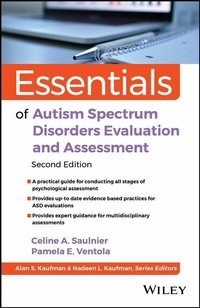
Essentials of Autism Spectrum Disorders Evaluation and Assessment
Description

Essentials of Autism Spectrum Disorders Evaluation and Assessment, 2nd Edition, helps professionals learn how to identify, assess, and diagnose autism spectrum disorders (ASD). In a time when detection and awareness of ASD are on the rise, this book addresses the primary domains of assessment, discusses the purpose of assessment, suggests test instruments, and identifies the unique clinical applications of each instrument to the diagnosis of ASD. As with all volumes in the Essentials of Psychological Assessment series, this book consists of concise chapters featuring callout boxes highlighting key concepts, easy-to-learn bullet points, and extensive illustrative material, as well as test questions that help you gauge and reinforce your grasp of the information covered.
* Understand the issues in identification and assessment of autism spectrum disorders
* Get expert advice on avoiding common pitfalls and misinterpretations
* Quickly and easily locate pertinent information, thanks to the convenient, rapid-reference format
* Access resources and tools to aid in performing professional duties.
This straightforward manual includes samples of integrated reports from diagnostic evaluations and prepares clinical and school psychologists, and clinicians from allied disciplines, to effectively evaluate and assess ASD.
More details
Other editions
Additional editions
Persons
CELINE A. SAULNIER, PhD, worked in the Yale Child Study Center's Autism Program for nearly a decade. Then, she joined the faculty at Emory University's School of Medicine and the Marcus Autism Center. Currently, she owns her own company, Neurodevelopmental Assessment & Consulting Services.
PAMELA E. VENTOLA, PhD, is an Associate Professor in the Yale Child Study Center and leads the Rare Disease and Pediatric Center of Excellence at Cogstate, supporting industry-sponsored clinical trials. She also has extensive clinical and research experience with diagnostic, developmental, and neuropsychological assessments with individuals with ASD across the life span.
Content
About the Authors x
Series Preface xi
Preface xiii
Acknowledgments xiv
One Overview 1
Diagnostic Criteria 1
References 7
Two Assessment of Developmental and Cognitive Skills 9
Selecting Instruments 10
Developmental and Early Cognitive Measures 12
Measures of Cognition and Intelligence in School-Age
Individuals and Adults 16
Measures of Nonverbal Intelligence 19
Neuropsychological Assessments 20
Qualitative Observations 22
Summary 23
References 24
Test Yourself 26
Answers 27
Three Speech, Language, and Communication Assessment 28
Receptive Language 31
Expressive Language 32
Pragmatic Language/Social Communication 34
Stages of Language Development 36
Formulation of Findings 38
Summary 38
References 42
Test Yourself 43
Answers 43
Four Assessment of Adaptive Behavior, Executive Functioning, and
Behavioral Regulation Skills 45
Assessment of Adaptive Behavior 45
Assessment of Executive Functioning 52
Assessment of Behavioral Regulation Skills 53
Summary 56
References 56
Test Yourself 58
Answers 59
Five Developmental History and Record Review 60
Clinical Interview 61
Methods of Collecting Information on Current and
Historical Presentation 70
Summary 74
References 75
Test Yourself 75
Answers 76
Six Direct Diagnostic Assessment 77
Screening Measures for Risk of ASD 77
Diagnostic Rating Scales 79
Direct Diagnostic Assessment 81
Considerations for First-Time Diagnostic Evaluations with Adolescents and Adults 94
Direct Measures of Autism Symptomatology 96
Options for Remote/Telehealth Diagnostic Assessments for ASD 99
Summary 100
References 101
Test Yourself 103
Answers 104
Seven Diagnostic Differentials and Co-Occurring Conditions 105
Intellectual Disability 106
Communication Disorders 110
Learning Disabilities 111
Attention Deficit/Hyperactivity Disorder 114
Anxiety Disorders 115
Depression and Mood Disorders 116
Obsessive-Compulsive Disorder (OCD) 118
TIC Disorders and Tourette's Disorder 119
Psychiatric Conditions in Adulthood 120
Summary 122
References 123
Test Yourself 125
Answers 127
Eight Catching the Misdiagnosed, Late Diagnosed, and Missed for Diagnosis 128
Factors Related to Racial, Ethnic, Socioeconomic, and Geographical Disparities 129
Factors Related to Sex Differences in ASD Symptomatology 130
Factors Related to Gender and Sexual Identity Development 133
Factors Related to Subtle or Complex Symptom Expression 134
References 136
Test Yourself 137
Answers 138
Nine Preparing for Transition to Adulthood 139
Idea and Transition Planning 139
Assessments Supporting the Transition Plan Process 140
Needs to Consider for Adulthood 146
Job Coaching and Vocational Training 148
Academic Accommodations and Modifications 149
Life Skills and Life Coaching/Mentoring 151
Transitional and College-Preparation Programs 153
References 156
Test Yourself 159
Answers 160
Ten Diagnostic Formulations and Case Conceptualizations 161
Providing Feedback of Results 161
The Written Report 162
Case Samples 163
Case Sample 1: Initial Diagnosis-Toddler 164
Case Sample 2: Re-Evaluation-School-Aged Child with Complex Presentation 175
Case Sample 3: Initial Diagnosis: Adult Female 191
Chapter Summary 205
Author Index 206
Subject Index 000
One
OVERVIEW
DIAGNOSTIC CRITERIA
Autism spectrum disorder (ASD) is among the most common childhood disorders, with prevalence rates currently estimating 1 in 36 school-aged children (Maenner, Warren, Williams et al., 2023). ASD is four times more prevalent in males than females, but as will be highlighted later in this book, the diagnostic presentation of females assigned at birth is complex and, consequently, could suggest an underrepresentation of true female prevalence rates. Although the cause(s) of ASD is likely neurobiological/genetic in nature, the exact etiology remains unknown. As such, the diagnosis of ASD has historically been determined based on behavioral symptomatology that, through the lens of a medical model, are generally described as delays, deficits, impairments, or similar terminology that implies the need for remediation or a "cure" (Pellicano & den Houting, 2022). As the spectrum has broadened over the 21st century to include an increasing number of individuals with intact language and cognition, many autistic individuals identify as being neurodiverse or neurodivergent and do not seek to be cured or viewed as disordered, but rather wish to be accepted and supported for their unique differences (den Houting, 2019). Nevertheless, the label still implies that the individual is experiencing challenges, vulnerabilities, and in some cases delays/deficits that negatively affect multiple areas in life. The authors of this book have tremendous respect for neurodiversity, as we do for every individual across the extremely diverse and complex spectrum, including those more severely affected. Thus, in our aim to help educate and train clinicians on how to effectively identify ASD based on behavioral "symptoms," we strive to focus on the diagnostic label serving to enhance the quality of life and self-determination rather than to imply curing or fixing anybody. We will use terms such as symptoms, disorder, condition, and disability throughout the text given that this terminology is still part of the diagnostic criteria and medical nomenclature to which clinicians are exposed. We will also use identity-first language (autistic individual) opposed to person-first language (individual with autism) to respect that not all individuals view ASD as something separate from who they are.
The current diagnostic criteria for ASD put forth in the Diagnostic and Statistical Manual, Fifth Edition, Text Revision (DSM-5-TR; APA, 2022) require persistent symptoms in two broad areas: (1) the presence of delays/deficits/challenges in social communication and interaction in all three of the following areas either currently or by developmental history: (a) social-emotional reciprocity (e.g., shared interests, shared affect, and conversations), (b) nonverbal communication (e.g., integrated eye contact, and directed facial expressions, (c) use and understanding of gestures and body posture), and (d) in developing, maintaining, and understanding relationships (e.g., interactive imaginative play, interest in peers, and making friends); and (2) the presence of restricted, repetitive, or stereotyped behaviors that include at least two of the following four areas: (a) stereotypical motor movements or use of objects (e.g., hand flapping, spinning, lining up toys, and repetitive or stereotyped speech), (b) insistence on sameness or routine (e.g., difficulty with transitions, changes in routine, and rigidity in thinking), (c) highly restricted interests that become overly intense or all-consuming (e.g., intense interests on topics and fixation on objects), and (d) sensory processing impairments (e.g., hyper- or hypo-reactivity to sensory input, or seeking out sensory input). This combination of social vulnerabilities and stereotyped behaviors must be present in early development (even if symptoms go undetected until adolescence or adulthood) and clinically impairing across multiple contexts in life.
Rapid Reference 1.1
Social communication and interaction criteria (must include all three either currently or by history):
- Challenges in social-emotional reciprocity
- Challenges in nonverbal communication
- Challenges in developing, maintaining, and understanding relationships
Restricted, repetitive, and stereotyped behaviors (must include at least two either currently or by history)
- Stereotypical motor movements or use of objects
- Insistence on sameness or routine
- Highly restricted interests
- Sensory processing impairments
In addition to listing the diagnostic criteria for the two categories of social communication/interaction symptoms and restricted, repetitive, and stereotyped behaviors, the DSM-5 has three severity levels that clinicians need to apply to both categories. Level 1 is specified for individuals who require support at the lowest level (e.g., symptoms interfere with functioning in one or more contexts, but they are mild); Level 2 is specified for those who require substantial support (e.g., there are marked impairments that interfere across multiple contexts); and Level 3 is specified for those who require very substantial support (e.g., delays or deficits are severe and entail comprehensive supports across contexts). Clinicians can specify different levels based on each category. For instance, an individual with intact language and cognition may only require Level 1 support for their social communication and interaction skills, but same individual's stereotypical behaviors might be so intrusive to life that Level 2 is required for this category.
DON'T FORGET
The DSM-5 has three levels of severity that need to be applied to each category of symptoms (social communication/interaction and restricted, repetitive, and stereotyped behaviors) as follows:
- Level 1: the individual requires support
- Level 2: the individual requires substantial support
- Level 3: the individual requires very substantial support
The DSM-5 also offers clinical specifiers for ASD that allow for descriptions of common co-occurring conditions. These include specifying whether ASD is accompanied by co-occurring intellectual impairment or language impairment (e.g., nonverbal, minimally verbal, phrase speech, and sentence speech), whether ASD is associated with a known genetic or other medical condition (e.g., Fragile X syndrome and Down syndrome), environmental factor, other neurodevelopmental (e.g., ADHD), mental (e.g., anxiety and depression), or behavioral problem, or whether co-occurring catatonia is present. Catatonic behaviors can include posturing, limited response to external stimuli, stupor, or mutism. Catatonia can be present in as many as 10% of autistic individuals, with features generally developing in late adolescence (Vaquerizo-Serrano, Salazar De Pablo, Singh, & Santosh, 2021).
DON'T FORGET
The DSM-5 has clinical specifiers that allow for indicating all co-occurring conditions. This helps inform levels of support needed as well as types of interventions.
- With or without accompanying intellectual impairment
- With or without accompanying language impairment
- Associated with a known genetic or medical condition, or environmental factor
- Associated with another neurodevelopmental, mental, or behavioral problem
- With catatonia
There is vast heterogeneity in symptom expression across the spectrum and throughout development, with some individuals experiencing only mild challenges in certain areas and other individuals experiencing quite debilitating challenges. Symptoms that impact autistic individuals are not just limited to the criteria for ASD, but also include varying levels of speech and language, cognition, emotional and behavioral regulation, and attention and executive functioning. Thus, clinicians need to be knowledgeable of these broader areas. When autism was first defined in the 1900s, the vast majority of individuals had co-occurring language and cognitive deficits that significantly affected development. However, current epidemiological data show that only about 38% of autistic children in the United States have co-occurring intellectual disability (ID; Maenner et al., 2023). This shift in levels of cognitive and language functioning has sparked a great deal of controversy in the field. Where historically there used to be a clear delineation of impairment to meet diagnostic criteria; currently, the diagnostic line between what is considered neurotypical and neurodiverse is quite blurred (Rodgaard, Jensen, Vergnes, Soulieres, & Mottron, 2019). This raises concerns about whether autism is a single condition or perhaps multiple disabilities, and whether the spectrum has become too broad to be accurately defined. Subtypes of autism were developed in the DSM-IV and DSM-IV-TR (APA, 1994, 2000) with autistic disorder, Asperger's disorder, pervasive developmental disorder, not otherwise specified, Rett's disorder, and childhood disintegrative disorder. However, research failed to show that these subtypes indeed had distinct phenotypes. Rather, research indicated that the main factor differentiating subtypes was the geographical site or clinicians providing the diagnoses (Lord, Petkova, Hus et al., 2012). Even expert...
