

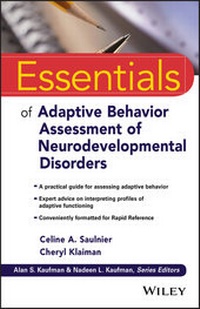
Essentials of Adaptive Behavior Assessment of Neurodevelopmental Disorders
Description

Adaptive behavior assessment measures independent living skills, including communication, social skills, personal care, and practical work skills. For individuals with intellectual disabilities, evaluation of these skills is a critical tool for measuring eligibility and can identify specific skills that must be learned before effective educational interventions can be implemented. Essentials of Adaptive Behavior Assessment of Neurodevelopmental Disorders describes the role of adaptive behavior in assessment and treatment, and provides clear guidance for measurement. Case samples provide real-world illustration of behaviors and assessment, and systematic comparison of various measures are presented and explained to better inform planning.
Individual chapters outline specific adaptive behaviors across a range of neurodevelopmental disorders, giving clinicians, practitioners, students, and researchers a better understanding of diagnostic differentials and how to place independent skill programming in treatment and intervention.
* Plan intervention and treatment based on accessible measurement guidelines across a range of disorders
* Gain a deeper understanding of adaptive functioning specific to ADHD, autism spectrum disorders, disruptive behavior disorders, and genetic disorders
* Compare and contrast current measures to evaluate their strengths, weaknesses, and areas of overlap
* Quickly locate essential information with Rapid Reference and Caution boxes
For individuals with neurodevelopmental disorders, adaptive behaviors are the keys to independence; without them, these individuals will perpetually struggle with achieving optimum independence without the basic skills needed to function at home, in school, and in the community. Assessment allows these skills to be factored in to treatment and intervention planning, and can help improve the outcomes of other intervention methods. Essentials of Adaptive Behavior Assessment of Neurodevelopmental Disorders clarifies the assessment of these important behaviors, helping clinicians make more informed decisions around diagnosis, education, and treatment planning.
More details
Other editions
Additional editions
Persons
CELINE A. SAULNIER, PHD, and CHERYL KLAIMAN, PHD, are Associate Professors in the Department of Pediatrics at the Emory University School of Medicine & Marcus Autism Center, Children's Healthcare of Atlanta.
Content
Series Preface xv
Acknowledgments xvii
One Introduction and History of Adaptive Behavior 1
Introduction 1
The Birth of Adaptive Behavior 1
Adaptive Behavior in the Definition of Intellectual Disability 5
Principles of Adaptive Behavior 9
Summary 13
Test Yourself 14
Two Methods of Assessing Adaptive Behavior 17
Types of Measures 19
Interviews 20
Unstructured Interviews 20
Semi-Structured and Structured Interviews 21
Direct Observation 21
Checklists and Rating Scales 21
Self-Administered 22
Other-Administered 22
Purpose of Measure 24
Psychometric Properties 25
Floor and Ceiling Effects 25
Item Density 26
Reliability 26
Validity 27
Adequacy of Normative Samples 28
Sociocultural Biases 29
Choosing a Measure 30
Summary 30
Test Yourself 31
Three Standardized Measures of Adaptive Behavior 33
Vineland Social Maturity Scale 33
AAMD/AAMR/AAIDD Adaptive Behavior Scales 35
Adaptive Behavior Scale (ABS) 36
Adaptive Behavior Scale, Public School Version (ABS-PSV) 36
Adaptive Behavior Scale, School Edition, and AAMR Adaptive Behavior Scale-School:2 (ABS-S:2) 37
Diagnostic Adaptive Behavior Scale (DABS) 38
Vineland Adaptive Behavior Scales 40
Vineland Adaptive Behavior Scale (Vineland ABS) 40
Vineland Adaptive Behavior Scales, Second Edition (Vineland-II) 42
Vineland Adaptive Behavior Scales, Third Edition (Vineland-3) 43
Adaptive Behavior Assessment System 46
Adaptive Behavior Assessment System (ABAS) 47
Adaptive Behavior Assessment System, Second Edition (ABAS-II) 47
Adaptive Behavior Assessment System, Third Edition (ABAS-3) 49
Scales of Independent Behavior-Revised (SIB-R) 50
Adaptive Behavior Evaluation Scale, Third Edition (ABES-3) 51
Developmental Assessments with Adaptive Behavior Sections 52
Battelle Developmental Inventory, Second Edition, Normative Update (BDI-2) 53
Bayley Scales of Infant and Toddler Development, Third Edition (Bayley-III) 53
Summary 53
Test Yourself 55
Four Adaptive Behavior Profiles in Intellectual Disability and Genetic Disorders 57
Eligibility Versus Diagnosis 58
Adaptive Behavior Profiles by Level of Cognition in ID 60
Comorbidities with ID 61
Incidence and Prevalence of ID 62
Etiologies of ID 64
Genetic Causes of ID 65
Idiopathic and Biomedical Causes of ID 75
Summary 76
Test Yourself 77
Five Adaptive Behavior Profiles in Autism Spectrum Disorder 79
Relationship Between Adaptive Behavior and Levels of Cognition 80
Relationship Between Adaptive Behavior and Age 82
Relationship Between Adaptive Behavior and Autism Symptomatology 84
Relationship Between Adaptive Behavior and Sensory Behaviors 85
Relationship Between Adaptive Behavior and Sex 86
Adaptive Behavior Profiles in Toddlers and Preschool-Age Children with ASD 87
The Impact of Race, Ethnicity, and Socioeconomic Status on Adaptive Behavior in ASD 89
Summary 91
Test Yourself 91
Six Adaptive Behavior Profiles in Other Neurodevelopmental Disorders 93
Learning Disabilities 93
Attention Deficit/Hyperactivity Disorder (ADHD) 94
Obsessive Compulsive Disorder (OCD) 96
Movement and Motor Disorders 97
Developmental Coordination Disorder (DCD) 97
Inborn Errors of Metabolism (IEM) 98
Cerebral Palsy 98
Tourette's Syndrome 98
Epilepsy 99
Hearing Impairments 100
Visual Impairments 101
Speech, Language, and Communication Disorders 102
Summary 103
Test Yourself 104
Seven Adaptive Behavior Profiles in Adults with Neurodevelopmental Disorders 107
Adaptive Profiles in Adults with Intellectual Disability 108
Adaptive Profiles in Adults with Genetic Disorders 110
Down Syndrome 110
Fragile X Syndrome 111
Williams Syndrome 112
Adaptive Behavior Profiles in Adults with Autism Spectrum Disorder 112
Adults with Language Impairments 115
Assessment for Intellectual Disability in Prisoners 116
The Relationship Between Adaptive Behavior and Residential and Vocational Success 119
Summary 121
Test Yourself 121
Eight The Role of Adaptive Behavior in Treatment and Intervention 123
Factors to Consider in Developing an Intervention Plan 124
Identifying Adaptive Behaviors to Target in Intervention 126
Evidenced-Based Practices for Treating Adaptive Behavior 130
Applied Behavior Analysis (ABA) 130
Naturalistic Developmental Behavioral Interventions (NDBIs) 133
Social Communication Approaches 134
Commercial Products 136
Summary 137
Test Yourself 138
Nine Case Samples 141
Case Sample 1: Individual with Intellectual Disability 141
Results 142
Sample Recommendations for Treatment of Adaptive Behavior 144
Case Sample 2: Individual with Autism Spectrum Disorder 145
Results 145
Sample Recommendations for ASD Educational Programming and Adaptive Behavior 148
Case Sample 3: Individual with Attention Deficit Hyperactivity Disorder 149
Results 149
Sample Recommendations for Treatment of Adaptive Behavior 153
Summary 154
References 157
About the Authors 183
Index 185
One
INTRODUCTION AND HISTORY OF ADAPTIVE BEHAVIOR
INTRODUCTION
The construct of adaptive behavior is defined as the independent performance of daily activities that are required for personal and social sufficiency (Sparrow, Cicchetti, & Saulnier, 2016). This is qualitatively different from intelligence, which is conceptualized more as a repertoire of skills that is innate or acquired over time. This book provides a comprehensive overview of profiles of adaptive behavior seen across neurodevelopmental disorders. Though there are many distinct or complex and multiplex causes for neurodevelopmental complications that result in extremely heterogeneous presentations, the delays or deficits in practical, "real-life" skills are the common thread throughout these disorders. Moreover, positive outcome is often associated with adaptive functioning and, as such, interventions to target adaptive behavior can be successful in an individual's ability to attain levels of independence in life.
DON'T FORGET
If cognition or IQ is an individual's repertoire of skills or capacity to perform a given behavior, adaptive behavior is an individual's independent performance of the behavior when life demands it.
THE BIRTH OF ADAPTIVE BEHAVIOR
When measures of cognitive ability were introduced in the early 1900s, the classification of intellectual disability (ID) relied solely on the assessment of intelligence quotient (IQ). Henry Herbert Goddard was one of the first to bring comprehensive intelligence tests to the United States when he translated and modified the Binet Intelligence Scale that was developed in France by Alfred Binet (Zenderland, 2001). Goddard's version, the Binet and Simon Tests of Intellectual Capacity, was published in 1908. At the time, Goddard was working as the research director at the Training School for Feeble-Minded Girls and Boys in Vineland, New Jersey, seeking ways to accurately assess children with IDs. The Vineland Training School was dedicated to the study of ID and, thus, defining and measuring intelligence became a strong focus.
Goddard defined feeble-mindedness as mental deficits originating at birth or early in development that resulted in an individual's incapacity for functioning independently in society (Goddard, 1914). The following labels were designated based on levels of cognitive impairment:
- Idiot designated a person with a mental age up to 2 years
- Imbecile designated a 3-7 years mental age
- Morons designated a 7-12 years mental age (though still designating cognitive delay, these individuals were not regarded as "defective" or "incapable of learning")
Goddard, similar to many of his time, believed in the heritable nature of feeble-mindedness, publishing a book about a family with mental retardation that crossed generations (Goddard, 1912). The notion that cognitive impairment was inherited reinforced the eugenics movement-one of selective breeding and sterilization in an attempt to eliminate undesired traits and maximize desired ones. This resulted in the institutionalization, sterilization, and limited immigration of many individuals with ID in the United States so as to increase the average IQ. These practices would not be fully eradicated until the 1960s and, thus, intelligence tests remained at the forefront of identifying the cognitively inferior, including children (Reilly, 1987). Despite the controversy surrounding his early involvement in the eugenics movement, Goddard is considered one of the founders of intelligence testing in our country and, in some regards, of the field of clinical psychology (Gelb, 1999).
During Goddard's tenure at the Vineland Training School, he had an assistant named Edgar Doll. Doll had recently received his bachelor's degree from Cornell University and began working with Goddard as a clinical psychologist. Doll believed that level of impairment was dependent on one's limited ability to meet designated social expectations, highlighting the necessity of social competence for functional independence (Doll, 1936). He therefore advocated that social criteria be established against which to measure intelligence. In 1917, Doll publishedClinical Studies in Feeble-Mindedness calling for clarification of the definition of intellectual disability.
After spending several years training with Goddard, Doll left the Vineland Training School to obtain his doctorate in psychology at Princeton University. He took a break from graduate school to join the Army during World War I, where he conducted cognitive assessments on army recruits. After leaving the Army and completing his doctorate at Princeton in 1920, Doll directed the Division of Classification and Education in the New Jersey State Department of Institutions and Agencies, where he assessed prisoners up for parole. Doll's experiences working with army recruits and prisoners revealed similar IQ levels between the groups. This was against the thinking at the time that criminality was caused by mental retardation (Doll, 1941). Doll's research debunking the theory that prisoners were "mentally deficient" was seminal to the field. However, this work would become overshadowed by Doll's subsequent focus on adaptive behavior.
In 1925, Doll returned to the Vineland Training School as the director of research where he remained through 1949. The practice of defining cognitive impairment on a single measure had become highly controversial, as had the theories of what caused ID (Brockley, 1999). Although some professionals such as Doll believed ID to be a genetically based and constitutional condition that resulted in social deficiencies, others argued that it was more developmental in nature arising from impaired social competence (Reschly, Myers, Hartel, & National Research Council, 2002). Evidence arose that not all individuals with ID had parents with cognitive impairment and it was discovered that ID could actually result from a host of non-genetically related factors, such as disease, physical trauma, poverty, and so on, placing into question the heritability of ID. These discoveries helped contribute to the demise of the eugenics theory and encouraged more sympathetic views toward the intellectually disabled.
Doll was a pioneer in developing the construct of adaptive behavior and emphasizing the need for assessing adaptive functioning in addition to IQ when diagnosing ID. Doll's definition for what was then called mental deficiency evolved over time. In his earlier work, Doll described a threefold criterion for diagnosing mental deficiency: "social incompetence, due to low intelligence, which has been developmentally arrested" (Doll, 1936, p. 429). Yet, he would later expand on this definition to include the following six criteria: (1) social incompetence, (2) mental subnormality, (3) developmental arrest, (4) obtains at maturity, (5) constitutional origin, and (6) essentially incurable (Doll, 1941, 1953).
Rapid Reference 1.1
Doll's Criteria for Mental Deficiency
- Social incompetence
- Mental subnormality
- Developmental arrest
- Obtains at maturity
- Constitutional origin
- Essentially incurable
Although some of Doll's proposed criteria for mental deficiency were controversial for his time (e.g., that mental deficiency was constitutional and incurable), several of his principles have sustained generations and still hold true in our contemporary definitions of ID. In fact, it was in one of his earliest works, Clinical Studies in Feeble-Mindedness, that Doll wrote about the criteria for intellectual disability: "social inefficiency is at present prerequisite, and is the most important practical manifestation of the condition" (Doll, 1917, p. 23). He stipulated that although all people with cognitive impairment were socially incompetent to some degree, not all people who were socially incompetent were "feeble-minded."
CAUTION
Despite early theories that intellectual deficiencies were innate and incurable, current views of cognition are more forgiving in that intelligence levels can improve with intervention.
Doll was instrumental in highlighting the role of social competence in intelligence. He believed that social competence was a universal human attribute, but one that was challenging to measure. He struggled with the barriers that prevented a universal definition of social competence and took strides to identify the behaviors that defined personal responsibility and independence across all individuals who were not influenced by factors such as race, geographic location, culture, or sex. These behaviors were, however, age-based in that one's repertoire of adaptive skills expanded with age. He ultimately defined social competence as the ability to demonstrate personal independence and social responsibility in everyday contexts, stating that "in short, social competence may be defined as a functional composite of human traits which subserves social usefulness as reflected in self-sufficiency and in service to others" (Doll, 1953, p. 2).
With an increased focus on self-sufficiency and social competence for functional independence, Doll developed the first standardized assessment of adaptive behavior. The Vineland...
