

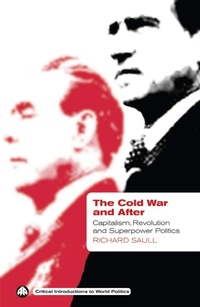
The Cold War and After
Capitalism, Revolution and Superpower Politics
1st Edition
Published on 20. January 2007
288 pages
978-1-78371-942-6 (ISBN)
Description

The Cold War is often presented as an international power struggle between the Soviet Union and the US. Richard Saull challenges this assumption. He broadens our understanding of the defining political conflict of the twentieth-century by stressing the social and ideological differences of the superpowers and how these differences conditioned their international behaviour.
Saull argues that US-Soviet antagonism was part of a wider conflict between capitalism and communism involving states and social forces other than the superpowers. The US was committed to containing revolutionary and communist movements that emerged out of uneven capitalist development.
In highlighting the socio-economic and ideological dimensions of the Cold War, Saull not only provides a richer history of the Cold War than mainstream approaches, but is also able to explain why revolutionary domestic transformations caused international crises. Tracing the origins of new resistance to American global power, Saull's book provides an ideal alternative perspective on the Cold War and its end.
Saull argues that US-Soviet antagonism was part of a wider conflict between capitalism and communism involving states and social forces other than the superpowers. The US was committed to containing revolutionary and communist movements that emerged out of uneven capitalist development.
In highlighting the socio-economic and ideological dimensions of the Cold War, Saull not only provides a richer history of the Cold War than mainstream approaches, but is also able to explain why revolutionary domestic transformations caused international crises. Tracing the origins of new resistance to American global power, Saull's book provides an ideal alternative perspective on the Cold War and its end.
Reviews / Votes
'A comprehensive reinterpretation of world politics in the 'short twentieth century' -- Mark Rupert, Professor of Political Science, Maxwell School of Citizenship & Public Affairs, Syracuse University, USA 'Richard Saull takes the long view of the rise and fall of the Cold War and into the turbulent history of the twentieth century. A must read for those looking for another way of thinking about our dark times' -- Professor Michael Cox, Department of International Relations and Director of the Cold War Studies Centre at the London School of Economics 'Demolishes standard accounts of the Cold War and its aftermath and ends with an intricate, complex approach to the political geography of the war on terror. An indispensable book' -- Professor Marilyn Young, Department of History, New York University 'Richard Saull's brilliant [book] is an indispensable account of the Cold War which challenges the standard accounts theoretically and analytically. He carries the reader along in a vigourously argued and persuasively written narrative. No other book on the Cold War comes close to Saull's striking integration of socio-economic, ideological, strategic and military perspectives' -- Professor Marilyn Young, Department of History, New York University 'Saull's survey of the theoretical debate on the Cold War is sophisticated and illuminating. It raises fundamental theoretical issues about the sociology of contemporary international politics' -- Peter Gowan, Professor of International Relations, London Metropolitan UniversityMore details
Series
Edition
1. Auflage
Language
English
Place of publication
London
United Kingdom
Target group
Professional and scholarly
File size
1,35 MB
ISBN-13
978-1-78371-942-6 (9781783719426)
Copyright in bibliographic data and cover images is held by Nielsen Book Services Limited or by the publishers or by their respective licensors: all rights reserved.
Schweitzer Classification
Other editions
Additional editions
Book
01/2007
Pluto Press
€52.50
Shipment within 10-20 days
Person
Richard Saull is Lecturer in International Politics in the Department of Politics, Queen Mary, University of London, and is the author of Rethinking Theory and History in the Cold War (Routledge, 2001) and The Cold War and After (Pluto, 2007).
Content
Acknowledgements
1. Introduction: History and Theory in the Cold War
2. The International Impact of the Bolshevik Revolution and the
Early Cold War, 1917-1945
3. The Cold War Transformed: Geopolitical Restructuring
and a New Wave of Social Revolution, 1945-49
4. The Militarization of Cold War: The Containment of the USSR 4
and the Emergence of New Revolutionary Fronts, 1950-62
5. The Final Gasp of Cold War: The Decline of US Military Superiority and the Expansion of International Communist Power, 1962-80
6. Ending the Cold War: From Militarized Counter-Revolution to the Collapse of Soviet Communism, 1980-91
7. Conclusions: Tracing the Paradoxical Ends of the Cold War and the Origins of Contemporary Conflict in World Politics
Select Bibliography
Index
1. Introduction: History and Theory in the Cold War
2. The International Impact of the Bolshevik Revolution and the
Early Cold War, 1917-1945
3. The Cold War Transformed: Geopolitical Restructuring
and a New Wave of Social Revolution, 1945-49
4. The Militarization of Cold War: The Containment of the USSR 4
and the Emergence of New Revolutionary Fronts, 1950-62
5. The Final Gasp of Cold War: The Decline of US Military Superiority and the Expansion of International Communist Power, 1962-80
6. Ending the Cold War: From Militarized Counter-Revolution to the Collapse of Soviet Communism, 1980-91
7. Conclusions: Tracing the Paradoxical Ends of the Cold War and the Origins of Contemporary Conflict in World Politics
Select Bibliography
Index
