

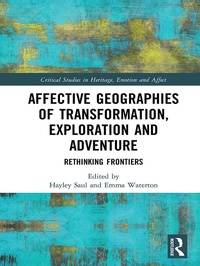
Affective Geographies of Transformation, Exploration and Adventure
Rethinking Frontiers
1st Edition
Published on 27. June 2018
222 pages
978-1-351-79044-4 (ISBN)
Description

Combining critical reflections from scholars around the globe as well as experiential records from some of the world's most tenacious explorers, this book interrogates the concept of the 'frontier' as a realm of transformation, exploration and adventure.
We discover the affective power of social, physical, spiritual and political frontiers in shaping humanity's abilities to change and become. We collectively unpack the enduring conceptualization of the frontier as a site of nation-state identity formation, violent colonization, masculine prowess and the triumph of progress. In its place, this book charts a more complex and subtle emotional geography amidst an array of frontiers: the expanding human psyche that is induced under free-diving narcosis and tales of survival on one of the most technically difficult mountains in the world, 'The Ogre'. Chapters consider solitude in the Sahara, near-death experiences in Tibetan Buddhism, the aftermath of a volcanic eruption in Bali, the Spanish Imaginary, snatched moments of sexual curiosity, and many more.
This book will be of upmost importance to researchers working on theories of affect, the Anthropocene, frontier theory and human geography. It will be vital supplementary reading for undergraduates and postgraduates on courses such as Heritage Studies, Human and Cultural Geography, Anthropology, Tourism Studies and History.
We discover the affective power of social, physical, spiritual and political frontiers in shaping humanity's abilities to change and become. We collectively unpack the enduring conceptualization of the frontier as a site of nation-state identity formation, violent colonization, masculine prowess and the triumph of progress. In its place, this book charts a more complex and subtle emotional geography amidst an array of frontiers: the expanding human psyche that is induced under free-diving narcosis and tales of survival on one of the most technically difficult mountains in the world, 'The Ogre'. Chapters consider solitude in the Sahara, near-death experiences in Tibetan Buddhism, the aftermath of a volcanic eruption in Bali, the Spanish Imaginary, snatched moments of sexual curiosity, and many more.
This book will be of upmost importance to researchers working on theories of affect, the Anthropocene, frontier theory and human geography. It will be vital supplementary reading for undergraduates and postgraduates on courses such as Heritage Studies, Human and Cultural Geography, Anthropology, Tourism Studies and History.
More details
Series
Edition
1. Auflage
Language
English
Place of publication
London
United Kingdom
Publishing group
Taylor & Francis Ltd
Target group
College/higher education
Illustrations
23 Halftones, black and white; 23 Illustrations, black and white
ISBN-13
978-1-351-79044-4 (9781351790444)
Copyright in bibliographic data and cover images is held by Nielsen Book Services Limited or by the publishers or by their respective licensors: all rights reserved.
Schweitzer Classification
Other editions
Additional editions
Hayley Saul | Emma Waterton
Affective Geographies of Transformation, Exploration and Adventure
Rethinking Frontiers
Book
08/2020
1st Edition
Routledge
€65.20
Shipment within 15-20 days
Hayley Saul | Emma Waterton
Affective Geographies of Transformation, Exploration and Adventure
Rethinking Frontiers
Book
07/2018
1st Edition
Routledge
€215.41
Shipment within 10-20 days
Persons
Hayley Saul is a lecturer at Western Sydney University, Australia, and Director of the Himalayan Exploration and Archaeological Research Team (HEART) research group. Following her Ph.D. at the University of York she undertook AHRC-funded post-doctoral research with the Early Pottery in East Asia project and was a Japan Society for the Promotion of Science post-doctoral fellow on the Japanese Archaeo-Ceramic Residue Research Strategy (JARRS) project. Her current research project, the Chaturale Museum of Cuisine, with a Nepalese community on the outskirts of Kathmandu, draws together her interests in culinary heritage and Nepalese archaeology.
Emma Waterton is Associate Professor in the Geographies of Heritage at Western Sydney University, Australia. She was a Research Councils UK (RCUK) Academic Fellow at Keele University from 2006-2010 and a DECRA Fellow at WSU from 2012-2016. Her research explores the interface between heritage, identity, memory and affect in both Australian and international contexts. She has published nineteen books, including the monographs Politics, Policy and the Discourses of Heritage in Britain (2010), Heritage, Communities and Archaeology (co-authored with Laurajane Smith; 2009) and The Semiotics of Heritage Tourism (co-authored with Steve Watson; 2014).
Emma Waterton is Associate Professor in the Geographies of Heritage at Western Sydney University, Australia. She was a Research Councils UK (RCUK) Academic Fellow at Keele University from 2006-2010 and a DECRA Fellow at WSU from 2012-2016. Her research explores the interface between heritage, identity, memory and affect in both Australian and international contexts. She has published nineteen books, including the monographs Politics, Policy and the Discourses of Heritage in Britain (2010), Heritage, Communities and Archaeology (co-authored with Laurajane Smith; 2009) and The Semiotics of Heritage Tourism (co-authored with Steve Watson; 2014).
Content
Part I: Transformation 1: Taboo Desires? James Baldwin, African Americans, Homo-Eroticism and the Frontiers of Mind/Place/Race and Sex 2: The Spanish Imaginary: A Trilogy of Frontiers 3: Under a Volcano: A Journey through Ruin and Regeneration in Bali 4: Facing a New Frontier: Defining Nature and Culture within Dinosaur Parks in Europe Part II: Exploration 5: The Ogre 6: Kelakua 7: 'Challenging Demoniacal Beings': Extinction, Materialities and the Mortal Frontier in the Journeys of Alexandra David-Neel 8: Everest and the Himalaya: The Evolution of Mountain Travel and Exploration Part III: Adventure 9: Freefalling the Water Column: Raptures and Ruptures of the Deep 10: Women Mountaineers and Affect: Fear, Play and the Unknown 11: 'Frontier Climbing' in the Wild, Wild East 12: On the Trail of the New Frontier: Doing Things the Hard Way in Australian Overland Travel
