

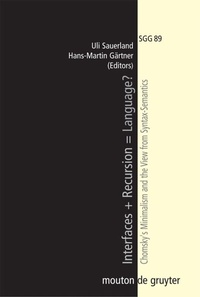
Interfaces + Recursion = Language?
Description

Human language is a phenomenon of immense richness: It provides finely nuanced means of expression that underlie the formation of culture and society; it is subject to subtle, unexpected constraints like syntactic islands and cross-over phenomena; different mutually-unintelligeable individual languages are numerous; and the descriptions of individual languages occupy thousands of pages. Recent work in linguistics, however, has tried to argue that despite all appearances to the contrary, the human biological capacity for language may be reducible to a small inventory of core cognitive competencies. The most radical version of this view has emerged from the Minimalist Program: The claim that language consists of only the ability to generate recursive structures by a computational mechanism. On this view, all other properties of language must result from the interaction at the interfaces of that mechanism and other mental systems not exclusively devoted to language. Since language could then be described as the simplest recursive system satisfying the requirements of the interfaces, one can speak of the Minimalist Equation: Interfaces + Recursion = Language.
The question whether all the richness of language can be reduced to that minimalist equation has already inspired several fruitful lines of research that led to important new results. While a full assessment of the minimalist equation will require evidence from many different areas of inquiry, this volume focuses especially on the perspective of syntax and semantics. Within the minimalist architecture, this places our concern with the core computational mechanism and the (LF-)interface where recursive structures are fed to interpretation. Specific questions that the papers address are: What kind of recursive structures can the core generator form? How can we determine what the simplest recursive system is? How can properties of language that used to be ascribed to the recursive generator be reduced to interface properties? What effects do syntactic operations have on semantic interpretation? To what extent do models of semantic interpretation support the LF-interface conditions postulated by minimalist syntax?
Reviews / Votes
"The present book makes worthwhile reading for anyone interested in foundational concerns [....]"Ángel J. Gallego & Juan Uriagereka in: Journal of Linguistics, 2008More details
Other editions
Additional editions
Persons
Content
2 - Table of Contents [Seite 7]
3 - Approaching VG from Below [Seite 9]
4 - The Subject-In-Situ Generalization Revisited [Seite 39]
5 - Towards a Relativized Concept of Cyclic Linearization [Seite 69]
6 - Strategies of Subject Extraction [Seite 123]
7 - Some Remarks on Locality Conditions and Minimalist Grammars [Seite 169]
8 - Flat Binding: Binding Without Sequences [Seite 205]
9 - The Grammar of Focus Interpretation [Seite 263]
10 - Backmatter [Seite 289]
