

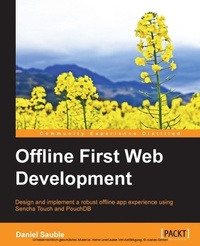
Offline First Web Development
Design and build robust offline-first apps for exceptional user experience even when an internet connection is absent
Published on 13. January 2025
316 pages
978-1-78588-566-2 (ISBN)
Description

Design and build robust offline-first apps for exceptional user experience even when an internet connection is absent
Key Features
? Understand the design principles behind a well-designed offline experience
? Create the illusion of being online when you're really offline
? Use common libraries such as Sencha Touch and PouchDB to enhance the offline experience of mobile apps
Book DescriptionWhen building mobile apps, it's easy to forget about the moments when your users lack a good Internet connection. Put your phone in airplane mode, open a few popular apps, and you'll quickly see how they handle being offline. From Twitter to Pinterest to Apple Maps, some apps might handle being offline better-but very few do it well. A poor offline experience will result in frustrated users who will abandon your app, or worse, turn to your competitor's apps Expert or novice, this book will teach you everything you need to know about designing and building a rigorous offline app experience. By putting the offline experience first, you'll have a solid foundation to build upon, avoiding the unnecessary stress and frustration of trying to retrofit offline capabilities into your finished app. This basic principle, designing for the worst-case scenario, could save you countless hours of wasted effort.What you will learn
? Design the behavior of the app, taking offline, online, and the transition between those two states into account
? Seamlessly implement the offline/online experience that you've designed using Sencha Touch and PouchDB
? Show the user what's happening under the hood with online/offline indicators and Good Mobile Messaging1
? Employ various strategies to cope with unreliable network conditions
? Help the user resolve conflicts related to the "split-brain" problem
? Choose intelligent defaults based on usage of the app
? Use point-to-point networking to partially overcome a lack of Internet connectivity
Who this book is forDo you want to make your app experience more robust and delightful? Are you eager to write apps that cater to a wider audience, not just the Silicon Valley crowd? Do you need to persuade your peers that offline-first is a worthwhile development paradigm? If your answer to all or any one of these questions is yes, then this is the book is for you. Some previous coding and command-line experience would be useful, but is not required.
Key Features
? Understand the design principles behind a well-designed offline experience
? Create the illusion of being online when you're really offline
? Use common libraries such as Sencha Touch and PouchDB to enhance the offline experience of mobile apps
Book DescriptionWhen building mobile apps, it's easy to forget about the moments when your users lack a good Internet connection. Put your phone in airplane mode, open a few popular apps, and you'll quickly see how they handle being offline. From Twitter to Pinterest to Apple Maps, some apps might handle being offline better-but very few do it well. A poor offline experience will result in frustrated users who will abandon your app, or worse, turn to your competitor's apps Expert or novice, this book will teach you everything you need to know about designing and building a rigorous offline app experience. By putting the offline experience first, you'll have a solid foundation to build upon, avoiding the unnecessary stress and frustration of trying to retrofit offline capabilities into your finished app. This basic principle, designing for the worst-case scenario, could save you countless hours of wasted effort.What you will learn
? Design the behavior of the app, taking offline, online, and the transition between those two states into account
? Seamlessly implement the offline/online experience that you've designed using Sencha Touch and PouchDB
? Show the user what's happening under the hood with online/offline indicators and Good Mobile Messaging1
? Employ various strategies to cope with unreliable network conditions
? Help the user resolve conflicts related to the "split-brain" problem
? Choose intelligent defaults based on usage of the app
? Use point-to-point networking to partially overcome a lack of Internet connectivity
Who this book is forDo you want to make your app experience more robust and delightful? Are you eager to write apps that cater to a wider audience, not just the Silicon Valley crowd? Do you need to persuade your peers that offline-first is a worthwhile development paradigm? If your answer to all or any one of these questions is yes, then this is the book is for you. Some previous coding and command-line experience would be useful, but is not required.
More details
Edition
Digital original
Language
English
Place of publication
Birmingham
United Kingdom
Target group
Professional and scholarly
US School Grade: College Graduate Student
Edition type
Digital original
File size
2,93 MB
ISBN-13
978-1-78588-566-2 (9781785885662)
Copyright in bibliographic data and cover images is held by Nielsen Book Services Limited or by the publishers or by their respective licensors: all rights reserved.
Schweitzer Classification
Other editions
Additional editions

Daniel Sauble
Offline First Web Development
Design and build robust offline-first apps for exceptional user experience even when an internet connection is absent
Book
11/2015
Packt Publishing
€56.20
Shipment within 3-4 weeks
Person
Sauble Daniel :
Daniel Sauble is part UX designer, part developer, and part researcher. He loves enterprise software start-ups and has worked at companies, including Puppet Labs and Sonatype, on problems encompassing configuration management, repository management, and patch management. Ironically, his first foray into book authorship has nothing to do with any of these. In his off time, he runs, speaks, writes, and spends time with his family. He has learned that there is nothing more painful than the end of an ultramarathon, more nerve-wracking than your first conference talk, or more satisfying than a long writing project. One day, he may be foolish enough to start his own company, but for now is content to hone his product design skills in the midst of start-up culture. Home is the verdant landscape of the Pacific Northwest, but Daniel enjoys a bit of travel now and then. Between travel, family, work projects, and the personality of an INTJ, he doesn't have much of a social life. He has no illusions that writing a book will change this much. That said, it's an excellent conversation starter, should the need arise.
Daniel Sauble is part UX designer, part developer, and part researcher. He loves enterprise software start-ups and has worked at companies, including Puppet Labs and Sonatype, on problems encompassing configuration management, repository management, and patch management. Ironically, his first foray into book authorship has nothing to do with any of these. In his off time, he runs, speaks, writes, and spends time with his family. He has learned that there is nothing more painful than the end of an ultramarathon, more nerve-wracking than your first conference talk, or more satisfying than a long writing project. One day, he may be foolish enough to start his own company, but for now is content to hone his product design skills in the midst of start-up culture. Home is the verdant landscape of the Pacific Northwest, but Daniel enjoys a bit of travel now and then. Between travel, family, work projects, and the personality of an INTJ, he doesn't have much of a social life. He has no illusions that writing a book will change this much. That said, it's an excellent conversation starter, should the need arise.
Content
Table of Contents
The Pain of being offline
Build a todo app
Designing Online Behavior
Get Online
Be Honest About What
Be (Eventually) Consistent
Choose Good Defaults, Adjust As Needed
Networking While Offline
Testing And Measuring The Experience
Appendix: References
The Pain of being offline
Build a todo app
Designing Online Behavior
Get Online
Be Honest About What
Be (Eventually) Consistent
Choose Good Defaults, Adjust As Needed
Networking While Offline
Testing And Measuring The Experience
Appendix: References
