

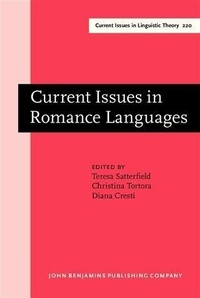
Current Issues in Romance Languages
Selected papers from the 29th Linguistic Symposium on Romance Languages (LSRL), Ann Arbor, 8-11 April 1999
1st Edition
Published on 31. May 2002
VIII, 412 pages
978-90-272-7543-1 (ISBN)
Description

This book presents an enlightening collection of papers contributing to theoretical discussions across many topics within the study of Romance Languages and Linguistics. The work originates from the 29th Linguistic Symposium on Romance Languages held in 1999 at the University of Michigan-Ann Arbor, although only a small subpart of the proceedings papers are included in this volume. The selected papers have been reworked for the current publication.
More details
Other editions
Additional editions
Teresa Satterfield | Christina Tortora | Diana Cresti
Current Issues in Romance Languages
Selected papers from the 29th Linguistic Symposium on Romance Languages (LSRL), Ann Arbor, 8-11 April 1999
Book
05/2002
John Benjamins Publishing Co
€137.80
Shipment within 10-15 days
Persons
Content
- CURRENT ISSUES IN ROMANCE LANGUAGES
- Editorial page
- Title page
- Copyright page
- Table of contents
- PREFACE
- ON BECOMING A CLITIC: THE PRENOMINAL POSSESSIVE IN ROMANCE
- 0. Introduction
- 1. Latin roots
- 2. Development from Latin
- 2.1 Old French
- 2.2 Old Spanish
- 2.3 Italian
- 3. Syntactic Representation
- 4. Conclusion
- REFERENCES
- PRIMARY STRESS IN SPANISH
- 0. Introduction
- 1. Data
- 2. Test
- 3. Analysis
- 3.1 Lexical patterns
- 3.2 Quantity sensitivity
- 3. 3 Falling diphthongs
- 3.4 A process in change
- 4. Ternary Feet
- 5. Conclusion
- REFERENCES
- SPANISH CLAUSES WITHOUT COMPLEMENTIZER
- 1. Introduction
- 2. Spanish clauses without complementizer
- 3. On the presence or absence of the CP projection
- 3.1 Topicalization
- 3.2 Wh-extraction
- 4. On the impossibility of a pre-verbal subject in complementizerless clauses
- 5. Conclusion
- REFERENCES
- ON THE NATURE OF BARE NOUNS IN HAITIAN CREOLE
- 1. Introduction
- 2. Theoretical Background
- 3. The properties of Haitian Creole bare Nouns
- 4. HC bare nouns in Chierchia's typology
- 5. Evidence for a null determiner in HC
- 6. The syntax and semantics of the Haitian Creole null D°
- REFERENCES
- TOWARDS A SYNTAX OF ADULT ROOT INFINITIVES
- 0. Introduction
- 1. Syntactic properties
- 1.1 Adverb placement
- 1.2 Left periphery
- 1.3 Clausal structure
- 2. Some differences
- 2.1 Temporal interpretation
- 2.2 Topic constructions
- 2.3 Subject properties
- 2.4 Infinitival raising
- 3. Syntactic analysis
- 4. Conclusion
- REFERENCES
- RE-EXAMINING SPANISH 'RESYLLABIFICATION'
- 1. Introduction
- 2. Data
- 3. The Status of Spanish Prefixes
- 4. A Theoretical Analysis of Spanish Syllabification
- 5. Previous Analyses and Their Shortcomings
- 6. Conclusion
- REFERENCES
- ON PREVERBAL SUBJECTS IN SPANISH
- 0. Introduction
- 1. Spanish preverbal subjects
- 2. Evidence that preverbal subjects are not in topic position
- 3. Focus/wh-phrases
- 4. Evidence that preverbal subjects are not in focus/wh- position
- 5. Towards a solution
- 6. Conclusions
- REFERENCES
- THE SEMANTICS OF SPANISH FREE RELATIVES
- 1. The morphological encoding of quantificational force
- 2. Indefinite FRs
- 3. Definite vs. universal FRs
- 4. The semantic interpretation of FRs
- REFERENCES
- SPLIT SUBJECTPRONOUN PARADIGMS: FEATURE GEOMETRY AND UNDERSPECIFICATION
- 0. Introduction
- 1. Linguistic Atlas Data
- 2. How many parameters?
- 3. Feature Geometry
- 4.Underspecification
- 4.1 The tu ~ vous split
- 5. Splitting the Geometry
- 6. Conclusion
- REFERENCES
- LOCATIVE INVERSION, PP TOPICALIZATION AND THE EPP
- 0. Introduction
- 1. The transitivity restriction in English
- 2. Agr as [+D] head in Spanish
- 3. Locative subjects vs. fronted locative PPs in Spanish
- 4. PP fronting in Italian
- 5. Conclusion
- REFERENCES
- CONTRAST MAINTENANCE AND INTERVOCALIC STOP LENITION IN SPANISH AND PORTUGUESE: WHEN IS IT ALRIGHT TO LENITE?
- 0. Introduction
- 1. Lenition Processes
- 2. The phonetic implementation of intervocalic stops in Spanish and Portuguese
- 3. Experimental design
- 4. Results
- 5. Conclusions
- 6. Summary
- REFERENCES
- EPENTHESIS VS. ELISION IN AFRO-IBERIAN LANGUAGE: A CONSTRAINT-BASED APPROACH TO CREOLE PHONOLOGY
- 0. Introduction
- 1. Coda consonants in Afro-Iberian language
- 2. Onset clusters in Afro-Iberian language
- 3. Treatment of Ibero-Romance onset clusters among African languages
- 4. A constraint-based analysis of Afro-Iberian epenthesis vs. elision
- 5. Representative analyses
- 6. The phonology of epenthesis/elision in pidginization and creolization
- REFERENCES
- CONTRASTIVE DISCOURSE MARKERS IN SPANISH: BEYOND CONTRAST
- 1. Introduction
- 2. Methodological approach
- 3. The concept of contrast
- 4. First level of analysis
- 4.1 Group #1
- 4.2 Group #2
- 4.3 Group #3
- 5. Second level of analysis
- 5.1 Group #1
- 5.2 Group #2
- 5.3 Group #3
- 6. Conclusions
- REFERENCES
- CODA OBSTRUENTS AND LOCAL CONSTRAINT CONJUNCTION IN NORTH-CENTRAL PENINSULAR SPANISH
- 0. Introduction
- 1. Coda obstruents in north-central Peninsular Spanish
- 2. Local conjunction
- 3. A constraint-based analysis
- 4. Conclusion
- REFERENCES
- BARE NOUNS AND THE MORPHOSYNTAX OF NUMBER
- 1. Introduction
- 1.1 The Nominal Mapping Parameter
- 1.2 Argumentai Bare NPs and the singular/plural asymmetry
- 1.3 Bare nouns and the predicate/argument asymmetry
- 2. Deriving the variation: the morphosyntax of number
- 2.1 The Free Agr Parameter
- 2.2 Applying free Agr to NP
- 2.3 Bare predicates and lack of number
- 2.4 Semantic number effects
- 3. Bare arguments and lack of number
- 3.1 Bare NP arguments in Brazilian Portuguese
- 3.2 Evidence for Lack of Number in Bare Singulars
- 3.3 Semantic number effects in bare arguments
- 4. Conclusion
- REFERENCES
- NON-LOGICAL IF
- 0. Introduction
- 1. Empirical Domain
- 1.1 Conditional interpretation
- 1.2 Syntactic status
- 2. Proposal
- 2.1 Mapping onto quantificational structures
- 2.2 A-Quantifiers
- 2.3 D-Quantifiers
- 3. The Role of Factivity
- 4. Conclusions
- REFERENCES
- SELECTING ATOMIC CELLS FROM TEMPORAL DOMAINS: FIXING PARAMETERS IN ROMANCE
- 1. Introduction
- 2. The syntactic analysis
- 3. The mechanism
- 3.1 Something about nouns
- 3.2 Applying the mechanism to the PIC, the PR and the GC
- 4. Some consequences
- 4.1 The aspectual markers cannot operate on atoms
- 4.2 The aspectual markers operate on sets
- 4.3 The phonological realization of the type shifter
- 4.4 C as a type shifter vs. ordinary Cs
- 5. Analytic or synthetic
- 6. Conclusions
- REFERENCES
- NON-HOMORGANIC NASAL CLUSTERS IN NORTHERN ITALIAN DIALECTS
- 0. Introduction
- 1. Data
- 2. Analysis
- 2.1 Feature Geometry
- 2.2 Optimality Theory
- 3. Non-homorganicity: Loiano
- 4. Vowel Epenthesis/Non-Homorganicity: Vediceto
- 5. Assimilation/Consonant Epenthesis vs. Non-Homorganicity: Brisighella
- 6.Conclusions
- REFERENCES
- ROMANIAN NOMINAL STRUCTURE, PROFORMS, AND GENITIVE CASE CHECKING
- 1. Introduction
- 2. The Genitive Article as a Syntactically Complex Pronominal
- 3. Genitive Case-Assignment
- 4.Conclusion
- REFERENCES
- ADJECTIVAL AGREEMENT WITHIN DP WITHOUT FEATURE MOVEMENT
- 0. Introduction
- 1. Chomsky (1995)
- 2. Kayne(1994)
- 3. Predicates and attributes
- 4. Against a feature movement analysis of attributival agreement
- 5. Attributival agreement as a consequence of theta-identification
- 6. Romance versus Germanic
- 7. Attributive adjectives
- 8. Conclusion
- REFERENCES
- A CONSTRAINT-BASED ANALYSIS OF INTRASPEAKER VARIATION: VOCALIC EPENTHESIS IN VIMEU PICARD
- 1. Introduction
- 2. Epenthesis in Vimeu Picard
- 3. The Prosodic Phonology of Vimeu Picard
- 4. A Theory of Prosodic Licensing
- 5. Licensing of Consonants in Vimeu Picard
- 5.1 Direct Licensing
- 5.2 Indirect Licensing
- 6. Intraspeaker Variation
- 6.1 Variable Triggering of Epenthesis Phrase-Initially
- 6.2 Variable Triggering of Epenthesis Phrase-Medially
- 7. Variation as a Result of Competition between Epenthesis and Indirect Licensing
- 8. Conclusion
- REFERENCES
- DATA SOURCES
- ASPECT IN THE PREPOSITIONAL SYSTEM OF ROMANCE
- 1. Introduction
- 2. The dative P and Romance have and be
- 2.1 Romance Participles: the theoretical issue
- 2.2 The relevance of the prepositional content of have
- 3. Spanish: the dative preposition with accusative objects
- 4. have, be and Participles
- 5. Participial Agreement versus Clitic Doubling
- 6. Conclusion
- REFERENCES
- A UNIFIED ANALYSIS OF FRENCH AND ITALIAN ENINE
- 1. Problems for a unified analysis of en/ne-cliticization
- 2. The clitic and its double
- 2.1 Categorial types as epiphenomena
- 2.2 Deriving categorial features for en/ne
- 2.2.1 Specifying pro for category features
- 2.2.2 Attraction of pro and specification of en/ne
- 3. Unity and diversity
- 3.1 Morphological differences
- 3.2 Syntactic differences
- 3.3 Interpretative differences
- 4. Concluding remarks
- REFERENCES
- VARIATION IN SPANISH ASPIRATION AND PROSODIC BOUNDARY CONSTRAINTS
- 0. Introduction
- 1. Prosodie Word Structure
- 2. Constraints for aspiration
- 3. Constraint Ranking
- 3.1 Buenos Aires Argentinian
- 3.2 Rio Negro Argentinian and Caribbean II
- 3.3 Caribbean I
- 3 4 Implications
- 4. Comparison with alternatives
- 4.1 Rule Based Analyses
- 4.2 OT Analyses
- 5. Conclusions
- REFERENCES
- GENERAL INDEX
