

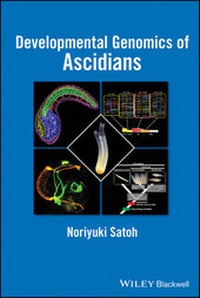
Developmental Genomics of Ascidians
Description

Reviews / Votes
"In his preface, the author describes Developmental Genomics of Ascidians as his "last and largest contribution to ascidian developmental biology" (p. xi). This book is indeed a major accomplishment and a great resource for the community" (The Quarterly Review of Biology 2016)More details
Other editions
Additional editions
Person
Dr. Noriyuki Satoh has conducted research on ascidians at the Kyoto University Department of Zoology for more than 35 years. In April 2008, he launched the Marine Genomics Unit at OIST and extended his studies from ascidians to other marine animals, such as the corals that abound in the marine environment around Okinawa.
On February 2, 2011, he was awarded the title of professor emeritus by Hirosaki University in Aomori Prefecture, Japan. The university recognized Dr. Satoh as one of Japan's leading biologists, who received the Zoological Society of Japan Prize in 1991, the Inoue Prize for Science in 1992, Toray Science and Technology Prize and the Japanese Society of Evolutionary Studies Prize in 1994, and the Medal with Purple Ribbon awarded by the Japanese government in 2006. In 2005, Dr. Satoh became the first Japanese scientist to receive the Alexander Kowalevsky medal, which is awarded to scientists for achievements in comparative and evolutionary embryology. In 2010, he also became the first Japanese scientist to receive the Edwin Grant Conklin Medal by the American Society for Developmental Biology (SDB). The SDB gives the award yearly to recognize a developmental biologist who has made and is continuing to make extraordinary research contributions to the field, and who is also an excellent mentor in training the next generation of outstanding scientists.
By awarding the title, Hirosaki University also recognized Dr. Satoh's other various distinguished contributions, including the establishment of the Asunaro Prize in the Faculty of Agriculture and Life Science in 2008. Dr. Satoh founded the prize to enhance the university's research level in life science, and to nurture young scientists by recognizing students who have produced outstanding research results.
Content
Chapter 1
A Brief Introduction to Ascidians
1.1 What are Ascidians?
Ascidians, or sea squirts, are sessile marine invertebrate chordates ubiquitous throughout the world. The name “ascidian” originated from the Greek word askidion, meaning a small bag or vase. The class comprises approximately 2900 extant species,1 most of which live in shallow water. Ascidians usually attach to rocks, shells, and pilings, and live by filtering tiny plankton and other nutrients from seawater. The entire adult body is invested with a thick covering, the tunic (or test), from which the subphylum name, Tunicata is derived. A major constituent of the tunic is tunicin, a type of cellulose. Tunicates or urochordates are the only animals that can synthesize cellulose independently.
An individual ascidian has two openings, an incurrent oral (branchial) siphon and an outcurrent atrial siphon (Fig. 1.1a, b). The mouth behind the oral siphon leads to a large pharynx, or branchial basket—a chamber perforated by dorsoventral rows of numerous gill slits called stigmata (Fig. 1.1b). Along the ventral margin of the branchial basket is a specialized organ called the endostyle, which secretes large quantities of mucus used for capturing food particles (Fig. 1.1b). The endostyle contains iodine, and therefore this organ has an evolutionary relationship with the vertebrate thyroid gland. The digestive tract leads to a stomach at the bottom of the U-shaped digestive loop, followed by an intestine that terminates at the anus, which opens into the atrial cavity (Fig. 1.1b).
Figure 1.1 The tunicate ascidian Ciona intestinalis. (a) An adult with oral (incurrent) and atrial (outcurrent) siphons. The white duct is the sperm duct and the orange duct paralleling it is the egg duct. (b) Diagram illustrating adult organs and tissues. (c–l) Embryogenesis. Embryos were dechorionated to clearly show their outer morphology. (c) Fertilized egg, (d) 2-cell embryo, (e) 4-cell embryo, (f) 16-cell embryo, (g) 32-cell embryo, (h) gastrula (∼150 cells), (i, j) neurulae, (k, l) tailbud embryos, and (m) tadpole larva. (n) Diagram illustrating larval organs and tissues. (o) A juvenile a few days after metamorphosis, with internal structures labeled.
The adult nervous system consists of a single cerebral ganglion lying between the two siphons and an adjacent neural gland (Fig. 1.1b). Several nerves elongate from the ganglion to various parts of the body, including the muscles, pharynx, viscera, gonad, and siphons (cover picture). By contrast, the neural gland leads through a duct to the pharynx, just behind the mouth. The open circulatory system is well developed and consists of a short, tubular heart and numerous blood vessels. The heart lies posteroventrally in the body near the stomach and behind the pharyngeal basket (Fig. 1.1b, o). The heartbeat and the direction of blood flow reverse periodically. The circulatory system contains several different types of blood cells or coelomic cells with specialized functions.
1.1.1 Taxonomy
Ascidians belong to the class Ascidiacea, subphylum Urochordata (Tunicata), and phylum Chordata (Fig. 1.2). Animals with a notochord or a rod-shaped axial organ and a dorsal hollow neural tube are classified into the phylum Chordata. Chordata consists of three subphyla, Cephalochordata, Urochordata, and Vertebrata (Fig. 1.2). Cephalochordates (lancelets or amphioxus) are headless (acraniates), and have well-segmented somites and a notochord running throughout the body. Urochordates contain a notochord in the tail during at least the larval stage, and have a well-organized larval central nervous system. Vertebrates or craniates develop vertebrae from the notochord, along with jaws, heads, and an adaptive immune system. Chordates were present on the Earth at least ∼520 million years (MYR) ago, as demonstrated by recent fossil records of Chenjan Fauna. The origin and evolution of chordates have been debated for more than 150 years. Recent molecular phylogeny and comparative genomics studies demonstrated that cephalochordates represent the most ancient and extant chordate lineage. Furthermore, urochordates and vertebrates were shown to form a sister group (Olfactants), indicating that urochordates are the invertebrates most closely related to vertebrates (Fig. 1.2).
Figure 1.2 A phylogenetic tree indicating the position of urochordates (tunicates) among deuterostomes and chordates. Several ascidians species (underlined) are listed in the corresponding phylogenetic positions. The phylogenetic relationship of Appendicularia (larvaceans) still remains to be determined (bold dotted lines).
The subphylum Urochordata or Tunicata is composed of three classes, Ascidiacea (ascidians), Thaliacea (salps), and Appendicularia (larvaceans) (Fig. 1.2). The evolutionary relationships among tunicates remain controversial because of their great variety of life cycles and rapid evolution. The class Ascidiacea comprises two subclasses, Enterogona and Pleurogona (Fig. 1.2). The Enterogona ascidians are characterized by the location of the gonad (a single ovary and a single testis; ascidians usually are hermaphrodites) within the gut loop or posterior to it. This subclass consists of Aplousobranchia (Clavelinai and others) and Phlebobranchia (Ciona intestinalis, Phallusia mammillata, and others) (Fig. 1.2). On the other hand, the Pleurogona ascidians, which have a pair of gonads inside the right and left body walls, include Molgulidae (Molgula oculuta and others), Styelidae (Styela plicata and others), and Pyuridae (Halocynthia roretzi, Botryllus schlosseri, and others) (Fig. 1.2). Some of these organisms live as individuals (solitary or simple ascidians), while others form colonies (colonial or compound ascidians). The colonial life style evolved several times independently in the orders.
1.1.2 Reproduction
Ascidians are hermaphrodites (Fig. 1.1a, b). Sexual reproduction is common in solitary ascidians, whereas colonial ascidians reproduce both sexually and asexually by budding. Colonial ascidians also have an extensive capacity for regeneration. Stereotypic embryogenesis of solitary ascidians proceeds rapidly (Fig. 1.1c–l). Bilaterally symmetrical cleavage takes place according to a highly determinate pattern (Fig. 1.1d–g). Gastrulation begins around the 120-cell stage and is followed by neurulation (Fig. 1.1h–j). Then, tailbud embryos are formed (Fig. 1.1k, l), and finally a conventional tadpole-type larva hatches from the chorion (Fig. 1.1m), usually within 12 h to a few days after fertilization. The ascidian tadpole consists of only ∼2600 cells, but has distinct tissues and organs, including the epidermis, central and peripheral nervous systems, endoderm (which gives rise to the adult digestive tract and its associated organs), notochord, muscle, and mesenchyme (from which several adult mesodermal organs are derived) (Fig. 1.1n). These organs represent the major components of any vertebrate body, including our own, and the mechanisms underlying their formation are the focal point of this book.
The ascidian tadpole larva differs from the amphibian tadpole in that it has no mouth. The nonfeeding larva swims for a few hours or more as solitary ascidians, and then metamorphoses into a juvenile (Fig. 1.1o). The growth of the juvenile is also rapid. For example, eggs of the most common and cosmopolitan species, C. intestinalis,2 give rise to adults with reproductive capacity within 2–3 months, or earlier in warm waters, suggesting that under optimal conditions Ciona can pass through several generations within a year. Closed-system inland culture conditions have been established for the maintenance of these organisms for laboratory study. In Japan, C. intestinalis are provided to researchers all year round through support of the National BioResource Project (NBRP).
1.2 A Brief History of Research on Ascidian Embryos
Ascidians have been recognized since the ancient Greeks, and were described by Aristotle. Because of their soft bodies, they were long classified as a group of mollusks by Carl Linnaeus. At that time, there was a noticeable gap between vertebrates and invertebrates. After the publication of Charles Darwin's “On the Origin of Species by Means of Natural Selection” in 1859, evolutionary theories came into vogue to describe relationships among animals. In 1886, the great Russian embryologist Alexander Kowalevsky (Fig. 1.3a) discovered that the ascidian larva has the general appearance of a simplified vertebrate tadpole (Fig. 1.3b). This observation, together with his other finding that amphioxus possess a notochord, positioned the ascidians and amphioxus as a new group, the protochordates, which were intermediate between invertebrates and vertebrates—filling the evolutionary gap. More recently, it seems that the long debate on the origin and evolution of chordates has reached a consensus opinion that cephalochordates are basal among chordates, while urochordate ascidians are a sister group to the vertebrates.
Figure 1.3 Three great pioneers of ascidian embryology with their descriptions of ascidian embryos. (a) Alexander Kowalevsky and (b) his illustrations of ascidian embryos. (c) Lawrent Chabry and (d) his sketches depicting the manipulation of Ascidiella eggs. (e) Edwin G. Conklin and (f) his drawings of ascidian embryos.
(Photographs were obtained from...
