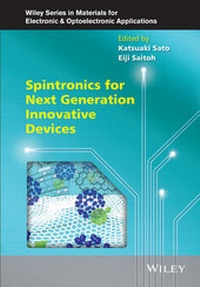
Spintronics for Next Generation Innovative Devices
Description
Alles über E-Books | Antworten auf Fragen rund um E-Books, Kopierschutz und Dateiformate finden Sie in unserem Info- & Hilfebereich.
All prices
More details
Other editions
Additional editions

Persons
Katsuaki Sato is Professor Emeritus at Tokyo University of Agriculture and Technology (TUAT), Japan and a Program Officer of the PRESTO Project "Next-Generation Innovative Devices", Japan Science and Technology Agency. After graduating from Kyoto University in 1964, he was affiliated with the Broadcasting Science Research Laboratories of NHK (Japan Broadcasting Corporation) until 1984. He received his degree of Dr. Eng., from Kyoto University in 1978, then got a professorship position at TUAT in 1984. He assumed Vice President of TUAT in 2005, and retired in 2007. His main research topics are applied solid state physics including magneto-optics, magnetic semiconductors, ternary and multinary semiconductors and superconducting devices. He is a Fellow of the Japan Society of Applied Physics.
Eiji Saitoh is a Professor at the Institute for Materials Research, Tohoku University, Japan. He received his PhD degree from Tokyo University. He was an Assistant Professor and a Lecturer at Keio University. He has been awarded the Sir Martin Wood Prize in 2008, IUPAP Young Scientist Award in 2009, and Japan Academy Medal in 2011. His main research topics are experimental solid state physics including spintronics, electronic properties in strongly correlated electron systems and nanoscale magnetism.

Content
System requirements
File format: PDF
Copy-Protection: Adobe-DRM (Digital Rights Management)
System requirements:
- Computer (Windows; MacOS X; Linux): Install the free reader Adobe Digital Editions prior to download (see eBook Help).
- Tablet/smartphone (Android; iOS): Install the free app Adobe Digital Editions or the app PocketBook before downloading (see eBook Help).
- E-reader: Bookeen, Kobo, Pocketbook, Sony, Tolino and many more (only limited: Kindle).
The file format PDF always displays a book page identically on any hardware. This makes PDF suitable for complex layouts such as those used in textbooks and reference books (images, tables, columns, footnotes). Unfortunately, on the small screens of e-readers or smartphones, PDFs are rather annoying, requiring too much scrolling.
This eBook uses Adobe-DRM, a „hard” copy protection. If the necessary requirements are not met, unfortunately you will not be able to open the eBook. You will therefore need to prepare your reading hardware before downloading.
Please note: We strongly recommend that you authorise using your personal Adobe ID after installation of any reading software.
For more information, see our eBook Help page.
File format: ePUB
Copy protection: Adobe-DRM (Digital Rights Management)
System requirements:
- Computer (Windows; MacOS X; Linux): Install the free reader Adobe Digital Editions prior to download (see eBook Help).
- Tablet/smartphone (Android; iOS): Install the free app Adobe Digital Editions or the app PocketBook before downloading (see eBook Help).
- E-reader: Bookeen, Kobo, Pocketbook, Sony, Tolino and many more (not Kindle).
The file format ePub works well for novels and non-fiction books – i.e., „flowing” text without complex layout. On an e-reader or smartphone, line and page breaks automatically adjust to fit the small displays.
This eBook uses Adobe-DRM, a „hard” copy protection. If the necessary requirements are not met, unfortunately you will not be able to open the eBook. You will therefore need to prepare your reading hardware before downloading.
Please note: We strongly recommend that you authorise using your personal Adobe ID after installation of any reading software.
For more information, see our ebook Help page.