

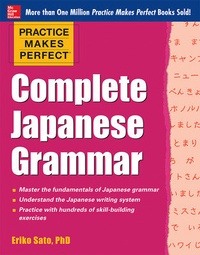
Practice Makes Perfect Complete Japanese Grammar (EBOOK)
1st Edition
Published on 16. April 2014
343 pages
978-0-07-180836-1 (ISBN)
Description

Strengthen your Japanese grammar skills with practice, practice, practice!From particles to pronouns, this comprehensive workbook covers all those aspects of Japanese grammar that you might find a little intimidating or hard to remember. Practice Makes Perfect: Complete Japanese Grammar introduces the fundamentals of the language and then progresses to show how these building blocks connect to create complex sentences. Each chapter features clear explanations, numerous realistic examples, and dozens of engaging exercises in a variety of formats for whatever your learning style.You will, of course, get plenty of practice, practice, practice using your new skills in context. With its winning formula for getting a handle on Japanese grammar right away, Practice Makes Perfect: Complete Japanese Grammar is your ultimate resource for mastering the grammar of this complex language.Practice Makes Perfect: Complete Japanese Grammar includes: - Everyday Japanese presented in both Japanese characters (hiragana, katakana, and kanji) and phonetic translation
- A comprehensive introduction to Japanese grammar
- High-frequency vocabulary presented in context
- A clear pronunciation guide
- Hundreds of exercises in a variety of formats
- A comprehensive introduction to Japanese grammar
- High-frequency vocabulary presented in context
- A clear pronunciation guide
- Hundreds of exercises in a variety of formats
More details
Other editions
Additional editions
Book
12/2013
McGraw-Hill Professional
€18.59
Article exhausted; check for reprint
Content
- Cover
- Title Page
- Copyright Page
- Contents
- Introduction
- 1: Introducing Japanese sounds, word order, and writing systems
- Basic sounds
- Pitch
- Basic hiragana
- Katakana
- Kanji
- Basic word order and particles
- Speech styles
- 2: Nouns
- Proper nouns
- Respectful titles
- Common nouns
- Compound nouns
- Demonstrative pronouns
- Personal pronouns
- The particle ? no
- Kinship terms
- 3: Numbers
- Bare numbers based on the Chinese system
- The native Japanese number system
- Class counters
- Ordinal counters
- Expressing time
- Expressing months and days
- Unit counters
- . . . ? me
- 4: Basic verb forms
- Dictionary form
- Masu form
- Nai form
- Stem form
- Ru verbs and u verbs
- Irregular verbs
- Conjugation patterns
- Te form
- Ta form
- Nakatta form
- Conjugating verbs in the plain form
- Conjugating verbs in the polite form
- Progressive form
- Potential form
- Conjugating the copular verb ?? desu
- 5: Verb types
- ?? suru verbs
- Existential verbs ?? aru and ?? iru
- Transitive and intransitive verbs
- Inherently potential verbs
- Verbs with hidden become/get
- Verbs of giving and receiving
- 6: Auxiliaries that follow verbs in the te form
- . ? te + ??? ageru, etc. (helpfulness)
- . ? te + ?? iru (progressive, resulting, and habitual states)
- . ? te + ??? shimau (completion)
- . ? te + ?? oku (preparation)
- . ? te + ?? miru (trial)
- . ? te + ?? iku and ?? kuru (progress)
- . ? te + ?? aru (resulting state)
- . ? te + ??? hoshii (desire)
- 7: Particles
- ? o (direct object)
- ? ga (subject)
- ? ni (at, in, to)
- ? de (at, by, in, with)
- ? e (toward, to)
- ?? kara (from)
- ?? made (until)
- ? no (of, 's)
- ? to, ? ya, and ? ka (listing nouns)
- ? wa (topic)
- ? mo (addition)
- ??? bakari (nothing but .)
- ?? shika (only)
- ?? dake (just/only)
- ?? demo (even)
- 8: Adjectives and adverbs
- Adjective types
- Basic adjective forms
- Multiple subjects
- Te forms of adjectives
- Degree adverbs
- Frequency adverbs
- Adverbs derived from adjectives
- Adverb + ?? suru/?? naru (change)
- Adverbs made from onomatopoeia and mimetic words
- Comparing two items
- Equivalent-degree comparison
- Comparing activities
- Superlative comparison
- 9: Sentence types
- Statements
- Questions
- Sentences with indefinite pronouns
- Enriching statements
- Suggestions, requests, and commands
- 10: Complex words and phrases
- . . . ??? sugiru, etc. (verbal compound)
- . . . ??? yasui / . . . ??? nikui (toughness)
- . . . ?? tai (to want to do . . . )
- . . . ?? garu (to show the signs of . . . )
- Noun + ??? rashii (typical )
- Noun + ???? no yo na (simile)
- Noun + ???? mitai na (simile)
- Stem form + ??? so na (appearance)
- Volitional form + ??? to omou (intention)
- Volitional form + ??? to suru (attempt)
- . . . ??? + ?? /?? yo ni suru/naru (change)
- . . . ??? + ?? /?? koto ni + suru/naru (decision)
- . . . ?????? koto ga dekiru (potential)
- . . . ????? koto ga aru (experience)
- 11: Clauses
- . . . ? to and . . . ? ka (verb complement clause)
- . . . ?? mae ni (adverbial clause before . . . ) and . . . ?? ato ni (adverbial clause after . . .)
- . . . ? aida ni (adverbial clause during/while . . .)
- . . . ??? uchi ni (adverbial clause during/while/before . . .)
- . . . ??? toki ni (adverbial clause at the time when . . .)
- . . . ??? nagara (adverbial clause simultaneously)
- . . . ?? kara and . . . ?? node (adverbial clause because . . . )
- . . . ? ga and . . . ?? noni (adverbial clause although . . . )
- Noun modifier clauses (which/that . . .)
- 12: Conjunctions
- Listing nouns with ? to (exhaustive), ? ya (partial), ? ka (disjunctive), and ? mo (addition)
- Listing verbs with te forms
- Listing adjectives with te forms
- Listing verbs and adjectives randomly using the tari form
- Listing verbs and adjectives emphatically using ? shi
- Sentence conjunctions
- 13: Conditionals
- . . . ?? tara (whenever, when, if)
- . . . ? ba (whenever, when, if )
- . . . ? to (whenever, when)
- . . . ?? nara (if it is the case that . . .)
- . . . ?? te mo (even if/though, no matter . . . )
- Permission and prohibition
- Obligation and discretion
- 14: Passives and causatives
- Passive verbs
- Direct passive
- Indirect passive
- Causative verbs
- Make-causative and let-causative
- Causative with auxiliary verbs of giving and receiving
- Causative passive
- 15: Honorifics
- Special honorific verbs
- . . . ??? (r)areru (respectful form of verbs)
- ? + stem + ??? o . . . ni naru (respectful)
- ? + stem + ?? o . . . suru (humble)
- Asking for permission very politely
- Making a request very politely
- Using ? o and ? go before a noun
- Family terms
- Honorific forms for adjectives
- Honorific/polite question words
- Appendix A: Basic verb forms
- Appendix B: Basic sentence predicate forms
- Japanese-English glossary
- English-Japanese glossary
- Answer key
