

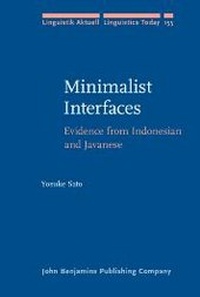
Minimalist Interfaces
Evidence from Indonesian and Javanese
1st Edition
Published on 17. June 2010
XIII, 159 pages
978-90-272-8829-5 (ISBN)
Description

This monograph explores the interface between syntax and its related components through in-depth investigation of a sizable portion of the grammar of Indonesian and Javanese. It can be read on two levels. Theoretically, it proposes the minimalist interface thesis that syntax-external linguistic interfaces are endowed with domain-specific operations (insertion, deletion, and type shifting) to legitimize an otherwise non-convergent result of the syntactic derivation for phonological and semantic interpretation. Empirically, the monograph substantiates this thesis from detailed analyses of four phenomena (reduplication, active voice morphology, P-stranding under sluicing, and nominal denotation). The study not only contains a wealth of new insights into comparative syntax from the perspective of Indonesian and Javanese, but also necessitates serious reconsideration of the common view of the interfaces as merely ornamental components of natural language grammar. The monograph should appeal to syntacticians, linguists interested in linguistic interfaces and the organization of grammar, and researchers on Austronesian languages.
More details
Other editions
Additional editions
Book
06/2010
John Benjamins Publishing Co
€100.70
Shipment within 10-15 days
Person
Content
- Minimalist Interfaces
- Editorial page
- Title page
- LCC data
- Dedication page
- Table of contents
- Acknowledgements
- List of Abbreviations
- Minimalist interfaces
- 1. Minimalist interfaces
- 2. Overview of the book
- Reduplication asymmetries at the syntax-lexicon interface
- 1. Introduction
- 2. Lexicalist vs. non-lexicalist theories
- 2.1 Lexicalist theories
- 2.2 Non-lexicalist theories
- 3. Asymmetries between nominal and verbal reduplication in Indonesian
- 4. Reduplication Asymmetries in Indonesian and Lexicalist Theories
- 4.1 Chomsky's (1970) Weak Lexicalist Hypothesis
- 4.2 Anderson's (1982, 1992) weak lexicalist theory
- 4.3 Kiparsky's (1982a, b, c, 1985)/Mohanan's (1986) lexical phonology
- 4.4 Di Sciullo and Williams' (1987)/Williams' (2007) strong lexicalist theory
- 4.5 The lexicon as the source of the ordering paradox
- 5. A distributed morphology approach to reduplication asymmetries in Indonesian
- 5.1 Verbal reduplication
- 5.2 Nominal reduplication
- 6. Conclusions
- Successive cyclicity at the syntax-morphology interface
- 1. Introduction
- 2. Active voice morphology in Standard Indonesian
- 3. Active voice deletion in Kendal Javanese
- 4. Locality and "deletion" at the syntax-morphology interface
- 4.1 meN- deletion" as failure of vocabulary insertion
- 4.2 Unaccusativity in Standard Indonesian and the phasehood of little v
- 5. Other alternative analyses within Phase Theory
- 5.1 Cole et al.'s (2008) Case-Agreement analysis
- 5.2 Aldridge's (2008) antipassive analysis
- 6. Conclusions
- P-stranding under sluicing at the syntax-phonology interface
- 1. Introduction
- 2. Merchant's (2001) theory of sluicing, the P-stranding generalization and Indonesian
- 3. The internal syntax of P-stranding sluices in Indonesian
- 3.1 Is P-less sluicing in Indonesian pseudosluicing?
- 3.1.1 Prosody
- 3.1.2 Exhaustivity diagnostics
- 3.1.3 The distribution of the question particle -kah in Indonesian
- 3.2 Indonesian-internal evidence for P-less sluicing ? pseudosluicing
- 3.2.1 Surface anaphora vs. deep anaphora
- 3.2.2 Sloppy identity and c-command
- 3.2.3 Sluicing with multiple potential antecedents
- 3.3 Other potential alternative treatments of P-stranding in Indonesian
- 3.3.1 Resumption (Wang 2006)
- 3.3.2 P-drop (Stjepanovic 2008)
- 4. P-stranding under sluicing in Indonesian and repair by ellipsis
- 4.1 Wh-feature percolation as feature pumping
- 4.2 Failure of percolation and repair by ellipsis
- 4.3 New predictions: P-stranding under pseudogapping in Indonesian
- 5. P-stranding under sluicing across languages: A case study with French and German
- 5.1 D-P coalescence, D-to-P incorporation, and the syntactic head movement
- 5.2 "Irreparable" computational violations
- 6. Conclusions
- The structure and denotation of bare nominals at the syntax-semantics interface
- 1. Introduction
- 2. Chierchia's (1998a, b) nominal mapping parameter
- 3. The denotation and morphosyntax of bare nominals in Indonesian and Javanese
- 3.1 Bare nominals in Indonesian
- 3.2 Bare nominals in Javanese
- 4. A relativized parametric theory of nominal denotation: From Indonesia to the world
- 4.1 A relativized parametric theory of nominal denotation and morphosyntax
- 4.2 Deriving the denotation and morphosyntax of bare nominals across languages
- 5. Conclusions
- Conclusion
- 1. Summary of the chapters
- 2. Minimalist interfaces: Their nature, origin and evolution
- 3. Questions for future research and conjectures about linguistic interfaces
- References
- Languages index
- Subjects index
- The series Linguistik Aktuell/Linguistics Today
