

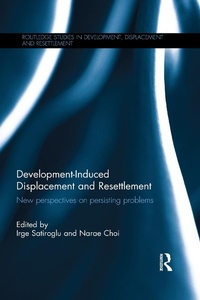
Development-Induced Displacement and Resettlement
New perspectives on persisting problems
Published on 10. April 2015
262 pages
978-1-317-64242-8 (ISBN)
Description

Every year millions of people are displaced from their homes, livelihoods and communities due to land-based development projects. There is no limit to what can be called a 'development project'. They can range from small-scale infrastructure or mining projects to mega hydropower plants; can be public or private, well-planned or rushed into. Knowledge of development-induced displacement and resettlement (DIDR) remains limited even after decades of experience and research. Many questions are yet unanswered: What is "success" in resettlement? Is development without displacement possible or can resettlement be developmental? Is there a global safeguard policy or do we need an international right 'not to be displaced'?
This book revisits what we think we know about DIDR. Starting with case studies that challenge some of the most widespread preconceptions, it goes on to discuss the ethical aspects of DIDR. The book assesses the current laws, policies and rights governing the sector, and provides a glimpse of how the displaced people defend themselves in the absence of effective governance and safeguard mechanisms.
This book is a valuable resource for students and researchers in development studies, population and development, and migration and development.
This book revisits what we think we know about DIDR. Starting with case studies that challenge some of the most widespread preconceptions, it goes on to discuss the ethical aspects of DIDR. The book assesses the current laws, policies and rights governing the sector, and provides a glimpse of how the displaced people defend themselves in the absence of effective governance and safeguard mechanisms.
This book is a valuable resource for students and researchers in development studies, population and development, and migration and development.
Reviews / Votes
"Theory meets experience in this volume of essays. It is about what actually happens to people and to communities when they become the development-induced-displaced. In querying the (im)probabilities of rehabilitation, it produces evidence from the ground that demands to be acknowledged while thinking about development, risk and loss." -Usha Ramanathan, research fellow at the Centre for the Study of Developing Societies."Forced population displacement and resettlement is among today's most complex and controversial development problems globally. Despite advanced planning, displacement is virtually always a mess and a breeding ground for unanticipated consequences and impoverishment risks. This book's co-authors invite the readers to a candid exploration of many questions seldom asked about development: Is success possible in recovery post-displacement? Are there adequate national and global safeguards against impoverishing the resettlers? Can powerless displaced people be empowered to stand up for their human rights? Yet despite big hurdles the book contends that realistic and innovative solutions to the difficult - but not intractable - problems of displacement and resettlement do exist. But how can enough political will be mobilised for applying the known solutions? Professors, students and development practitioners, specialists in building the infrastructures that require displacement, sociologists and lawyers, economists, political scientists, and philosophers, can understand better the contradictions of the world we live in due to the perspectives, research, and findings reported in this book." -Prof. Michael M. Cernea, NR Senior Fellow, Brookings Institution, Washington, DC.
"This aptly titled volume of edited essays provides state of the art analysis of current thinking and case study evidence on the continuing challenges of development-induced displacement and resettlement. Deploying an innovative cross cutting structure that covers assumptions, ethics, policy, and voice and power, the book will be of immense value to academics, policy makers and activists alike." - Prof. Roger Zetter, Professor Emeritus in Refugee Studies, University of Oxford
"Development-induced resettlement is one of the most important issues associated with large scale infrastructure construction, urbanization and industrialization globally. The impoverishment risks caused by resettlement have been recognized by affected people, international organizations, governments, developers, consultants and civil society. Successful resettlement is a result of multiple factors such as policy, compensation, patterns of rehabilitation and reconstruction, planning, databases and management. China has the largest scale resettlement population in the word. Since the 1980s a number of excellent practices have been created but have received little attention. This book presents an excellent opportunity to examine both the successes and the lessons learnt from development-induced resettlement and will be an excellent asset for all researchers, policy-makers and practitioners from China and all over the world." - Prof. SHI Guoqing, Professor and Director of National Research Center for Resettlement, Hohai University, China
More details
Series
Language
English
Place of publication
London
United Kingdom
Publishing group
Taylor & Francis Ltd
Target group
College/higher education
Product notice
Reflowable
Illustrations
9 s/w Abbildungen, 10 s/w Tabellen, 7 s/w Photographien bzw. Rasterbilder, 2 s/w Zeichnungen
10 Tables, black and white; 2 Line drawings, black and white; 7 Halftones, black and white; 9 Illustrations, black and white
File size
5,55 MB
ISBN-13
978-1-317-64242-8 (9781317642428)
Copyright in bibliographic data and cover images is held by Nielsen Book Services Limited or by the publishers or by their respective licensors: all rights reserved.
Schweitzer Classification
Other editions
Additional editions
Irge Satiroglu | Narae Choi
Development-Induced Displacement and Resettlement
New perspectives on persisting problems
Book
01/2017
1st Edition
Routledge
€83.70
Shipment within 10-20 days
Irge Satiroglu | Narae Choi
Development-Induced Displacement and Resettlement
New perspectives on persisting problems
Book
04/2015
1st Edition
Routledge
€231.80
Shipment within 10-20 days
Persons
Irge Satiroglu is an independent social impact assessment and resettlement specialist. She joined the University of Oxford as a visiting research fellow in 2011-2012.
Narae Choi is a Social Development Specialist at the World Bank, currently supporting the Indonesian government's national program of community empowerment.
Narae Choi is a Social Development Specialist at the World Bank, currently supporting the Indonesian government's national program of community empowerment.
Content
Foreword Introduction Part 1: Challenges to the assumptions of DIDR 1. Looking for a 'successful' resettlement: Is Tahtali Dam the right address? 2. Reinvigorating a critical discussion on 'development' in development-induced displacement and resettlement: A study of non-displacement impacts 3. Risk information sharing: An empirical study on risk perception and depressive symptoms among those displaced by the Three Gorges Project 4. "They are not family, they just live with us!" Exploring the practical, social and ethical implications of defining the household Part 2: Ethics of DIDR 5. Spatial- and complexity-based perspectives on the ethics of development-induced displacement and resettlement 6. The centrality of empowerment in DIDR: An ethical perspective 7. Resettlement projects as spaces of exception Part 3: International and national policies 8. Is there a global safeguard for development displacement? 9. Protection against development-induced displacement in international law 10. Destroying a way of life: The Forest Rights Act of India and land dispossession of indigenous peoples 11. Patterns in arbitrariness: Resettlement experiences of the unrecognized urban poor in Chennai Part 4: Voice and power of people 12. Forging new avenues for rights-claiming: Community responses to development-induced displacement in resettlement in rural Myanmar 13. Speaking through the silence: The role of literature in DIDR activism 14. Activists in urban forced resettlement Conclusion
