

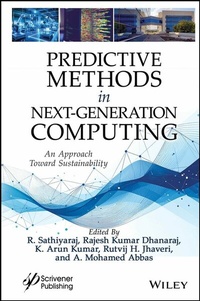
Predictive Methods in Next-Generation Computing
An Approach Toward Sustainability
1st Edition
Published on 26. February 2026
341 pages
978-1-394-24881-0 (ISBN)
Description

An Approach Toward Sustainability
More details
Other editions
Additional editions
Sathiyaraj R. | Rajesh Kumar Dhanaraj | K. Arun Kumar
Predictive Methods in Next-Generation Computing
An Approach Toward Sustainability
Book
approx. 02/2026
1st Edition
Wiley-Scrivener
€180.50
Not yet published
Content
- Cover
- Series Page
- Title Page
- Copyright Page
- Contents
- Preface
- Chapter 1 Introduction to Intelligent Computational Technologies
- 1.1 Introduction
- 1.2 Literature Survey
- 1.3 Methodology
- 1.4 Simulation Metrics
- 1.4.1 Identification of E-Governance Adoption and Assessment Factors
- 1.4.2 Sample Data Collection Using Questionnaire
- 1.4.3 Respondent Details
- 1.4.4 Fuzzy Conjoint Model
- 1.4.4.1 Calculation of Weight for Each Respondent
- 1.4.4.2 Calculating the Similarity Degree
- 1.5 Computation
- 1.5.1 Computation of Fuzzy Vector of Responses
- 1.5.2 Computation of Similarity Degree
- 1.5.3 Result Analysis
- 1.5.4 Validation
- 1.5.5 Limitations and Future Study
- 1.6 Summary
- Bibliography
- Chapter 2 Design of Smart and Sustainable Applications Using Intelligent Computational Techniques
- 2.1 Introduction
- 2.2 Background
- 2.2.1 Adoption Models and Theories
- 2.3 Methodology
- 2.3.1 Simulation Metrics
- 2.3.2 Identification of E-Governance Adoption and Assessment Factors
- 2.3.3 Sample Data Collection Using Questionnaire
- 2.3.4 Respondent Details
- 2.3.5 Fuzzy Conjoint Model
- 2.3.5.1 Calculating the Similarity Degree
- 2.4 Result Analysis
- 2.5 Conclusion
- References
- Chapter 3 Intelligent Predictive Analysis for Sustainable Global Development
- 3.1 Introduction
- 3.2 Literature Survey
- 3.2.1 Concepts of ANN
- 3.3 Proposed Work
- 3.3.1 Layout of a Neural Network
- 3.3.2 Neural Network Structure
- 3.3.3 Back-Propagation Neural Network
- 3.3.4 SVM
- 3.3.5 Learning Sequence of NN
- 3.3.6 Forage Progressive Network
- 3.3.7 Neural Network Learning
- 3.3.8 Model Somatic Cell
- 3.3.9 Fabricated Visual Structure
- 3.3.10 Neuron Weight Adjustment
- 3.4 Results and Discussion
- 3.4.1 Normalization of Knowledge
- 3.4.2 Testing and Validation
- 3.4.3 Error Measures
- 3.4.4 Prediction Analysis
- 3.4.5 Overall Prediction Analysis
- 3.4.6 Actual and Predicted Value Analysis
- 3.4.7 Overall Actual and Predicted Value Analysis
- 3.5 Summary
- References
- Chapter 4 Intelligent Transport System and Traffic Management Frameworks
- 4.1 Introduction
- 4.2 Background Study
- 4.3 Methodology
- 4.3.1 Segmentation-Fuzzy Clustering
- 4.3.2 Fuzzy Clustering
- 4.4 Artificial Neural Network (ANN)
- 4.5 Proposed Methodology
- 4.5.1 Detection and Extraction of Traffic Sign
- 4.5.1.1 Image Extraction and Pre-Processing Using YCbCr
- 4.5.1.2 Active Appearance Model (AAM)
- 4.5.1.3 Extracting the Region of Interest
- 4.5.1.4 Edge Detection Using Sobel Operator
- 4.5.1.5 Segmentation Using Adaptive Fuzzy Clustering
- 4.5.1.6 Tracking the Detected Sign
- 4.5.2 Recognition of Traffic Sign
- 4.5.2.1 MTANN Training Model for Classification
- 4.5.2.2 Multiple MTANN Training Models
- 4.5.2.3 MTANN Classification
- 4.6 Results and Discussion
- 4.6.1 LiU Traffic Sign Database
- 4.6.2 Investigations of Various Classification Techniques
- 4.7 Summary
- References
- Chapter 5 Internet of Things in Smart and Secure Applications Development-Based Sustainability
- 5.1 Introduction
- 5.2 Literature Survey
- 5.3 Methodology
- 5.3.1 Module for the Database
- 5.3.2 Information Preparation Section
- 5.3.3 Database Module
- 5.3.4 Data Preprocessing Module
- 5.3.5 Optimal Feature Selection Module
- 5.3.6 Classification Module
- 5.4 Generative Adversarial Network
- 5.5 Datasets Used in This Work
- 5.5.1 NSL-KDD Dataset
- 5.5.2 CIC-DDoS Dataset
- 5.6 Performance Measures Used for Evaluation
- 5.7 Conclusion
- References
- Chapter 6 Modern Application for Smart Applications in Traffic Management
- 6.1 Introduction
- 6.2 Related Work
- 6.3 Delimited Spaces: Proposed Method
- 6.3.1 Bag of Features (BoF)
- 6.4 Implementation Details
- 6.4.1 Datasets
- 6.4.2 Experiment 2: Original and Split Dictionaries
- 6.4.3 Experiment 3: Feature Fusion
- 6.4.4 Results: Delimited Spaces
- 6.5 Non-Delimited Spaces: Proposed Method
- 6.5.1 Background Subtraction for Hypothesis Generation
- 6.5.2 Results: Non-Delimited Spaces
- 6.6 Conclusion
- References
- Chapter 7 Artificial Intelligence and Deep Learning in Healthcare: Evaluation, Opportunities, Challenges and Future Prospects Technologies in Healthcare Systems
- 7.1 Introduction
- 7.1.1 Artificial Intelligence
- 7.1.2 Deep Intelligence
- 7.2 Applications of AI and Deep Learning in Healthcare
- 7.2.1 Medical Imaging
- 7.2.2 Personalized Medicine
- 7.2.3 Precision Diagnostics
- 7.2.4 Predictive Analytics
- 7.2.5 Drug Discovery
- 7.2.6 Drug Development
- 7.2.7 Remote Patient Monitoring
- 7.2.8 Electronic Health Records
- 7.3 Development of Deep Learning and Artificial Intelligence in Healthcare Sector
- 7.4 Analytics of Healthcare Data Through AI And DL
- 7.4.1 Machine Learning Models
- 7.4.1.1 Supervised Learning
- 7.4.1.2 Unsupervised Learning
- 7.4.2 Reinforcement Learning
- 7.4.3 Natural Language Processing (NLP)
- 7.4.4 Machine Vision
- 7.4.5 Data Mining
- 7.4.6 Artificial Neural Networks
- 7.4.7 Fuzzy Logic
- 7.4.8 Expert System
- 7.5 Deep Learning Models
- 7.5.1 Convolutional Neural Networks (CNNs)
- 7.5.2 Network Based on Long Short-Term Memory (LSTM)
- 7.5.3 Recurrent Neural Networks (RNNs)
- 7.5.4 Generative Adversarial Network (GANs)
- 7.5.5 Radial Basis Function Networks (RBFNs)
- 7.5.6 Multilayer Perceptrons (MLPs)
- 7.5.7 Self-Organizing Maps (SOMs)
- 7.6 Potential of AI and Deep Learning Models in Healthcare
- 7.7 The Rise of AI and DL in Drug Discovery
- 7.8 Application of AI in Drug Discovery
- 7.9 Challenges of AI And DL Models
- 7.10 Future Vision in Developing Rural Health
- 7.10.1 Telemedicine
- 7.10.2 Disease Prediction and Prevention
- 7.10.3 Resource Allocation
- 7.10.4 Personalized Medicine
- 7.11 Conclusion
- References
- Chapter 8 Heart CAP: Heart Disease Classification: Autoencoders and Principal Components
- 8.1 Introduction
- 8.2 Related Study
- 8.3 Model Architecture
- 8.3.1 Cleveland Heart Disease Dataset
- 8.3.2 Data Preparation
- 8.3.3 Feature Scaling
- 8.3.4 Dimensionality Reduction Techniques
- 8.3.4.1 Principal Component Analysis (PCA)
- 8.3.4.2 Autoencoder Architecture
- 8.4 Results
- 8.4.1 Classification Performance
- 8.4.2 Analysis of Principal Component and Feature Coefficients
- 8.4.3 Analysis of Autoencoder Features
- 8.4.4 Analysis of Receiver Operating Characteristics
- 8.5 Conclusion
- References
- Chapter 9 Application of Intelligent Computational Techniques in the Development of Smart Cities
- 9.1 Introduction
- 9.1.1 Organization of the Chapter
- 9.2 Motivation and Justification
- 9.3 Iris Recognition System
- 9.4 Algorithm for Iris Recognition System
- 9.5 Block Diagram of Iris Recognition System
- 9.5.1 Edge Detection
- 9.5.2 Variance
- 9.5.3 Support Vector Machine
- 9.6 Performance Analysis of Various Biometric Method
- 9.6.1 Performance Evaluation
- 9.6.1.1 False Acceptance Ratio (FAR)
- 9.6.1.2 False Rejection Ratio (FRR)
- 9.6.2 Result and Discussion
- 9.7 Summary
- Bibliography
- Chapter 10 Security and Privacy Issues in Data Processing with Predictive Models
- 10.1 Introduction
- 10.2 Literature Survey
- 10.3 System Model
- 10.3.1 Cryptic Framework
- 10.3.2 Prediction Framework
- 10.4 System Algorithm
- 10.5 Results and Discussion
- 10.5.1 Examining the Security Model's Performance
- 10.5.2 Duration of Key Generation
- 10.5.3 Performance Analysis of Prediction Model
- 10.5.3.1 Description of the Dataset
- 10.5.4 Performance Metrics
- 10.5.4.1 Sensitivity
- 10.5.4.2 Specificity
- 10.5.4.3 F-Measure
- 10.5.4.4 Diabetes Prediction
- 10.6 Summary of Contributions
- References
- Chapter 11 SmartMed: A Blockchain-Based Intelligent System for Managing Patient Data
- 11.1 Introduction
- 11.1.1 The Need for the Digitization of Medical Records
- 11.1.2 What is Blockchain?
- 11.1.3 How to Use Blockchain to Digitize Medical Records
- 11.2 Literature Survey
- 11.2.1 State-of-the-Art
- 11.2.2 Research Gap
- 11.3 SmartMed: Proposed System
- 11.4 SmartMed: Model Implementation
- 11.4.1 Software Requirements
- 11.4.2 User Registration
- 11.4.3 Login
- 11.4.4 Upload Records
- 11.4.5 View Records
- 11.4.6 Grant/Revoke Permissions
- 11.4.7 Encryption of Medical Records
- 11.4.8 Need for Encryption
- 11.4.9 Symmetric vs. Asymmetric Encryption
- 11.5 Result Analysis Using Hybrid Model
- 11.5.1 Scenario 1: Patient Uploads a Record
- 11.5.2 Scenario 2: Patient Views the Uploaded Record
- 11.5.3 Scenario 3: Patient Grants Access to His/Her Records to a Doctor
- 11.5.4 Scenario 4: Patient Revokes Access to His/Her Records from a Doctor
- 11.5.5 Scenario 5: Doctor Views the Patient Record
- 11.5.6 Scenario 6: Doctor Uploads a Record for the Patient
- 11.6 SmartMed: Performance Evaluation
- 11.6.1 Latency/Delay
- 11.6.2 Resource Utilization
- 11.7 Conclusion and Perspective
- References
- Chapter 12 Trinity: A Blockchain-Based Stablecoin Lending Protocol Using Decentralized Credit Default Swaps
- 12.1 Introduction
- 12.1.1 Background and Related Work
- 12.2 Motivation and Problem Statement
- 12.3 Methodology
- 12.3.1 Option Fees Exchanged Among the Participants
- 12.4 Discussions
- 12.4.1 Stakeholders in Protocol
- 12.4.2 Tokens in Protocol
- 12.4.3 Components of the Protocol
- 12.4.4 Option Price Calculation
- 12.4.5 Risk Management and Protocol Tokens/Reserve Currency
- 12.4.5.1 Use of Protocol Tokens/Reserve Currency in Risk Management
- 12.4.5.2 Managing Liquidation in Protocol
- 12.4.5.3 Liquidation Management
- 12.4.5.4 Calculation of dCDS Holder Accrued Amount During Withdrawal/Close
- 12.4.6 Utilization of Protocol Tokens as Reserve Currency
- 12.5 Conclusion
- Appendix
- References
- Chapter 13 Renewable Energy Integration in Data Centers: Strategies and Challenges
- 13.1 Introduction
- 13.2 Renewable Generation Technologies
- 13.2.1 Photovoltaic Solar
- 13.2.2 Wind Power
- 13.2.3 Geothermal Heat
- 13.3 Impacts of Supply Variability
- 13.3.1 Power Distribution
- 13.3.2 Cooling Systems
- 13.3.3 IT Equipment
- 13.4 Network Architecture
- 13.4.1 Renewable Energy Integration Methods
- 13.4.2 Task Time Management
- 13.4.3 Integrated Architectures
- 13.5 Proposed Smart and Sustainable Framework
- 13.5.1 Geo-Distributed Load Balancing
- 13.6 Conclusions
- References
- Chapter 14 Optimizing Energy Efficiency in Computing Systems: An In-Depth Exploration: Analytics for Sustainable Global Resources
- 14.1 Introduction
- 14.2 Energy-Efficient Hardware and Software in Computing Systems
- 14.3 Smart Solutions to Optimize Energy Efficiency in Computing Systems
- 14.3.1 Low-Power Processors
- 14.3.2 Low-Power Memory
- 14.3.3 On-Chip Interconnects
- 14.3.4 Hardware Accelerators
- 14.3.5 Operating Systems
- 14.3.6 Compilers and Runtimes
- 14.3.7 Algorithms and Applications
- 14.3.8 Energy-Efficient Data Centers
- 14.4 Augmentations of Artificial Intelligence (AI)/ Machine Learning (ML)/IoT in Optimizing Energy Efficiency in Computing Systems
- 14.5 Sustainable Computing
- 14.6 Conclusions
- Acknowledgment
- References
- About the Editors
- Index
- Also of Interest
- EULA
