

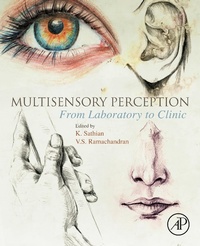
Multisensory Perception
From Laboratory to Clinic
Published on 15. September 2019
488 pages
978-0-12-812564-9 (ISBN)
Description

Multisensory Perception: From Laboratory to Clinic surveys the current state of knowledge on multisensory processes, synthesizing information from diverse streams of research and defining hypotheses and questions to direct future work. Reflecting the nature of the field, the book is interdisciplinary, comprising the findings and views of writers with diverse backgrounds and varied methods, including psychophysical, neuroanatomical, neurophysiological and neuroimaging approaches. Sections cover basic principles, specific interactions between the senses, the topic of crossmodal correspondences between particular sensory attributes, the related topic of synesthesia, and the clinic.
- Offers a comprehensive, up-to-date overview of the current state of knowledge on multisensory processes
- Coverage includes basic principles, specific interactions between the senses, crossmodal correspondences and the clinical aspects of multisensory processes
- Includes psychophysical, neuroanatomical, neurophysiological and neuroimaging approaches
More details
Other editions
Additional editions
Book
09/2019
Academic Press
€184.50
Shipment within 15-20 days
Content
SECTION I: FOUNDATIONS OF MULTISENSORY PERCEPTION1. Bouba-Kiki: Cross-domain resonance and the origins of synesthesia, metaphor, and words in the human mind2. Philosophical insights 3. Neural development of multisensory integration 4. The development of multisensory processes for perceiving the environment and the self5. Computational models of multisensory integration 6. Multisensory contributions to object recognition and memory across the lifespan
SECTION II: MULTISENSORY INTERACTIONS 7. Visuo-haptic object perception8. Multisensory processes in body ownership9. Visual-vestibular interactions 10. Multisensory flavor perception: A cognitive neuroscience perspective11. Audiovisual crossmodal correspondences: Behavioural consequences and neural underpinnings12. How do crossmodal correspondences and multisensory processes relate to synesthesia?13. Synesthesia: The current state of the field 14. How synesthesia may lead to enhanced memory
SECTION III: CLINICAL APPLICATIONS15. Task-selectivity in the sensory deprived brain and sensory substitution approaches for clinical practice: evidence from blindness 16. Crossmodal neuroplasticity in deafness: Evidence from animal models and clinical populations17. Neurodevelopmental and neuropsychiatric disorders affecting multisensory processes 18. Disorders of body representation 19. Hemianopia, spatial neglect and their multisensory rehabilitation20. Mirror therapy
