

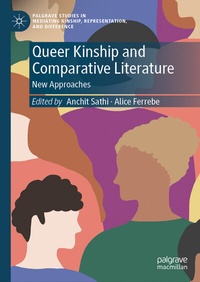
Queer Kinship and Comparative Literature
Description

This edited collection provides a critical forum for scholars to examine the evolution of queer kinship-encompassing the wide range of relationships, both biological and nonbiological, that queer individuals choose (or are compelled) to establish-through its representation in literature over time and across cultural contexts. In particular, the ten essays in this collection utilize close readings, philosophy, and theory to address the following question: How can we conceptualize the nature of queer kinship based on its textual representations?
To this end, the essays engage with a diverse array of texts, from Buddhist writing to contemporary song lyrics, French literature from the 17th and 18th centuries to contemporary drama and novels from Sweden, Israel, and the Anglosphere. This broad temporal and geographic scope yields new critical insights into the varied ontologies of queer kinship and highlights the inherent paradoxes and fundamental messiness in queer kinship formations across different times, spaces, and contexts. In doing so, the collection makes a significant and timely contribution to the fields of kinship studies, queer studies, and comparative literature.
More details
Other editions
Additional editions
Persons
Anchit Sathi retired in 2019, but still keeps himself busy as an independent scholar of comparative literature. Anchit has taught and supervised both undergraduate and postgraduate students at the University of Potsdam and at the University of Washington in Seattle, and his work has been published in journals such as Textual Practice , German Life and Letters , Monatshefte , Comparative Critical Studies and Sprachkunst. His research interests include world literature, 20th and 21st century writing, trauma studies, and queer theory.
Alice Ferrebe has led departments of literature at universities in both the UK and China, and is currently an Associate Professor, and Head of Academic Skills, at the University of Chester, UK. She has published extensively on literary gender and mid-twentieth century British literature and culture, including two monographs, Literature of the 1950s: Good, Brave Causes, Edinburgh History of Twentieth-Century Literature in Britain (2012) and Masculinity in Male-Authored Fiction 1950-2000 (2005). She is working on a study of the British novelist Elizabeth Taylor, subtitled "Art and Labour".
Content
Chapter 1: Introduction: The Messiness of Queer Kinship.- Part I: Kinships in Contexts of Spirituality.- Chapter 2: "What have we to do with that?" Queer Kinship and the Buddhist Monastery.- Chapter 3: Queer Kinship in boygenius: Musical Narratives Reflecting a Therapeutic Journey.- Part II: Queer Relationality in Pre-Revolutionary Times.- Chapter 4: Once Upon a Time in a Queer Kingdom.- Chapter 5: The Queer Family of Feeling in Paul et Virginie.- Part III: Networks of Care.- Chapter 6: Those Who Lived and Those Who Died: Queer Communities of Care in the Swedish Play Kurage .- Chapter 7: Kinship in the Contemporary Queer Novel of Care.- Part IV: Intergenerational Kinships.- Chapter 8: Yotam Reuveny and Kobi Ovadia: A Queer Kinship Between Foundling Writers.- Chapter 9: How To Stop Pruning Your Queer Family Tree.- Part V: Trans-Temporal Kinships.- Chapter 10: "It's not a Uni-verse": Kinships, Bodies, and Ecologies in the Speculative .- Chapter 11: Queer diffractive kinship in time: Rereading the epistolary tradition through This Is How You Lose the Time War.
