

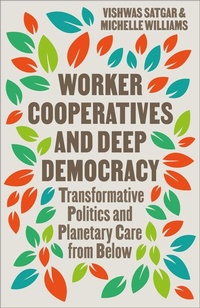
Worker Cooperatives and Deep Democracy
Transformative Politics and Planetary Care from Below
1st Edition
Published on 20. December 2025
241 pages
978-0-7453-5158-2 (ISBN)
Description

Capitalism's crisis is planetary. It is a system upending nature and society, causing many to live and work in despair. So far, the left has been incapable of inspiring an effective challenge to it. In Worker Cooperatives and Deep Democracy, Vishwas Satgar and Michelle Williams map a new transformative politics arising from inspiring worker cooperative systems that advance planetary care from below and which have the potential to undermine the capitalist status quo.
Based on over a decade of research across 15 countries, the authors examine case studies that explore transformative approaches to social reproduction, public power, nature and territorial expansion in opposition to global hegemonic power.
They also uncover the power of solidarities engendering emancipatory, utopian imaginaries in the global north and south. They show how, against all the odds, people are experimenting with deep democracy and building systems of care to live differently and exit the planetary crisis.
Based on over a decade of research across 15 countries, the authors examine case studies that explore transformative approaches to social reproduction, public power, nature and territorial expansion in opposition to global hegemonic power.
They also uncover the power of solidarities engendering emancipatory, utopian imaginaries in the global north and south. They show how, against all the odds, people are experimenting with deep democracy and building systems of care to live differently and exit the planetary crisis.
Reviews / Votes
'In a world spiraling through climate breakdown and extreme inequality, this book reveals how communities are already building real alternatives from below. From Kerala to Mondragon, these stories of solidarity, commons, and planetary care show that another post-capitalist future is not just possible, it's happening' -- Kohei Saito, author of <i>Marx in the Anthropocene: Towards the Idea of Degrowth Communism</i> 'Just when it seems the world is hurtling toward capitalism's final solution, Satgar and Williams show us another path forward; masses of people making life, fashioning new social relations, and building power, not by withdrawing from struggle but heightening the contradictions and finding strength in creativity and collectivity. In these dark times, this book is the brilliant light and the compass we need, not just to save the planet but to make the world anew' -- Robin D. G. Kelley, author of <i>Freedom Dreams: The Black Radical Imagination</i> 'As social democratic politicians do their best to prove in practice that there is no alternative, Satgar and Williams provide a timely map of the transformative experiments that are daily seeding feasible systemic alternatives. A remarkable book in which the documentation of innovation in ethical economics drives the development of an original theory of a solidarity based political economy just when it is most needed. A very useful resource for immediate use rather than simply a book to add to your bookshelves!' -- Hilary Wainwright, <i>Red Pepper</i>, co-author of <i>New Politics from The Left</i> 'Grounded in research across continents, this remarkable book reveals how ordinary people are building cooperative and solidarity-based alternatives to capitalism. These real-world experiments show that a radical, justice-centered politics is not only necessary but possible in the face of the global polycrisis' -- Ruy Braga, Professor of Sociology, University of Sao Paulo 'A book for our times, highlighting the planetary nature of the contemporary capitalist crisis and demonstrating that emancipatory ways of living, working, and consuming exist all over the world. Drawing on Marxist feminism and several years of in-depth research, care-based alternatives are highlighted for us to learn from to build the next society. Read this compass for grounded hope' -- Thomas Isaac, former finance minister in the Left Government of Kerala, and author of <i>Kerala: Another Possible World</i> 'An unsanitised reflection on the deep intersecting crisis that humanity finds itself in at a time of global pessimism and despair. Yet, the inspirational case studies and the lessons they offer guide us to a transformative path towards sanity, justice and sustainability. A timely contribution in this moment of deep searching for systemic solutions' -- Kumi Naidoo, President, Fossil Fuel Non-Proliferation Treaty Initiative and Global ambassador, Africans Rising for Justice, Peace and Dignity 'For anyone wanting to find out what worker cooperatives and the solidarity-economy based cooperative systems are, this book is an important source of knowledge and insights. It is also a great source of inspiration about the positive difference that the cooperative system can, and does, make to individuals, communities, societies, and to nature' -- Adotey Bing-Pappoe, Co-Chair of Cooperation AfricaMore details
Edition
1. Auflage
Language
English
Place of publication
London
United Kingdom
Target group
Professional and scholarly
File size
1,13 MB
ISBN-13
978-0-7453-5158-2 (9780745351582)
Copyright in bibliographic data and cover images is held by Nielsen Book Services Limited or by the publishers or by their respective licensors: all rights reserved.
Schweitzer Classification
Other editions
Additional editions
Vishwas Satgar | Michelle Williams
Worker Cooperatives and Deep Democracy
Transformative Politics and Planetary Care from Below
Book
approx. 12/2025
Pluto Press
€25.00
Not yet published
Persons
Vishwas Satgar is Professor of International Relations at the University of the Witwatersrand, Johannesburg. He is the editor of the Democratic Marxism series, Principal Investigator for Emancipatory Futures Studies in the Anthropocene and a veteran activist. He has worked extensively on post-apartheid cooperative development in township communities and has co-founded the South African Food Sovereignty Campaign and Climate Justice Charter Movement. He is the author of A Love Letter to the Many - Arguments for Transformative Left Politics in South Africa.
Michelle Williams is Professor of Sociology at the University of the Witwatersrand, Johannesburg. Her research focuses on democracy, transformative projects, alternative development and women's participation in political and economic spaces. She is the co-author (with Thomas Isaac) of India, Building Alternatives: the Story of India's Oldest Worker Cooperative, and the co-editor (with Vishwas Satgar) of Destroying Democracy: Neoliberal Capitalism and the Rise of Authoritarian Politics.
Michelle Williams is Professor of Sociology at the University of the Witwatersrand, Johannesburg. Her research focuses on democracy, transformative projects, alternative development and women's participation in political and economic spaces. She is the co-author (with Thomas Isaac) of India, Building Alternatives: the Story of India's Oldest Worker Cooperative, and the co-editor (with Vishwas Satgar) of Destroying Democracy: Neoliberal Capitalism and the Rise of Authoritarian Politics.
Content
Introduction
Part I: Beyond the Planterary Polycrisis
1. The Planetary Polycrisis of Socio-ecological Reproduction and the Challenge of Commons Ontology
2. The Rise of Transformative Politics and Planetary Care from Below
3. Cooperatives and Transformative Change
Part II: Worker Cooperatives and Solidarity Economies as Counterhegemony Regimes of Socio-ecological Reproduction
5. Integrating Socio-Ecological Reproduction: ULCCS in Kerala, Chilavert in Argentina and Uniforja in Brazil
6. Recalibrating Relations with Nature: Cecosesola in Venezuela, Heiveld in South Africa and Trentino in Italy
6. Engaging Political Power and Creating Solidarities: Mondragon in Spain, State-Civil Society Synergies in Kerala and the Solidarity Economy Forum in Brazil
Conclusion: Transformative Alternatives in the Age of Planetary Crisis
Part I: Beyond the Planterary Polycrisis
1. The Planetary Polycrisis of Socio-ecological Reproduction and the Challenge of Commons Ontology
2. The Rise of Transformative Politics and Planetary Care from Below
3. Cooperatives and Transformative Change
Part II: Worker Cooperatives and Solidarity Economies as Counterhegemony Regimes of Socio-ecological Reproduction
5. Integrating Socio-Ecological Reproduction: ULCCS in Kerala, Chilavert in Argentina and Uniforja in Brazil
6. Recalibrating Relations with Nature: Cecosesola in Venezuela, Heiveld in South Africa and Trentino in Italy
6. Engaging Political Power and Creating Solidarities: Mondragon in Spain, State-Civil Society Synergies in Kerala and the Solidarity Economy Forum in Brazil
Conclusion: Transformative Alternatives in the Age of Planetary Crisis
