
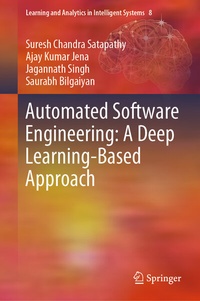
Automated Software Engineering: A Deep Learning-Based Approach
Description
Alles über E-Books | Antworten auf Fragen rund um E-Books, Kopierschutz und Dateiformate finden Sie in unserem Info- & Hilfebereich.
This book discusses various open issues in software engineering, such as the efficiency of automated testing techniques, predictions for cost estimation, data processing, and automatic code generation. Many traditional techniques are available for addressing these problems. But, with the rapid changes in software development, they often prove to be outdated or incapable of handling the software's complexity. Hence, many previously used methods are proving insufficient to solve the problems now arising in software development.
The book highlights a number of unique problems and effective solutions that reflect the state-of-the-art in software engineering. Deep learning is the latest computing technique, and is now gaining popularity in various fields of software engineering. This book explores new trends and experiments that have yielded promising solutions to current challenges in software engineering. As such, it offers a valuable reference guide for a broad audience including systems analysts, software engineers, researchers, graduate students and professors engaged in teaching software engineering.
More details
Other editions
Additional editions

Content
System requirements
File format: PDF
Copy protection: Watermark-DRM (Digital Rights Management)
System requirements:
- Computer (Windows; MacOS X; Linux): Use the free software Adobe Reader, Adobe Digital Editions, or any other PDF viewer of your choice (see eBook Help).
- Tablet/Smartphone (Android; iOS): Install the free app Adobe Digital Editions or another reading app for eBooks, e.g., PocketBook (see eBook Help).
- E-reader: Bookeen, Kobo, Pocketbook, Sony, Tolino and many more (only limited: Kindle).
The file format PDF always displays a book page identically on any hardware. This makes PDF suitable for complex layouts such as those used in textbooks and reference books (images, tables, columns, footnotes). Unfortunately, on the small screens of e-readers or smartphones, PDFs are rather annoying, requiring too much scrolling.
This eBook uses Watermark-DRM, a „soft” copy protection. This means that there are no technical restrictions to prevent illegal distribution. However, there is a personalised watermark embedded in the eBook that can be used to identify the purchaser of the eBook in the event of misuse and to provide evidence for legal purposes.
For more information, see our eBook Help page.