

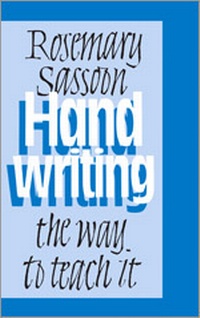
Handwriting
The Way to Teach It
2nd Edition
Published on 18. March 2003
128 pages
978-1-84787-756-7 (ISBN)
Description

`I found this a fascinating book to read, I could identify with my time at school when I would often write with my paper almost in at right angles to my body because I found this comfortable, and the teacher's insistence that the paper be "straight" in front of me. This then made me twist my body into a ridiculous shape, and would sometimes result in punishment for not "sitting on the chair correctly"....if only the teacher had understood the same principles as Rosemary Sassoon, who in this book emphasizes "flexibility and clear thinking about essential issues, rather than to impose solutions' - Spare-Chair
`Handwriting: The Way to Teach It should be required reading wherever Primary school teachers are trained, then perhaps there would be fewer young people still struggling to communicate in legible writing in Secondary school and later life' - Handwriting Today
`This is a comprehensive textbook, and an extremely accessible and practical guide which should be on the bookshelf of every practitioner. I recommend it highly' - Jeni Riley, Head of Early Childhood and Primary Education, Institute of Education, University of London
This book is an essential classroom guide to the teaching of handwriting. It covers all aspects of the subject: from whole-school planning, to classroom management and the teaching of letters in a highly illustrated and practical sequence; and from initial letter forms through to joined writing. The author presents many examples and imaginative ideas to make learning to write more effective and interesting for children and for teachers. This Second Edition includes material on problems which children can have with handwriting, and how to diagnose and remedy them.
The author offers strategies for better teaching, and her aim throughout the book is to encourage flexibility and clear thinking about essential issues, rather than to impose solutions.
`Handwriting: The Way to Teach It should be required reading wherever Primary school teachers are trained, then perhaps there would be fewer young people still struggling to communicate in legible writing in Secondary school and later life' - Handwriting Today
`This is a comprehensive textbook, and an extremely accessible and practical guide which should be on the bookshelf of every practitioner. I recommend it highly' - Jeni Riley, Head of Early Childhood and Primary Education, Institute of Education, University of London
This book is an essential classroom guide to the teaching of handwriting. It covers all aspects of the subject: from whole-school planning, to classroom management and the teaching of letters in a highly illustrated and practical sequence; and from initial letter forms through to joined writing. The author presents many examples and imaginative ideas to make learning to write more effective and interesting for children and for teachers. This Second Edition includes material on problems which children can have with handwriting, and how to diagnose and remedy them.
The author offers strategies for better teaching, and her aim throughout the book is to encourage flexibility and clear thinking about essential issues, rather than to impose solutions.
Reviews / Votes
`This is a comprehensive textbook, and an extremely accessible and practical guide which should be on the bookshelf of every practitioner. I recommend it highly' - Jeni Riley, Head of Early Childhood and Primary Education Institute of Education, University of LondonAll prices
More details
Edition
Second Edition
Language
English
Place of publication
London
United Kingdom
Target group
Professional and scholarly
ISBN-13
978-1-84787-756-7 (9781847877567)
Copyright in bibliographic data and cover images is held by Nielsen Book Services Limited or by the publishers or by their respective licensors: all rights reserved.
Schweitzer Classification
Other editions
Additional editions
Book
04/2003
2nd Edition
SAGE Publications Inc
€190.90
Shipment within 15-20 days
Book
03/2003
2nd Edition
SAGE Publications Inc
€79.41
Shipment within 15-20 days
Person
Rosemary Sassoon is an independent consultant and lecturer, based in Sevenoaks, Kent. She is the author of Handwriting: The Way to Teach it, Paul Chapman Publishing, 2003.
Content
PART ONE: PLANNING HANDWRITING ACROSS THE WHOLE SCHOOL
The Priority for Handwriting in the Curriculum
The Relationship between the Skill of Handwriting and Other Subjects
When to Introduce Handwriting in the Reception Class
The Choice of Handwriting Model
Balancing Movement and Neatness
How Much Emphasis on Joining
Display Writing - Both by Teachers and Pupils
Liaison with Pre-School Groups, Parents and Other Schools
A Policy for Left-Handers
A Policy for Special Needs
A Policy for Newcomers from Other Schools
Terminology
Assessment and Record Keeping
PART TWO: CLASSROOM MANAGEMENT
Layout of the Classroom
Balancing Whole-Class Instruction with One-to-One Attention
Posture
Appropriate Furniture
Paper Position and Its Effect on Posture
Penhold
Materials
Pencils and Pens, Paper Size and Lines
Making Children Aware of the Importance of All These Ideas
PART THREE: A SYSTEM FOR TEACHING LETTERS
The Vital Early Years
The Concepts Behind Our Writing System
Different Approaches to Teaching
Explaining the Act of Writing in a Logical Sequence
Introducing Letters in Stroke-Related Families
Teaching the First Letter Family
Teaching the Second Letter Family
Teaching the Round Letters
Complex Letters and Emerging Problems
Name Writing
Designing Exercises
Starting to Use Letters
Lines
Drawing with Writing
Remedial Work Often Begins on Day One
Joining as Soon as Possible
Personal Letters Lead to Efficiency and Speed
What Handwriting Problems May Indicate
Layouts for Practice Cards
Recommendations from Research into Children's Handwriting
Some Personal Comments
PART FOUR: A NEW WAY OF LOOKING AT HANDWRITING PROBLEMS
Handwriting as a Diagnostic Tool
Problems That Show through Handwriting
Specific Problems for Left-Handers
Problems with Directionality
Perceptual Problems
Observing, Assessing and Dealing with Tremors
Fatigue
Gaps in Learning
Posture as an Indicator, as Well as a Cause of Problems
An Attitude of Understanding
The Priority for Handwriting in the Curriculum
The Relationship between the Skill of Handwriting and Other Subjects
When to Introduce Handwriting in the Reception Class
The Choice of Handwriting Model
Balancing Movement and Neatness
How Much Emphasis on Joining
Display Writing - Both by Teachers and Pupils
Liaison with Pre-School Groups, Parents and Other Schools
A Policy for Left-Handers
A Policy for Special Needs
A Policy for Newcomers from Other Schools
Terminology
Assessment and Record Keeping
PART TWO: CLASSROOM MANAGEMENT
Layout of the Classroom
Balancing Whole-Class Instruction with One-to-One Attention
Posture
Appropriate Furniture
Paper Position and Its Effect on Posture
Penhold
Materials
Pencils and Pens, Paper Size and Lines
Making Children Aware of the Importance of All These Ideas
PART THREE: A SYSTEM FOR TEACHING LETTERS
The Vital Early Years
The Concepts Behind Our Writing System
Different Approaches to Teaching
Explaining the Act of Writing in a Logical Sequence
Introducing Letters in Stroke-Related Families
Teaching the First Letter Family
Teaching the Second Letter Family
Teaching the Round Letters
Complex Letters and Emerging Problems
Name Writing
Designing Exercises
Starting to Use Letters
Lines
Drawing with Writing
Remedial Work Often Begins on Day One
Joining as Soon as Possible
Personal Letters Lead to Efficiency and Speed
What Handwriting Problems May Indicate
Layouts for Practice Cards
Recommendations from Research into Children's Handwriting
Some Personal Comments
PART FOUR: A NEW WAY OF LOOKING AT HANDWRITING PROBLEMS
Handwriting as a Diagnostic Tool
Problems That Show through Handwriting
Specific Problems for Left-Handers
Problems with Directionality
Perceptual Problems
Observing, Assessing and Dealing with Tremors
Fatigue
Gaps in Learning
Posture as an Indicator, as Well as a Cause of Problems
An Attitude of Understanding
