

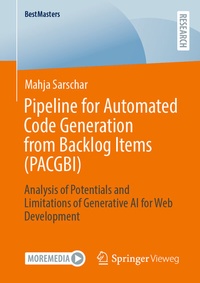
Pipeline for Automated Code Generation from Backlog Items (PACGBI)
Description

This book investigates the potential and limitations of using Generative AI (GenAI) in terms of quality and capability in agile web development projects using React. For this purpose, the Pipeline for Automated Code Generation from Backlog Items (PACGBI) was implemented and used in a case study to analyse the AI-generated code with a mix-method approach. The findings demonstrated the ability of GenAI to rapidly generate syntactically correct and functional code with Zero-Shot prompting. The PACGBI showcases the potential for GenAI to automate the development process, especially for tasks with low complexity. However, this research also identified challenges with code formatting, maintainability, and user interface implementation, attributed to the lack of detailed functional descriptions of the task and the appearance of hallucinations. Despite these limitations, the book underscores the significant potential of GenAI to accelerate the software development process and highlights the need for a hybrid approach that combines GenAI's strengths with human expertise for complex tasks. Further, the findings provide valuable insights for practitioners considering GenAI integration into their development processes and set a foundation for future research in this field.
More details
Other editions
Additional editions
Person
Mahja Sarschar , MSc is a graduate of the study program computer science with focus on media at the HTW Berlin. Her research bridges the gap between advancements in Generative AI and their possible applications in the software industry.
Content
Introduction.- Theoretical Background.- Related Work.- Method.- Implementation.- Results.- Discussion.- Summary.
