

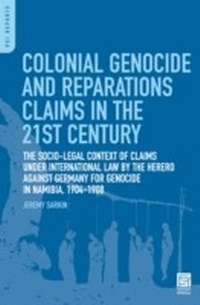
Colonial Genocide and Reparations Claims in the 21st Century
The Socio-Legal Context of Claims Under International Law by the Herero Against Germany for Genocide in Namibia, 1904-1908
1st Edition
Published on 30. November 2008
320 pages
978-0-313-36257-6 (ISBN)
Description

More and more, the descendants of indigenous victims of genocide, land expropriation, forced labor, and other systematic human rights violations committed by colonial powers are seeking reparations under international law from the modern successor governments and corporations. As the number of colonial reparations cases increases, courts around the world are being asked to apply international law to determine whether reparations are due for atrocities and crimes that might have been committed long ago but whose lasting effects are alleged to injure the modern descendants of the victims. Sarkin analyzes the thorny issues of international law raised in such suits by focusing on groundbreaking cases in which he is involved as legal advisor to the paramount chief of the Herero people of Namibia. In 2001, the Herero became the first ethnic group to seek reparations under the legal definition of genocide by bringing multi-billion-dollar suits against Germany and German companies in a number of U.S. federal courts under the Alien Torts Claim Act of 1789.
The Herero genocide, conducted in German South-West Africa (present-day Namibia) between 1904 and 1908, is recognized by the UN as the first organized state genocide in world history. Although the Herero were subjected to Germany's First Genocide, they have, unlike the victims of the Holocaust, received no reparations from Germany. By machine-gun massacres, starvation, poisoning, and forced labor in Germany's first concentration camps, the German Schutztruppe systematically exterminated as many as 105,000 Herero women, and children, composing most of the Herero population. Sarkin considers whether these historical events constitute legally defined genocide, crimes against humanity, and other international crimes. He evaluates the legal status of indigenous polities in Africa at the time and he explores the enduring impact in Namibia of the Germany's colonial campaign of genocide. He extrapolates the Herero case to global issues of reparations, apologies, and historical human rights violations, especially in Africa.
The Herero genocide, conducted in German South-West Africa (present-day Namibia) between 1904 and 1908, is recognized by the UN as the first organized state genocide in world history. Although the Herero were subjected to Germany's First Genocide, they have, unlike the victims of the Holocaust, received no reparations from Germany. By machine-gun massacres, starvation, poisoning, and forced labor in Germany's first concentration camps, the German Schutztruppe systematically exterminated as many as 105,000 Herero women, and children, composing most of the Herero population. Sarkin considers whether these historical events constitute legally defined genocide, crimes against humanity, and other international crimes. He evaluates the legal status of indigenous polities in Africa at the time and he explores the enduring impact in Namibia of the Germany's colonial campaign of genocide. He extrapolates the Herero case to global issues of reparations, apologies, and historical human rights violations, especially in Africa.
More details
Series
Edition
1. Auflage
Language
English
Place of publication
New York
United States
Publishing group
Bloomsbury Publishing Plc
Target group
Interest Age: From 7 to 17 years
ISBN-13
978-0-313-36257-6 (9780313362576)
Copyright in bibliographic data and cover images is held by Nielsen Book Services Limited or by the publishers or by their respective licensors: all rights reserved.
Schweitzer Classification
Other editions
Additional editions
Jeremy Sarkin
Colonial Genocide and Reparations Claims in the 21st Century
The Socio-Legal Context of Claims under International Law by the Herero against Germany for Genocide in Namibia, 1904-1908
Book
11/2008
Praeger Publishers Inc
€111.61
Shipment within 15-20 days
Person
Jeremy Sarkin is Visiting Professor of Human Rights at the Fletcher School at Tufts University and Senior Professor of Law at the University of the Western Cape in Cape Town, South Africa. He is Special Rapporteur for Enforced and Involuntary Disappearances to the United Nations Human Rights Council. He served as an acting judge in the Cape High Court in South Africa. He is Legal Advisor to the Paramount Chief of the Herero people in Nambia. He has published over 100 articles and 12 books, including Human Rights in African Prisons (2008), Reconciliation in Divided Societies: Finding Common Ground (2007), Carrots and Sticks: The Truth and Reconciliation Commission and the South African Amnesty Process (2004), and Human Rights, The Citizen, and the State: South African and Irish Perspectives (2002).
Content
Introduction
1. THE LEGACY OF THE HERERO GENOCIDE ON NAMIBIA TODAY
2. THE HISTORICAL AND CURRENT LEGAL IMPLICATIONS OF GERMANYS CONDUCT
3. THE DEVELOPING NORM OF REPARATIONS AND APOLOGIES FOR HISTORICAL CLAIMS: PAST, PRESENT AND FUTURE
CONCLUSION
1. THE LEGACY OF THE HERERO GENOCIDE ON NAMIBIA TODAY
2. THE HISTORICAL AND CURRENT LEGAL IMPLICATIONS OF GERMANYS CONDUCT
3. THE DEVELOPING NORM OF REPARATIONS AND APOLOGIES FOR HISTORICAL CLAIMS: PAST, PRESENT AND FUTURE
CONCLUSION
