

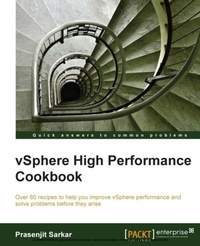
vSphere High Performance Cookbook
A cookbook is the ideal way to learn a tool as complex as vSphere. Through experiencing the real-world recipes in this tutorial you'll gain deep insight into vSphere's unique attributes and reach a high level of proficiency.
Published on 13. January 2025
240 pages
978-1-78217-001-3 (ISBN)
Description

A cookbook is the ideal way to learn a tool as complex as vSphere. Through experiencing the real-world recipes in this tutorial you'll gain deep insight into vSphere's unique attributes and reach a high level of proficiency.
Key Features
Troubleshoot real-world vSphere performance issues and identify their root causes
Design and configure CPU, memory, networking, and storage for better and more reliable performance
Comprehensive coverage of performance issues and solutions including vCenter Server design and virtual machine and application tuning
Book DescriptionVMware vSphere is the key virtualization technology in today's market. vSphere is a complex tool and incorrect design and deployment can create performance-related problems. vSphere High Performance Cookbook is focused on solving those problems as well as providing best practices and performance-enhancing techniques. vSphere High Performance Cookbook offers a comprehensive understanding of the different components of vSphere and the interaction of these components with the physical layer which includes the CPU, memory, network, and storage. If you want to improve or troubleshoot vSphere performance then this book is for you! vSphere High Performance Cookbook will teach you how to tune and grow a VMware vSphere 5 infrastructure. This book focuses on tuning, optimizing, and scaling the infrastructure using the vSphere Client graphical user interface. This book will enable the reader with the knowledge, skills, and abilities to build and run a high-performing VMware vSphere virtual infrastructure. You will learn how to configure and manage ESXi CPU, memory, networking, and storage for sophisticated, enterprise-scale environments. You will also learn how to manage changes to the vSphere environment and optimize the performance of all vSphere components. This book also focuses on high value and often overlooked performance-related topics such as NUMA Aware CPU Scheduler, VMM Scheduler, Core Sharing, the Virtual Memory Reclamation technique, Checksum offloading, VM DirectPath I/O, queuing on storage array, command queuing, vCenter Server design, and virtual machine and application tuning. By the end of this book you will be able to identify, diagnose, and troubleshoot operational faults and critical performance issues in vSphere.What you will learn
Understand VMM Scheduler, Cache aware CPU Scheduler, NUMA Aware CPU Scheduler, and so on during CPU Performance Design
Learn about the virtual memory reclamation technique, monitoring host ballooning, and swapping activity
Get to grips with different vSwitch load balancing, considerations for checksum offloading, VMDirectPath I/O, and so on
Understand DRS algorithms, resource pool guidelines, SIOC threshold consideration, SDRS and its affinity/anti-affinity rules in DRS, SDRS, and resource control design
Scale up and scale out cluster design for performance, FT and its caveats, application monitoring, DPM, host affinity/anti-affinity rules
Design your vSphere storage based on various workloads and FC storage for best performance
Choose the right platform while designing your vCenter Server, redundant vCenter design, vCenter SSO and its deployment
Who this book is forThe book is primarily written for technical professionals with system administration skills and some VMware experience who wish to learn about advanced optimization and the configuration features and functions for vSphere 5.1.
Key Features
Troubleshoot real-world vSphere performance issues and identify their root causes
Design and configure CPU, memory, networking, and storage for better and more reliable performance
Comprehensive coverage of performance issues and solutions including vCenter Server design and virtual machine and application tuning
Book DescriptionVMware vSphere is the key virtualization technology in today's market. vSphere is a complex tool and incorrect design and deployment can create performance-related problems. vSphere High Performance Cookbook is focused on solving those problems as well as providing best practices and performance-enhancing techniques. vSphere High Performance Cookbook offers a comprehensive understanding of the different components of vSphere and the interaction of these components with the physical layer which includes the CPU, memory, network, and storage. If you want to improve or troubleshoot vSphere performance then this book is for you! vSphere High Performance Cookbook will teach you how to tune and grow a VMware vSphere 5 infrastructure. This book focuses on tuning, optimizing, and scaling the infrastructure using the vSphere Client graphical user interface. This book will enable the reader with the knowledge, skills, and abilities to build and run a high-performing VMware vSphere virtual infrastructure. You will learn how to configure and manage ESXi CPU, memory, networking, and storage for sophisticated, enterprise-scale environments. You will also learn how to manage changes to the vSphere environment and optimize the performance of all vSphere components. This book also focuses on high value and often overlooked performance-related topics such as NUMA Aware CPU Scheduler, VMM Scheduler, Core Sharing, the Virtual Memory Reclamation technique, Checksum offloading, VM DirectPath I/O, queuing on storage array, command queuing, vCenter Server design, and virtual machine and application tuning. By the end of this book you will be able to identify, diagnose, and troubleshoot operational faults and critical performance issues in vSphere.What you will learn
Understand VMM Scheduler, Cache aware CPU Scheduler, NUMA Aware CPU Scheduler, and so on during CPU Performance Design
Learn about the virtual memory reclamation technique, monitoring host ballooning, and swapping activity
Get to grips with different vSwitch load balancing, considerations for checksum offloading, VMDirectPath I/O, and so on
Understand DRS algorithms, resource pool guidelines, SIOC threshold consideration, SDRS and its affinity/anti-affinity rules in DRS, SDRS, and resource control design
Scale up and scale out cluster design for performance, FT and its caveats, application monitoring, DPM, host affinity/anti-affinity rules
Design your vSphere storage based on various workloads and FC storage for best performance
Choose the right platform while designing your vCenter Server, redundant vCenter design, vCenter SSO and its deployment
Who this book is forThe book is primarily written for technical professionals with system administration skills and some VMware experience who wish to learn about advanced optimization and the configuration features and functions for vSphere 5.1.
All prices
More details
Edition
Digital original
Language
English
Place of publication
Birmingham
United Kingdom
Target group
US School Grade: College Graduate Student
Edition type
Digital original
File size
6,26 MB
ISBN-13
978-1-78217-001-3 (9781782170013)
Copyright in bibliographic data and cover images is held by Nielsen Book Services Limited or by the publishers or by their respective licensors: all rights reserved.
Schweitzer Classification
Other editions
Additional editions
Prasenjit Sarkar
Vsphere High Performance Cookbook
Book
05/2013
Packt Publishing
€68.50
Shipment within 3-4 weeks
Person
Sarkar Prasenjit :
Prasenjit Sarkar is a product manager at Oracle for their public cloud, with a focus on cloud strategy, Oracle Ravello, cloud-native applications, and the API platform. His primary focus is driving Oracle's cloud computing business with commercial and public sector customers, helping to shape and deliver a strategy to build broad use of Oracle's Infrastructure as a Service offerings, such as Compute, Storage, and Database as a Service. He is also responsible for developing public/private cloud integration strategies, customers' cloud computing architecture visions, future state architectures, and implementable architecture roadmaps in the context of the public, private, and hybrid cloud computing solutions that Oracle can offer. He has also authored six industry-leading books on virtualization, SDN, and physical compute, among others. He has six successful patents and six more patents pending at the US PTO. He has also authored numerous research articles.
Prasenjit Sarkar is a product manager at Oracle for their public cloud, with a focus on cloud strategy, Oracle Ravello, cloud-native applications, and the API platform. His primary focus is driving Oracle's cloud computing business with commercial and public sector customers, helping to shape and deliver a strategy to build broad use of Oracle's Infrastructure as a Service offerings, such as Compute, Storage, and Database as a Service. He is also responsible for developing public/private cloud integration strategies, customers' cloud computing architecture visions, future state architectures, and implementable architecture roadmaps in the context of the public, private, and hybrid cloud computing solutions that Oracle can offer. He has also authored six industry-leading books on virtualization, SDN, and physical compute, among others. He has six successful patents and six more patents pending at the US PTO. He has also authored numerous research articles.
Content
Table of Contents

