


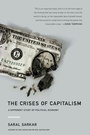
The Crises of Capitalism
A Different Study of Political Economy
1st Edition
Published on 1. September 2012
224 pages
978-1-61902-125-9 (ISBN)
Description

For nearly 300 years, capitalism propelled the world's most successful economies to new heights of development. But a spate of global environmental disasters and severe economic crises compels thinkers to question whether the system continues to function. Leveraging historical perspective, extensive research, and case studies, The Crises of Capitalism builds a compelling argument that challenges the most fundamental assumptions of prevailing economic theory.
Saral Sarkar exposes capitalism's flaws through the lens of ecosocialism, a philosophy that asserts that natural resources drive production and development. Keynes, Schumpeter, Marx, and Engles had no reason to believe that there would ever be a shortage of oil, minerals, water, or food-and that technological innovation could surmount any obstacle. But oil extraction has peaked, food is harder to come by, and the cost to maintain what natural resources remain has increased exponentially. Capitalism requires constant innovation to create growth-but as Sarkar establishes, even computers wouldn't exist without copper, gold, and zinc.
The Crises of Capitalism exists at the intersection of environmental awareness and economic theory. Sarkar challenges predominant explanations for catastrophic events like the 2008 global economic crisis, revises the classic paradigm of growth, and points to evidence of systemic economic failure. In this provocative, revolutionary criticism, Sarkar suggests that like other long-abandoned economic theories, capitalism has reached its limits.
"This is an important book, and it is on the front edge of the thinking that has to come to bear on the real crisis the world is facing, of the impossible idea of growth forever and the economic model that is driving the planet into irreversible crises.” -Doug Tompkins
More details
Other editions
Additional editions
Book
03/2014
Counterpoint
€19.10
Article exhausted; check different version
Book
08/2012
Counterpoint
€52.23
Article exhausted; check different version
Persons
Saral Sarkar was a lecturer at the Goethe Institute, Hyderabad, and is a leading proponent of ecosocialism. He has published several works including Green?Alternative Politics in West Germany and Eco?Socialism or Eco?Capitalism?: A Critical Analysis of Humanity's Fundamental Choices.
Content
- Intro
- Contents
- Note on the English Edition
- Preface
- I. Marxist Theories of Crisis
- 1. The Tendency of the Rate of Profit to Fall
- 2. Dissatisfaction with the Law of the Tendency of the Rate of Profit to Fall
- 3. The Marxist Under-Consumption Theory of Crisis
- 4. Dissatisfaction with the Under-Consumption Theory of Crisis -The Disproportionality Theory of Crisis
- 5. So Where Is the Final Crisis of Capitalism?
- 6. The Controversy over the Breakdown Theory
- a) The Pauperization Theory
- b) Rosa Luxemburg: Limits to Accumulat ion
- c) Critique of Luxemburg's Theory
- II. The Great Crash and the Great Depression
- 1. The 1920s
- 2. The Boom and the Delirium
- 3. The Crash
- 4. The Great Depression
- 5. Explanations
- III. The Saviors of Capitalism
- 1. Keynes and the Keynesians
- a) Crisis of Orthodox Economics
- b) The Non-Marxist Crisis Management
- c) The Keynesian Revolution
- d) Keynes versus Marx
- e) The Rise of Keynesianism
- 2. Schumpeter's Transfiguration of Crises: Creative Destruction
- a) Schumpeter's Theory of Business Cycles
- b) The Long Waves
- c) Demise of Capitalism
- d) Schumpeterian Economic Policy
- IV. Stagflation - The Decline of Keynesianism and the Rise of Neo-Liberalism
- 1. Stagflation
- 2. The Neo-Liberal Counterrevolution
- 3. The Theoretical Foundation of Neo-Liberal Policies -Monetarism versus Keynesianism
- 4. Monetarist Economic Policy
- 5. Neo-Liberalism and Supply-Side Economics
- V. Why Keynesianism Failed -Explanations of Professional Economists
- 1. A Political Decision
- 2. Is Inflation a Major or Rather a Minor Evil?
- 3. Public Campaigns
- 4. Some More Objective Explanations
- 5. The Objective Compulsion to Restructure the Economy -Why Keynesianism Had to be Buried
- 6. Macro-Politics
- VI. The Crises in Globalized Neo-Liberal Capitalism With
- 1. From the 1970s to the End of the 1980s
- a) The Debt Crisis of the Developing Countries
- b) The Stock Exchange Bubble and the Crash of 1987
- 2. The Turbulent 1990s
- a) The Neo-Liberal Democrats in the USA
- b) Recession and Stagnation in Japan
- c) Rescue Effort for Japan
- About-Turn in the USA
- d) Crises in the "Emerging Markets"
- e) The Great Crisis in East Asia
- f ) Russia
- g) Latin America
- h) Japan and the USA af ter the East Asian Crisis
- 3. A Long-Drawn-Out Crash and a Collapse in the New Millennium
- a) A Great Crash in Installments
- b) The Collapse in Ar gentina
- VII. Can Keynesianism Solve the Problems This Time?
- 1. Inflation
- 2. Had Keynesianism Really Been Buried?
- 3. Recipes of German Keynesians Against the Stagnation
- 4. My Doubts
- 5. Global Keynesianism?
- 6. Keynesians Do Not Know Any Limits to Growth
- 7. A Half-Socialism Cannot Function
- VIII. Why Globalization Should Be Criticized
- 1. The Theory of Comparative Advantage and the Arguments for Globalization
- 2. The Assumptions of the Theory and the Reality
- a) The Political Reality
- b) The Economic Reality
- 3. The Sustainability Criterion
- IX. Aspects of the Crisis of Capitalism
- 1. Instability of the International Financial System
- 2. Mass Unemployment and Workers' Discontent
- 3. Unfulfilled Promises of Innovations
- 4. The Crisis of the Welfare State
- 5. The Crisis of Social Democracy
- 6. Economic Compulsions, Limitations, and Temptations
- 7. Crisis of Capitalism in the Third World
- 8. Growing Defensive and Compensatory Costs
- X. Where Does the Surplus Come From?
- 1. The Secret of Rising Labor Productivity
- 2. Sustainable Growth?
- 3. Entropy, Low Entropy, and the Economic Process
- 4. Perspectives
- 5. The Pincer-Grip Crisis
- XI. The Future of Capitalism
- 1. Harry Shutt's Vision of a Regulated, Egalitarian, and Global Capitalism
- 2. A Few Success Stories
- 3. Can Capitalism Survive in a Contracting Economy?
- a) Herman Daly's Steady-State Capitalism
- b) Elmar Altvater's Mutually Supportive Economy
- 4. Conclusion - Perspective on the Future
- XII. The Global Economic Crisis of 2008-2010
- 1. The Course of the Crisis to Date
- 2. The Immediate Causes of the Crisis
- 3. Superficial Explanations
- 4. Why Did the Housing Bubble Burst?
- 5. The Real, Deeper Cause of the Crisis - Limits to Growth
- 6. Short-Term Perspective
- Notes
- References
