

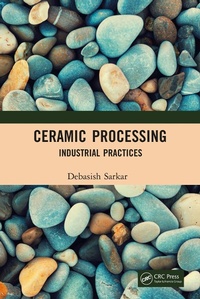
Ceramic Processing
Industrial Practices
1st Edition
Published on 20. June 2019
384 pages
978-1-351-38161-1 (ISBN)
Description

This book gives a comprehensive account on the manufacturing techniques to synchronize the desired properties of both traditional and advanced ceramics.
Offers exclusive and up to date information on industrial ceramic processing equipment and approaches and discusses actual industrial practices taking a product-oriented approach
It should serve as a text to answer the processing of ceramics and achieve targeted product in industrial environment.
Offers exclusive and up to date information on industrial ceramic processing equipment and approaches and discusses actual industrial practices taking a product-oriented approach
It should serve as a text to answer the processing of ceramics and achieve targeted product in industrial environment.
Reviews / Votes
The book title succinctly describes its contents. Processing of ceramics on an industrial scale has always come with compromises, and this publication will enlighten the reader as to why.Original ceramic processing in ancient times was performed mainly on an individual basis to provide simple articles such as containing vessels. Enlarging this process to manufacture complex shapes, numerous applications and repeatability is no easy task. Multiply fields of study are required to be understood for example, geology, chemistry, physics, thermodynamics, phase changes all these and more are present within ceramic processing and manufacture.
It is these issues which the author provides the reader with. A detailed description of the most commonly occurring techniques, potential problems and the science behind why a particular path has been taken.
This book allows the reader to gain specific information on a desired topic very quickly. All the chapters are easily identified via the titles and a list of their respective contents. Individual reference material can be very quickly sourced.
The overall amount of information is quite large considering the size of the publication. Most chapters contain a thorough explanation process which some lay readers may find initially a little daunting. There is a fair amount of scientific/mathematical formula, however the explanations and descriptive processes used to guide the reader are excellent.
Traditional and modern ceramic processing procedures are covered in detail. A surprise addition was the first chapter 'manufacturing excellence', this introduces the idea that newer manufacturing processes such as just in time, six sigma, Kanban systems can be used within ceramic manufacture. Having been within the industry for over thirty years I'm aware that these systems have been tried. The author does offer a detailed appraisal as to which particular system would suit which product base. For traditional ceramic manufacture for example. tableware these systems would be used sparingly if at all. In a high-volume low variety manufacture for example tile production these systems can and do have considerable merit.
On a personal note I found chapter nine 'the miniaturization of complex ceramics' very informative. Having some experience in ceramic injection moulding I found the newer processes of 3D printing, laser sintering and atomic layer deposition a very welcome addition to what methods are currently available.
In conclusion this book is a valuable reference source and excellent publication. It's well written, well presented and informative. It will be beneficial to students or professionals looking for information on ceramic processing.
Ian Richards CEnv. RSci. BSc(Hons). AMIMMM
Materials World
More details
Edition
1. Auflage
Language
English
Place of publication
London
United Kingdom
Publishing group
Taylor & Francis Ltd
Target group
College/higher education
Professional and scholarly
Illustrations
42 Tables, black and white; 171 Illustrations, black and white
ISBN-13
978-1-351-38161-1 (9781351381611)
Copyright in bibliographic data and cover images is held by Nielsen Book Services Limited or by the publishers or by their respective licensors: all rights reserved.
Schweitzer Classification
Other editions
New editions
Mohamed N. Rahaman
Ceramic Processing
E-Book
06/2017
2nd Edition
CRC Press
€205.99
Available for download
Additional editions
Book
03/2021
1st Edition
CRC Press
€72.70
Shipment within 15-20 days
Book
06/2019
1st Edition
CRC Press
€260.22
Shipment within 10-20 days
Person
Dr. Debasish Sarkar is currently a Professor at the Department of Ceramic Engineering, National Institute of Technology (NIT), Rourkela, Odisha, India. After his undergraduate in Ceramic Engineering from University of Calcutta in 1996, he completed a M.Tech in Metallurgical and Materials Engineering from Indian Institute of Technology, Kanpur, followed by a Ph.D in Ceramic Engineering at NIT, Rourkela. In due course of visiting researcher in Korea Research Institute of Standards and Science (KRISS), South Korea, he has gained extensive experience in ceramic processing for the wide perspective. As Principal Investigator, he has managed several research projects including Nanomaterials for functional and structural applications, and Refractories. The government of India and Industry like Tata Steel Ltd., Tata Krosaki Refractories Ltd, etc. sponsored most of the fund.
Debasish is internationally recognized expert in the academic and industrial research. Several works are highlighted in "Global Medical Discovery, Canada" as well as published as European patent. He has been awarded Materials Research Society (MRSI) of India Medal Award, 2016 for the work on patient-specific Orthopaedic implants, is a symbol of his outstanding career. He is life member of American Ceramic Society, Indian Ceramic Society and Indian Institute of Metals.
He has cumulative 23 years of experience and published 65 peer-reviewed international journal papers, 20 papers in conference proceedings, and 3 book chapters in Pan Stanford Publisher, Singapore, Wiley - VCH Verlag GmbH and Elsevier. In recent he has published a book on Nanostructured Ceramics in CRC Press, USA. He has been a lead inventor in one Korean patent, one European patent and one Indian Patent, and co-inventor for two Korean patents. He has published and reviewed in ACS, Blackwell Publishing Inc, Electrochemical Society, Elsevier, RSC, Springer, etc. He is holding position a member of different Editorial Board and Technical Committee around the globe.
Debasish is internationally recognized expert in the academic and industrial research. Several works are highlighted in "Global Medical Discovery, Canada" as well as published as European patent. He has been awarded Materials Research Society (MRSI) of India Medal Award, 2016 for the work on patient-specific Orthopaedic implants, is a symbol of his outstanding career. He is life member of American Ceramic Society, Indian Ceramic Society and Indian Institute of Metals.
He has cumulative 23 years of experience and published 65 peer-reviewed international journal papers, 20 papers in conference proceedings, and 3 book chapters in Pan Stanford Publisher, Singapore, Wiley - VCH Verlag GmbH and Elsevier. In recent he has published a book on Nanostructured Ceramics in CRC Press, USA. He has been a lead inventor in one Korean patent, one European patent and one Indian Patent, and co-inventor for two Korean patents. He has published and reviewed in ACS, Blackwell Publishing Inc, Electrochemical Society, Elsevier, RSC, Springer, etc. He is holding position a member of different Editorial Board and Technical Committee around the globe.
Content
1. Manufacturing Excellence in Ceramic Industry. 2. Particle Management. 3. Transparent Ceramics. 4. Porous Ceramics. 5. Ceramic Coatings. 6. Refractories and Failures. 7. Whitewares and Glazes. 8. Glass Processing and Properties. 9. Miniaturization of Complex Ceramics. 10. Structural and Functional Prototypes.
