

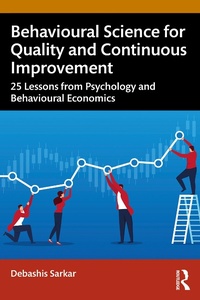
Behavioural Science for Quality and Continuous Improvement
25 Lessons from Psychology and Behavioural Economics
1st Edition
Published on 27. February 2022
198 pages
978-1-000-54534-0 (ISBN)
Description

This impactful volume demonstrates the application and power of psychology and behavioural economics in the pursuit of quality and continuous improvement.
It focusses on how the works of stalwarts such as Daniel Kahneman, Richard Thaler, Mihaly Csikszentmihalyi and many others can be used to build an organization that is known for quality products and flawless service delivery. The application of psychology and behavioural economics is still new to quality improvement, and in this book, Debashis Sarkar shares 25 lessons, featuring specific examples based on real life, that show how their application can increase the effectiveness of outcomes.
Behavioural Science for Quality and Continuous Improvement: 25 Lessons from Psychology and Behavioural Economics is ideal for business improvement professionals of all hierarchies and across different functional areas and industries seeking to understand the potential of psychology and behavioural economics and their applications, as well as in training and executive development programmes and for scholars of operations management, quality management, and engineering.
It focusses on how the works of stalwarts such as Daniel Kahneman, Richard Thaler, Mihaly Csikszentmihalyi and many others can be used to build an organization that is known for quality products and flawless service delivery. The application of psychology and behavioural economics is still new to quality improvement, and in this book, Debashis Sarkar shares 25 lessons, featuring specific examples based on real life, that show how their application can increase the effectiveness of outcomes.
Behavioural Science for Quality and Continuous Improvement: 25 Lessons from Psychology and Behavioural Economics is ideal for business improvement professionals of all hierarchies and across different functional areas and industries seeking to understand the potential of psychology and behavioural economics and their applications, as well as in training and executive development programmes and for scholars of operations management, quality management, and engineering.
More details
Edition
1. Auflage
Language
English
Place of publication
London
United Kingdom
Publishing group
Taylor & Francis Ltd
Target group
College/higher education
Illustrations
11 Tables, black and white; 4 Line drawings, black and white; 4 Illustrations, black and white
ISBN-13
978-1-000-54534-0 (9781000545340)
Copyright in bibliographic data and cover images is held by Nielsen Book Services Limited or by the publishers or by their respective licensors: all rights reserved.
Schweitzer Classification
Other editions
Additional editions

Debashis Sarkar
Behavioural Science for Quality and Continuous Improvement
25 Lessons from Psychology and Behavioural Economics
Book
02/2022
1st Edition
Routledge
€206.10
Shipment within 10-20 days

Debashis Sarkar
Behavioural Science for Quality and Continuous Improvement
25 Lessons from Psychology and Behavioural Economics
Book
02/2022
1st Edition
Routledge
€63.00
Shipment within 10-20 days
Person
Debashis Sarkar is a managing partner at Proliferator Advisory & Consulting, a firm focused on customer-centricity and operational excellence. A pioneer in the field of quality and organizational improvement, Debashis has authored several books, including The Little Big Things in Operational Excellence. He is the recipient of various recognitions such as the Phil Crosby Medal, the Simon Collier Award and the first Quality Champion Platinum Award from Quality Council of India - the highest award for quality from the Indian government. He is a Fellow of the American Society for Quality.
Content
1. Lesson: 1 - Solidifying the business case
2. Lesson: 2 - Cementing relationships
3. Lesson: 3 - Gaining commitment
4. Lesson: 4 - Getting across the message
5. Lesson: 5 - Not always about people
6. Lesson: 6 - What quality experts need to know
7. Lesson: 7 - When facts are overlooked
8. Lesson: 8 - The intricacies of change
9. Lesson: 9 - The power of familiarity
10. Lesson: 10 - Role of Emotions
11. Lesson: 11 - Engaging hearts and minds
12. Lesson: 12 - The biases in problem-solving
13. Lesson: 13 - Minimizing cognitive load
14. Lesson: 14 - Five Rules for customer solution design
15. Lesson: 15 - Making quality issues known
16. Lesson: 16 - The halo Effect
17. Lesson: 17 - Building Psychological Safety
18. Lesson: 18 - The power of open-ended questions
19. Lesson: 19 - The invisible gorillas
20. Lesson: 20 - Goals, Measurements, and Targets
21. Lesson: 21 - When Employee are defensive
22. Lesson: 22 - Blind Optimism during Eruptions
23. Lesson: 23 - Communicating Visually
24. Lesson: 24 - Not-So-Obvious Tactics for solving problems
25. Lesson: 25 - Taking employees on-board
2. Lesson: 2 - Cementing relationships
3. Lesson: 3 - Gaining commitment
4. Lesson: 4 - Getting across the message
5. Lesson: 5 - Not always about people
6. Lesson: 6 - What quality experts need to know
7. Lesson: 7 - When facts are overlooked
8. Lesson: 8 - The intricacies of change
9. Lesson: 9 - The power of familiarity
10. Lesson: 10 - Role of Emotions
11. Lesson: 11 - Engaging hearts and minds
12. Lesson: 12 - The biases in problem-solving
13. Lesson: 13 - Minimizing cognitive load
14. Lesson: 14 - Five Rules for customer solution design
15. Lesson: 15 - Making quality issues known
16. Lesson: 16 - The halo Effect
17. Lesson: 17 - Building Psychological Safety
18. Lesson: 18 - The power of open-ended questions
19. Lesson: 19 - The invisible gorillas
20. Lesson: 20 - Goals, Measurements, and Targets
21. Lesson: 21 - When Employee are defensive
22. Lesson: 22 - Blind Optimism during Eruptions
23. Lesson: 23 - Communicating Visually
24. Lesson: 24 - Not-So-Obvious Tactics for solving problems
25. Lesson: 25 - Taking employees on-board
