

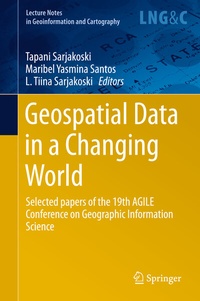
Geospatial Data in a Changing World
Selected papers of the 19th AGILE Conference on Geographic Information Science
Published on 14. May 2016
XIII, 415 pages
978-3-319-33783-8 (ISBN)
Description

This book collects innovative research presented at the 19th Conference of the Association of Geographic Information Laboratories in Europe (AGILE) on Geographic Information Science, held in Helsinki, Finland in 2016.
More details
Series
Edition
1st ed. 2016
Language
English
Place of publication
Cham
Switzerland
Publishing group
Springer International Publishing
Target group
Professional and scholarly
Product notice
Reflowable
Illustrations
XIII, 415 p. 168 illus.
File size
18,21 MB
ISBN-13
978-3-319-33783-8 (9783319337838)
DOI
10.1007/978-3-319-33783-8
Schweitzer Classification
Other editions
Additional editions
Tapani Sarjakoski | Maribel Yasmina Santos | L. Tiina Sarjakoski
Geospatial Data in a Changing World
Selected papers of the 19th AGILE Conference on Geographic Information Science
Book
05/2016
Springer
€213.99
Shipment within 10-15 days
Content
- Intro
- Preface
- Organizing Committee
- Scientific Programme Committee Chairs
- Local Organizing Committee
- Scientific Programme Committee
- Contents
- Part I Cognitive and Computational Aspects onSpatial Concepts
- A Computational Model for Context and Spatial Concepts
- 1 Introduction
- 2 State of the Art
- 2.1 (Spatial) Concepts
- 2.2 Context and Its Influence on Concepts
- 3 An Abstract Model for Context--Dependent Concepts
- 4 A Computational Model for Context-Dependent Concepts
- 5 Case Study: Mapping the Spatial Relation ``near'' onto Spatial Queries
- 5.1 The Case Study of ``near''
- 5.2 Examples for the Mapping of ``near'' onto Spatial Queries
- 6 Conclusions and Outlook
- References
- 2 Inferring Complex Geographical Concepts with Implicit Geometries Using Ontologies: A Case of Peninsulas
- Abstract
- 1 Introduction
- 2 Related Work
- 2.1 Algorithmic Approach to Concept Inference
- 2.2 Ontology-Driven Spatial Data Interpretation
- 3 Method
- 3.1 Generic Algorithms to Detect Primitive Relations and Implicit Geometries
- 3.2 Formalizing Geographical Concepts with Description Logics
- 3.2.1 Reasoning with Description Logics
- 3.3 Concept Interpretation as Reasoning Over Knowledge Bases
- 4 Case Study: Interpreting Peninsulas from Spatial Databases
- 4.1 Setting the Scene
- 4.2 Initializing the Knowledge Base
- 4.2.1 Characterization of Peninsula Candidates
- 4.2.2 Refined Results
- 5 Main Findings and Outlook
- Acknowledgments
- References
- Question-Based Spatial Computing---A Case Study
- 1 Introduction
- 2 Question-Based Spatial Computing
- 3 Related Work
- 4 Core Concepts and Computations for Spatial Information
- 5 A Case Study from Economics
- 5.1 Solution with Procedural GIS
- 5.2 Solution Based on Spatial Questions
- 5.3 Implementation
- 5.4 Comparison and Discussion
- 6 Conclusions
- References
- 4 Measuring Space-Time Prism Similarity Through Temporal Profile Curves
- Abstract
- 1 Introduction
- 2 Space-Time Paths and Path Similarity
- 3 Analytical Space-Time Prisms
- 4 Measuring Space-Time Prism Similarity Using Temporal Profile Curves
- 5 Examples
- 6 Future Steps
- 7 Conclusion
- References
- Deriving the Geographic Footprint of Cognitive Regions
- 1 Introduction
- 2 Related Work
- 2.1 Place and Activities
- 2.2 Geographic Information Retrieval and Natural Language Processing
- 3 Deriving the Geographic Footprint of Cognitive Regions
- 3.1 Natural Language Preprocessing
- 3.2 Geographic Matching
- 3.3 Machine Learning
- 4 Evaluation
- 4.1 Experimental Results
- 4.2 Preliminary Evaluation
- 5 Conclusion and Future Work
- References
- Part II Crowdsourcing and Social Networks
- 6 Android-Based Multi-Criteria Evaluation Approach for Enhancing Public Participation for a Wind Farm Site Selection
- Abstract
- 1 Introduction
- 2 System Architecture
- 2.1 Client Design
- 2.2 Server Design
- 2.3 Geospatial Integration and Study Area
- 3 Wind Farm Siting: Implementation of an Android Spatial Decision Support Tool
- 3.1 User Interface
- 3.2 Voting and Decision Making Process
- 3.3 Calculation of Suitability Scores
- 4 Conclusions
- Acknowledgments
- References
- Presenting Citizen Engagement Opportunities Online: The Relevancy of Spatial Visualization
- 1 Introduction
- 2 Related Work
- 2.1 Participation and Geographic Information Systems
- 2.2 Spatial Dimension and Engagement
- 3 Presenting Engagement Opportunities Spatially
- 4 1000h for Münster
- 5 Results
- 5.1 Citizen Information Portal
- 5.2 Interactions Mosaic-View and Geo-Visualization
- 5.3 User Flow
- 6 Discussion
- 6.1 Limitations and Implications
- 7 Conclusions
- References
- 8 Spatial Data Relations as a Means to Enrich Species Observations from Crowdsourcing
- Abstract
- 1 Introduction
- 2 Differentiation of Relationships Between Species Observations
- 3 Determination and Application of Species Entity Relations
- 4 A Crowdsourcing Approach to Validate Species Entity Relations
- 5 Conclusion and Outlook
- Acknowledgments
- References
- 9 Cross-Linkage Between Mapillary Street Level Photos and OSM Edits
- Abstract
- 1 Introduction
- 2 Literature Review
- 3 Study Setup
- 3.1 Extraction of Mapillary Related OSM Events
- 3.2 Extraction of Mapillary and OSM Features from Across-Platform Users
- 4 Results
- 4.1 Contribution Patterns for Cross-Tagged OSM Features
- 4.1.1 Cross-Linkage Between OSM Event Types and Mapillary
- 4.1.2 Cross-Linkage for OSM Primary Features
- 4.1.3 OSM Activity Types Associated with Mapillary
- 4.2 Across-Platform User Contributions
- 5 Discussion and Conclusions
- References
- Geo-Privacy Beyond Coordinates
- 1 Introduction and Motivation
- 2 Related Work
- 3 Data and Semantic Signatures
- 4 Indicativeness of Digital Footprints
- 4.1 Spatial Indicativeness
- 4.2 Temporal Indicativeness
- 4.3 Thematic Indicativeness
- 5 Implementation: A Use Case
- 5.1 Thematic Content
- 5.2 Spatial Constraints
- 5.3 Spatial Change
- 5.4 Content Change
- 5.5 Temporal Baseline
- 5.6 A Combined Approach: Thematic and Temporal Bands
- 6 Conclusions and Future Work
- References
- Part III Analysis and Visualization of (Big) SpatialData
- Modelling Spatial Patterns of Outdoor Physical Activities Using Mobile Sports Tracking Application Data
- 1 Introduction
- 2 Related Research
- 3 Required Data
- 3.1 Mobile Sports Tracking Application Data
- 3.2 OpenStreetMap
- 3.3 European Urban Atlas Road Land-Use Data
- 4 Urban Space Network
- 4.1 Definition of an Urban Space Network
- 4.2 Dataset Integration
- 4.3 Validation
- 5 Space Usage
- 5.1 Filtering GPS Trajectories
- 5.2 GPS Track Snapping on an Urban Space Network
- 5.3 Value of Recreational Usage
- 6 Results
- 7 Discussion and Future Work
- 8 Conclusions
- References
- 12 Estimating the Biasing Effect of Behavioural Patterns on Mobile Fitness App Data by Density-Based Clustering
- Abstract
- 1 Introduction
- 2 Trajectory Similarity Analysis
- 2.1 Previous Research
- 2.2 Discovering Similarity Patterns in Mobile Fitness App Data
- 3 Dataset
- 4 Results and Analysis
- 4.1 Performance Evaluation
- 4.2 Identified Clusters
- 4.3 Effects on the Dataset
- 5 Discussion
- 6 Conclusions
- Acknowledgments
- References
- 13 Enhancing Exploratory Analysis by Summarizing Spatiotemporal Events Across Multiple Levels of Detail
- Abstract
- 1 Context and Motivation
- 2 Related Work
- 3 Granularity Theory
- 4 SUITE: A Framework for Summarizing Spatiotemporal Events
- 4.1 Abstracts
- 4.2 Properties of Abstracts Functions
- 4.3 Discussion
- 5 SUITE's Prototype
- 6 Conclusions and Future Work
- Acknowledgments
- Appendix
- References
- 14 Representation and Visualization of Imperfect Geohistorical Data About Natural Risks: A Qualitative Classification and Its Experimental Assessment
- Abstract
- 1 Introduction
- 2 Representation of Spatio-Temporal Data Imperfection
- 2.1 Classifications of Imperfection: A State of the Art
- 2.1.1 Extent of This State of the Art
- 2.1.2 A Review of Reviews
- 2.2 Synthesis of Imperfection Classifications
- 3 From the Qualitative Classification to Its Visualization
- 3.1 Inspiration from Previous Work
- 3.2 Quantification and Aggregation of Individual Imperfections
- 3.3 Proposal of Visualization Method
- 4 Evaluation of the Proposed Classification by Domain Experts
- 4.1 Objectives and Hypothesis
- 4.2 Experimental Design
- 4.2.1 Participants
- 4.2.2 Material and Method
- 4.3 Results
- 4.3.1 Exercise 1
- 4.3.2 Exercise 2
- 4.3.3 Practical Use in an Expert Context
- 4.3.4 Overall Opinions of Participants About the Classifications
- 5 Discussion and Outlook
- Acknowledgments
- References
- Part IV Pedestrian and Vehicle Mobilityin Smart Cities
- Conflict in Pedestrian Networks
- 1 Introduction
- 2 Related Work
- 2.1 Walkability Measurement
- 2.2 Collective Movement
- 2.3 Network Centrality
- 3 Method
- 3.1 Rotation Graph and Crossing Paths
- 3.2 Generalising Betweenness
- 4 Movement Data Analysis
- 4.1 The Case Study
- 4.2 Implementation
- 4.3 Results
- 5 Discussion
- 6 Future Work
- 7 Conclusion
- References
- 16 Personalizing Walkability: A Concept for Pedestrian Needs Profiling Based on Movement Trajectories
- Abstract
- 1 Motivation
- 2 Background
- 2.1 Empirical Research on Micro-Scale Walkability
- 2.2 Computing Personalized Suitability Values
- 3 Method
- 3.1 A Subjective Model of Walkability
- 3.2 Inferring a User Profile from Trajectory Data
- 3.3 Computing Personalized Walkability Maps for Routing
- 4 An Exemplary Application of the Method
- 5 Discussion and Conclusion
- References
- Learning On-Street Parking Maps from Position Information of Parked Vehicles
- 1 Motivation
- 2 Related Work
- 3 Methodology
- 3.1 Overview
- 3.2 Description of Required Data
- 3.3 Data Preprocessing
- 3.4 Feature Set Definitions
- 3.5 Learning the Parking Legality of Road Subsegments
- 4 Evaluation
- 4.1 Evaluation Approach
- 4.2 Results
- 5 Conclusion
- References
- Visualizing Location Uncertainty on Mobile Devices: Assessing Users' Perception and Preferences
- 1 Introduction
- 2 Related Work
- 3 Categorizing Options to Visualize Location Uncertainty
- 4 Comparison Study
- 4.1 Design
- 4.2 Participants
- 4.3 Materials
- 4.4 Procedure
- 4.5 Results
- 5 Discussion
- 6 Conclusions and Future Work
- References
- Part V Information Retrieval, Modelling andAnalysis
- Feature-Aware Surface Interpolation of Rooftops Using Low-Density Lidar Data for Photovoltaic Applications
- 1 Introduction
- 2 Related Work
- 3 Data
- 4 Method
- 5 Results
- 6 Implementation
- 7 Discussion
- 8 Conclusion
- References
- 20 Critical Situation Monitoring at Large Scale Events from Airborne Video Based Crowd Dynamics Analysis
- Abstract
- 1 Introduction
- 2 System Overview and Workflow
- 3 Airborne Crowd Monitoring
- 3.1 Video Analysis
- 3.2 Crowd Density Estimation
- 3.2.1 Workflow
- 3.2.2 Object Detection
- 3.2.3 Object Counting and Density Estimation
- 3.2.4 Results of Object Counting and Density Estimation
- 3.3 Ortho-Rectification
- 3.4 Crowd Behaviour Analysis
- 3.4.1 Turbulent Crowd Flows
- 3.4.2 "Pressure" in the Crowd
- 3.4.3 Method Employed
- 4 Data Management
- 5 System Demonstration
- 6 Conclusions and Outlook
- Acknowledgments
- References
- 21 Probabilistic Framework for Modelling the Evolution of Geomorphic Features in 10,000-Year Time Scale: The Eurajoki River Case
- Abstract
- 1 Introduction
- 2 Inputs for River Network Modelling
- 2.1 Eurajoki and Lapinjoki Rivers-Past and Present
- 2.2 Digital Elevation Model
- 2.3 Land Uplift Model
- 2.4 Combining Probabilistic DEM and Land Uplift Models to Obtain Realizations of Future Land Surface
- 3 River Network Modelling
- 4 Results
- 5 Discussion and Conclusions
- References
- 22 GeoPipes Using GeoMQTT
- Abstract
- 1 Introduction
- 2 Related Work
- 3 GeoPipes with GeoMQTT
- 3.1 Message Queue and Telemetry Transport (MQTT)
- 3.1.1 Addressing via Topics
- 3.1.2 MQTT Features
- 3.1.3 MQTT for Sensor Networks
- 3.2 GeoMQTT
- 3.2.1 Temporal and Spatial Filters
- 3.2.2 Extending the MQTT Protocol
- 3.2.3 Handling Conflicts Between MQTT and GeoMQTT
- 3.2.4 Extending the MQTT-SN Protocol
- 3.2.5 GeoMQTT Implementation
- 4 Applications
- 4.1 Closing the Interoperability Gap Between SWE Services
- 4.2 Further Applications
- 5 Conclusions and Future Work
- References
- Continuous Generalization of Administrative Boundaries Based on Compatible Triangulations
- 1 Introduction
- 2 Overall Algorithm
- 2.1 Preprocessing
- 2.2 Morphing a Polyline to Its Corresponding Polyline
- 2.3 Morphing a Polyline to Its Generated Corresponding Polyline During Fade-Out
- 2.4 Running Time Analysis
- 3 Case Study
- 4 Conclusions
- References
