

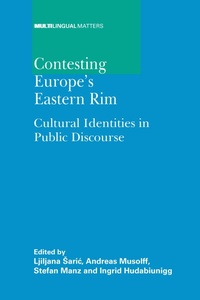
Contesting Europe's Eastern Rim
Cultural Identities in Public Discourse
Published on 15. November 2010
264 pages
978-1-84769-486-7 (ISBN)
Description

Since 1989, Europe's eastern rim has been in constant flux. This collection focuses on how political and economic transformations have triggered redefinitions of cultural identity. Using discursive modes of identity construction (deconstruction, reconstruction, reformulation, and invention) the book focuses on the creation of opposition to old and new 'outsiders' and 'insiders' in Europe. The linguistic study of discourse elements in connection with an exploration of the significance of metaphors in anchoring individual and collective identity is innovative and allows for a unique analysis of public discourse in Europe.
Reviews / Votes
This is a timely book with a rich array of contributions exploring discursive constructions of identity in a number of countries on Europe's Eastern rim. Thematically focused and integrated, the volume provides much needed perspectives on hitherto underresearched areas and languages. At the same time, the theoretical and methodological issues that it addresses will appeal more generally to scholars studying political and media discourse. -- Gerlinde Mautner, Wirtschaftsuniversitaet Wien, Austria This publication offers a convincing case for the fluidity of national and cultural identities, especially those predicated on 'Europe'. It corroborates the proposition that identities are constructed in relational terms and it offers clear insights on how the 'other' has been dynamically contested, negotiated and reconstructed in public discourses on an enlarged EU, thus highlighting the key role of different linguistic representations in redefining identities. This publication is certainly refreshing as it invites reflections on the construction of 'Europeanness'. -- Franco Zappettini, Birkbeck College, University of London * Journal of Language and Politics Vol.12:2 (2013) *More details
Series
Language
English
Place of publication
Bristol
United Kingdom
Publishing group
Channel View Publications Ltd
Target group
Professional and scholarly
ISBN-13
978-1-84769-486-7 (9781847694867)
Copyright in bibliographic data and cover images is held by Nielsen Book Services Limited or by the publishers or by their respective licensors: all rights reserved.
Schweitzer Classification
Other editions
Additional editions
Ljiljana Saric | Andreas Musolff | Stefan Manz
Contesting Europe's Eastern Rim
Cultural Identities in Public Discourse
Book
11/2010
Multilingual Matters
€153.00
Shipment within 10-20 days
Persons
Ljiljana SariAE? is Professor of Bosnian/Croatian/Serbian at the University of Oslo. Her publications include Discourses of Intercultural Identity in Britain, Germany and Eastern Europe (co-editor, 2004), and Red-Letter Days and Discursive Identity Construction in Central Europe and the Balkans (co-editor, forthcoming).
Andreas Musolff is Professor of Intercultural Communication Studies at the University of East Anglia. His books include Metaphor, Nation and the Holocaust (2010) and Metaphor and Political Discourse (2004). He has co-edited Metaphor and Discourse (2009) and several volumes comparing British and German political debates about the European Union.
Stefan Manz is Senior Lecturer and Director of German Studies at Aston University. Publications include Discourses of Intercultural Identity in Britain, Germany and Eastern Europe (2004, co-edited) and Migration and Transfer from Germany to Britain, 1660a??1914 (2007, co-edited).
Ingrid Hudabiunigg is Professor Emeritus of German as a foreign language and European studies at the Technical University of Chemnitz (Germany). She has published extensively on discursive identity construction.
Andreas Musolff is Professor of Intercultural Communication Studies at the University of East Anglia. His books include Metaphor, Nation and the Holocaust (2010) and Metaphor and Political Discourse (2004). He has co-edited Metaphor and Discourse (2009) and several volumes comparing British and German political debates about the European Union.
Stefan Manz is Senior Lecturer and Director of German Studies at Aston University. Publications include Discourses of Intercultural Identity in Britain, Germany and Eastern Europe (2004, co-edited) and Migration and Transfer from Germany to Britain, 1660a??1914 (2007, co-edited).
Ingrid Hudabiunigg is Professor Emeritus of German as a foreign language and European studies at the Technical University of Chemnitz (Germany). She has published extensively on discursive identity construction.
Content
Introduction - Ljiljana Saric, Stefan Manz, Andreas Musolff, and Ingrid Hudabiunigg
Part I
Chapter 1 Expellees, Counterfactualism, and Potatoes. Enlargement and Cross-National Debates in German-Polish Relations - Stefan Manz
Chapter 2 The Role of Metaphor in Shaping Cultural Stereotypes: A Case Study of French Public Discourse on European Union Enlargement - Steffen Buch and Uta Helfrich
Chapter 3 Metaphors in German and Lithuanian Discourse Concerning the Expansion of the European Union - Sandra Petraskaite-Pabst Part II
Chapter 4 Domestic and Foreign Media Images of the Balkans - Ljiljana Saric
Chapter 5 Naming Strategies and Neighboring Nations in the Croatian Media - Dubravka Kuna and Branko Kuna
Chapter 6 Mujahiddin in Our Midst: Bosnian Croats after the Wars of Succession - Daphne Winland
Chapter 7 Construction of Serbian and Montenegrin Identities through Layout and Photographs of Leading Politicians in Official Newspapers - Tatjana Radanovic Felberg
Chapter 8 Krekism and the Construction of Slovenian National Identity: Newspaper Commentaries on Slovenia's EU Integration - Andreja Vezovnik
Chapter 9 The Linguistic Image of the Balkans in the Polish Press in Discourse on European Union Expansion - Pawel Bak
Chapter 10 The Eternal Outsider? Scenarios of Turkey's Ambitions to Join the EU in the German Press - Andreas Musolff
Part III
Chapter 11 Contested Identities: Miroslav Krleza's Two Europes vs. the Notion of Europe's Edge - Ingrid Hudabiunigg
Chapter 12 Masculinity and the New Sensibility: Reading a Contemporary Montenegrin Novel - Biljana Jovanovic Lauvstad
Chapter 13 The Rhetoric of Present Absence: Representing Jewishness in Post-Totalitarian Poland - Knut Andreas Grimstad Conclusion - Ljiljana Saric
Part I
Chapter 1 Expellees, Counterfactualism, and Potatoes. Enlargement and Cross-National Debates in German-Polish Relations - Stefan Manz
Chapter 2 The Role of Metaphor in Shaping Cultural Stereotypes: A Case Study of French Public Discourse on European Union Enlargement - Steffen Buch and Uta Helfrich
Chapter 3 Metaphors in German and Lithuanian Discourse Concerning the Expansion of the European Union - Sandra Petraskaite-Pabst Part II
Chapter 4 Domestic and Foreign Media Images of the Balkans - Ljiljana Saric
Chapter 5 Naming Strategies and Neighboring Nations in the Croatian Media - Dubravka Kuna and Branko Kuna
Chapter 6 Mujahiddin in Our Midst: Bosnian Croats after the Wars of Succession - Daphne Winland
Chapter 7 Construction of Serbian and Montenegrin Identities through Layout and Photographs of Leading Politicians in Official Newspapers - Tatjana Radanovic Felberg
Chapter 8 Krekism and the Construction of Slovenian National Identity: Newspaper Commentaries on Slovenia's EU Integration - Andreja Vezovnik
Chapter 9 The Linguistic Image of the Balkans in the Polish Press in Discourse on European Union Expansion - Pawel Bak
Chapter 10 The Eternal Outsider? Scenarios of Turkey's Ambitions to Join the EU in the German Press - Andreas Musolff
Part III
Chapter 11 Contested Identities: Miroslav Krleza's Two Europes vs. the Notion of Europe's Edge - Ingrid Hudabiunigg
Chapter 12 Masculinity and the New Sensibility: Reading a Contemporary Montenegrin Novel - Biljana Jovanovic Lauvstad
Chapter 13 The Rhetoric of Present Absence: Representing Jewishness in Post-Totalitarian Poland - Knut Andreas Grimstad Conclusion - Ljiljana Saric
