

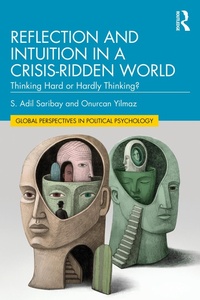
Reflection and Intuition in a Crisis-Ridden World
Thinking Hard or Hardly Thinking?
1st Edition
Published on 6. December 2024
302 pages
978-1-040-25767-8 (ISBN)
Description

This book provides a definitive guide to the value of reflective thinking in the modern world, showing how today's most fundamental problems are, to an important degree, based on citizens' thinking styles.
The authors highlight the importance of reflection by systematically revealing the causes underlying differences in people's thinking styles and the consequences of thinking in different ways. These different ways of thinking contribute to socio-political views, and can result in misunderstandings of complex issues such as beliefs in conspiracy theories and fake news, anti-vaccine attitudes, and even fundamentalism and extremism. By training and strengthening reflective thinking in society, via education and other means, we can encourage individuals to challenge misinformation, and their own belief systems around controversial topics. The book also explores the idea that reflection is not enough on its own and examines the shortcomings of reflection and the other skills that complement it positively, especially holistic and systems thinking. In doing so, the authors highlight how implementing a solid, science-based understanding of key issues in education and society at large, can contribute to the solution of problems, from climate change to economic inequality.
By showing how we can put our reflective capacity to good use, alongside critically examining reflection in relation to modern problems experienced by humanity, this book is a fascinating reading for students, researchers, and academics in psychology, politics, and the broader social sciences.
The authors highlight the importance of reflection by systematically revealing the causes underlying differences in people's thinking styles and the consequences of thinking in different ways. These different ways of thinking contribute to socio-political views, and can result in misunderstandings of complex issues such as beliefs in conspiracy theories and fake news, anti-vaccine attitudes, and even fundamentalism and extremism. By training and strengthening reflective thinking in society, via education and other means, we can encourage individuals to challenge misinformation, and their own belief systems around controversial topics. The book also explores the idea that reflection is not enough on its own and examines the shortcomings of reflection and the other skills that complement it positively, especially holistic and systems thinking. In doing so, the authors highlight how implementing a solid, science-based understanding of key issues in education and society at large, can contribute to the solution of problems, from climate change to economic inequality.
By showing how we can put our reflective capacity to good use, alongside critically examining reflection in relation to modern problems experienced by humanity, this book is a fascinating reading for students, researchers, and academics in psychology, politics, and the broader social sciences.
Reviews / Votes
'An interesting and very broad survey of much current thinking about reflection and intuition and their relation to public issues. It is special in recognizing connections with social psychology, which is often neglected in the literature and often unfamiliar to me.'Jonathan Baron, Professor Emeritus of Psychology, School of Arts and Sciences, University of Pennsylvania, USA
'The field of cognitive science is well served by this book which expands and extends the concept of cognitive reflection into broad-based areas that are politically charged and full of real-world implications. This volume takes reflection out of the laboratory and connects it to pressing cultural and political debates.'
Keith E. Stanovich, Emeritus Professor of Applied Psychology and Human Development, University of Toronto, Canada
More details
Series
Edition
1. Auflage
Language
English
Place of publication
London
United Kingdom
Publishing group
Taylor & Francis Ltd
Target group
College/higher education
Professional and scholarly
Illustrations
1 Tables, black and white; 1 Halftones, black and white; 1 Illustrations, black and white
ISBN-13
978-1-040-25767-8 (9781040257678)
Copyright in bibliographic data and cover images is held by Nielsen Book Services Limited or by the publishers or by their respective licensors: all rights reserved.
Schweitzer Classification
Other editions
Additional editions
S. Adil Saribay | Onurcan Yilmaz
Reflection and Intuition in a Crisis-Ridden World
Thinking Hard or Hardly Thinking?
Book
12/2024
1st Edition
Routledge
€63.70
Shipment within 10-20 days
S. Adil Saribay | Onurcan Yilmaz
Reflection and Intuition in a Crisis-Ridden World
Thinking Hard or Hardly Thinking?
Book
12/2024
1st Edition
Routledge
€195.90
Shipment within 10-20 days
Persons
S. Adil Saribay is a Professor of Psychology at Kadir Has University, Istanbul, Turkey. His research focuses on cognitive style and face perception.
Onurcan Yilmaz is an Associate Professor of Psychology at Kadir Has University, Istanbul, Turkey, and currently leads the Moral Intuitions Laboratory (MINT Lab). His research primarily focuses on the cognitive and contextual determinants of moral judgment and behavior.
Onurcan Yilmaz is an Associate Professor of Psychology at Kadir Has University, Istanbul, Turkey, and currently leads the Moral Intuitions Laboratory (MINT Lab). His research primarily focuses on the cognitive and contextual determinants of moral judgment and behavior.
Content
Part I 1. The Intuitive Mind 2. Dual Process Models of the Mind 3. Development and Training of Reflective Thinking Part II 4. Situational Influences on Reflectiveness: Threat and Politics 5. Epistemically Suspect Beliefs 6. Ideology 7. Morality and Cooperation 8. Violent Extremism Part III 9. Revisiting Reflectionism 10. Revisiting the Dual-Process Model of the Mind Conclusion: Final Thoughts
