

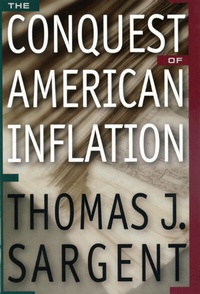
The Conquest of American Inflation
1st Edition
Published on 19. November 2018
168 pages
978-0-691-18668-9 (ISBN)
Description

In the past fifteen years, inflation has been conquered by many advanced countries. History reveals, however, that it has been conquered before and returned. In The Conquest of American Inflation, Thomas J. Sargent presents a groundbreaking analysis of the rise and fall of U.S. inflation after 1960. He examines two broad explanations for the behavior of inflation and unemployment in this period: the natural-rate hypothesis joined to the Lucas critique and a more traditional econometric policy evaluation modified to include adaptive expectations and learning. His purpose is not only to determine which is the better account, but also to codify for the benefit of the next generation the economic forces that cause inflation.
Sargent begins with an explanation of how American policymakers increased inflation in the early 1960s by following erroneous assumptions about the exploitability of the Phillips curve--the inverse relationship between inflation and unemployment. In subsequent chapters, he connects a sequence of ideas--self-confirming equilibria, least-squares and other adaptive or recursive learning algorithms, convergence of least-squares learners with self-confirming equilibria, and recurrent dynamics along escape routes from self-confirming equilibria. Sargent synthesizes results from macroeconomics, game theory, control theory, and other fields to extend both adaptive expectations and rational expectations theory, and he compellingly describes postwar inflation in terms of drifting coefficients. He interprets his results in favor of adaptive expectations as the relevant mechanism affecting inflation policy.
Providing an original methodological link between theoretical and policy economics, this book will engender much debate and become an indispensable text for academics, graduate students, and professional economists.
Sargent begins with an explanation of how American policymakers increased inflation in the early 1960s by following erroneous assumptions about the exploitability of the Phillips curve--the inverse relationship between inflation and unemployment. In subsequent chapters, he connects a sequence of ideas--self-confirming equilibria, least-squares and other adaptive or recursive learning algorithms, convergence of least-squares learners with self-confirming equilibria, and recurrent dynamics along escape routes from self-confirming equilibria. Sargent synthesizes results from macroeconomics, game theory, control theory, and other fields to extend both adaptive expectations and rational expectations theory, and he compellingly describes postwar inflation in terms of drifting coefficients. He interprets his results in favor of adaptive expectations as the relevant mechanism affecting inflation policy.
Providing an original methodological link between theoretical and policy economics, this book will engender much debate and become an indispensable text for academics, graduate students, and professional economists.
More details
Other editions
Additional editions
Book
12/2001
Princeton University Press
€52.20
Shipment within 10-20 days

Thomas J. Sargent
The Conquest of American Inflation
Book
01/1999
Princeton University Press
€84.18
Article exhausted; check different version
Person
Thomas J. Sargent is Donald Lucas Professor of Economics, Stanford University, and Senior Fellow at the Hoover Institution at Stanford. He is the author of many articles and books on macroeconomic theory, most recentlyBounded Rationality in Macroeconomics.
Content
- Cover
- Title Page
- Copyright Page
- Contents
- PREFACE
- 1. THE RISE AND FALL OF U.S. INFLATION
- Facts
- Two interpretations
- The triumph of natural-rate theory
- The vindication of econometric policy evaluation
- Readers's guide
- The Lucas critique
- Time-consistency and credible plans
- Adaptive expectations and the Phelps problem
- Equilibrium under misspecification
- Two types of self-confirming equilibria
- Adaptive expectations
- Empirical vindication
- Raw and filtered Data
- Demographic adjustment and drift
- 2. IGNORING THE LUCAS CRITIQUE
- The Lucas critique
- Outline
- The appeal to drifting coefficients
- A loose end
- Parameter drift as point of departure
- Relevance of the critique
- Rational expectations models
- 3. THE CREDIBILITY PROBLEM
- Introduction
- One-period economy
- Least squares learning converges to Nash
- More foresight
- Appendix on stochastic approximation
- 4. CREDIBLE GOVERNMENT POLICIES
- Perfection
- Historical antecedents
- The method of Abreu-Pearce-Stacchetti
- Examples of recursive SPE
- Infinite repetition of Nash outcome
- Infinite repetition of a better-than-Nash outcome
- Something worse: a stick and carrot strategy
- The worst SPE
- Multiplicity
- Attaining the worst, method 1.
- Attaining the worst, method 2.
- Attaining the worst, method 3.
- Numerical examples
- Interpretations
- Remedies
- 5. ADAPTIVE EXPECTATIONS (1950's)
- Adaptive expectations
- The original Phelps problem
- Phelps problem: general version
- Testing the natural-rate hypothesis
- Disappearance of beliefs as state variable
- Subversion of Phelps's model
- 6. OPTIMAL MISSPECIFIED BELIEFS
- Equilibrium with mistakes
- An experiment in Bray's lab
- Misspecification
- Lessons
- 7. SELF-CONFIRMING EQUILIBRIA
- Two literatures
- Directions of fit
- Imperfect (1970's) rational expectations equilibria
- Self-confirming equilibria
- Objects in Phelps problem
- Elements of self-confirming models
- The actual Phillips curve
- Self-confirmation
- Direction of minimization
- Vanishing parameters
- Self-confirmation under classical direction
- Moment formulas
- Keynesian direction of fit
- Government beliefs and behavior
- Calculation of S
- Special case by hand
- Why not Ramsey?
- Direction of minimization: caution
- Equilibrium computation
- Messages
- Equilibrium with misspecified beliefs
- An erroneous forecasting function
- Approaching Ramsey
- Grounds for optimism
- 8. ADAPTIVE EXPECTATIONS (1990's)
- Least squares adaptation
- Primer on recursive algorithms
- Iteration
- Stochastic approximations
- Mean dynamics
- Constant gain
- Escape routes
- Simplification of action functional
- From computation to adaptation
- Adaptation with the classical identification
- The government's beliefs and behavior
- RLS and the Kalman filter
- Private sector beliefs
- System evolution
- Mean dynamics
- Stochastic approximation
- Adaptation with Keynesian identification
- Government beliefs and behavior
- Technical details
- Simulations
- Classical adaptive simulations
- Relation to equilibria under forecast misspecification
- Simulation with Keynesian adaptation
- Role of discount factor
- Conclusions
- Appendix A: RLS and the Kalman filter
- The Kalman filter
- Recursive least squares
- Matching RLS to the Kalman filter
- Initial conditions for simulations
- Appendix B: Anticipated utility
- Boiler plate recursive rational expectations model
- Anticipated utility model
- 9. ECONOMETRIC POLICY EVALUATION
- Introduction
- Likelihood function
- Estimates
- Interpretation
- Appendix on likelihood function
- 10. TRIUMPH OR VINDICATION?
- Expectations and the Lucas critique
- Reservations
- GLOSSARY
- REFERENCES
- AUTHOR INDEX
- SUBJECT INDEX
