

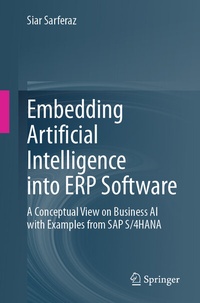
Embedding Artificial Intelligence into ERP Software
Description

This book explains how to embed artificial intelligence in digitized business processes of ERP software by solving the two related substantial challenges: how can artificial intelligence be systematically integrated into ERP business processes for ease of consumption, and how can artificial intelligence be made enterprise-ready by covering ERP qualities like compliance, lifecycle management, extensibility, or scalability?
As a general introduction, the first part of this book takes the reader through a historical journey towards intelligent ERP systems. In addition, reference processes and a reference architecture for ERP systems are proposed which build the foundation for the suggested subsequent solution concept, including a method for operationalizing intelligence for ERP business processes. Subsequently, in the second part detailed concepts of embedding artificial intelligence into ERP software are proposed. In this context the suggested solution architecture is depicted, and specific topics are resolved like data integration, model validation, explainability, data protection and privacy, model degradation and performance. In the last part an implementation framework is suggested which enables the previously introduced concepts and harmonizes the development and operations of artificial intelligent ERP applications. This part concludes with case studies considering artificial intelligence scenarios of SAP S/4HANA in the areas of logistics, finance and sales which apply the defined solution approach and shows its real-world feasibility.
This book is written for professionals who want to implement (as developers) or exploit (as business analysts or consultants) or consider/plan the implementation/exploitation (as managers) of artificial intelligence in business information systems.
More details
Other editions
Additional editions
Person
Siar Sarferaz is a chief software architect for the enterprise resource planning (ERP) solution SAP S/4HANA, working in the research and development department of SAP's headquarter in Walldorf, Germany. In this role he drives the digital transformation by defining the solution architecture for the product and by providing inventive concepts scaling for mission critical business processes. For example, he is the lead architect for artificial intelligence implementations in SAP S/4HANA and is responsible for all conceptions how to add intelligence to business processes. In the context of ERP software, he owns 30+ patents. Siar had studied computer science and philosophy and holds a Ph.D. in computer science. He began his career as a method researcher at Siemens, before moving to SAP, where he has now worked for more than 20 years.
Content
1. Methodology.- Part I: ERP Fundamentals.- 2. Intelligent ERP.- 3. ERP Reference Processes.- 4. ERP Reference Architecture.- 5. ERP Reference Artificial Intelligence Technology.- Part II: Concepts for Embedding Artificial Intelligence.- 6. 6 Solution Architecture.- 7. Lifecycle Management.- 8. Data Integration.- 9. Data Protection and Data Privacy.- 10. Configuration.- 11. Extensibility.- 12. Model Degradation.- 13. Explanation of Results.- 14. Workload Management and Performance.- 15. Legal Auditing.- 16. Model Validation.- 17. User Interface Design.- 18. Embedding Generative AI.- Part III: Implementation Framework and Case Studies.- 19. Implementation Framework.- 20. Sales and Research.- 21. Sourcing and Procurement.- 22. Inventory and Supply Chain.- 23. Finance.- 24. Epilogue - Ethical Considerations.
