

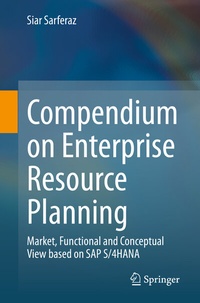
Compendium on Enterprise Resource Planning
Description

This book explains the functional scope, the data model, the solution architecture, the underlying engineering concepts, and the programming model of SAP S/4HANA as the most well-known enterprise resource planning (ERP) system. The approach is to start with general concepts and then to proceed step-by-step to concrete implementations in SAP S/4HANA.
In the first part the reader learns about the market view of ERP solutions and vendors. The second part deals with the business processes for sales, marketing, finance, supply chain, manufacturing, services, procurement, and human resources which are covered with SAP S/4HANA. In the third part the underlying concepts of SAP S/4HANA are described, for example in-memory storage, analytics and search, artificial intelligence, process and data integration, security and compliance, lifecycle management, performance and scalability, configuration and implementation. The book is concluded with a final chapter explaining how to deploy anappliance to explore SAP S/4HANA.
The target audience for the book are managers and business analysts who want to understand the market situation and future ERP trends, end users and process experts who need to comprehend the business processes and the according solution capabilities provided with SAP S/4HANA, architects and developers who have to learn the technical concepts and frameworks for enhancing SAP S/4HANA functionality, and consultants and partners who require to adopt and configure SAP S/4HANA.
More details
Other editions
Additional editions
Person
Siar Sarferaz is a chief software architect for the enterprise resource planning (ERP) solution SAP S/4HANA, working in the research and development department of SAP's headquarter in Walldorf, Germany. In this role he drives the digital transformation by defining the solution architecture for the product and by providing inventive concepts scaling for mission critical business processes. For example, he is the lead architect for artificial intelligence implementations in SAP S/4HANA and is responsible for all conceptions how to add intelligence to business processes. In the context of ERP software, he owns 30+ patents. Siar had studied computer science and philosophy and holds a Ph.D. in computer science. He began his career as a method researcher at Siemens, before moving to SAP, where he has now worked for more than 20 years.
Content
Part 1: Market View.- 1. Challenges and Characteristics of ERP Systems.- 2. ERP Market Analysis.- 3. ERP Future Trends.- Part 2: Functional View.- 4. Functional Departments and Enterprise Domains.- 5. Master Data of Business Partner.- 6. Master Data of Product.- 7. Master Data of Bill of Material.- 8. Process of Idea to Market.- 9. Process of Source to Pay.- 10. Process of Plan to Fulfill.- 11. Process of Lead to Cash.- 12. Process of Recruit to Retire.- 13. Process of Acquire to Decommission.- 14. Process of Governance.- 15. Process of Finance.- 16. Industry Solutions.- Part 3: Conceptual View.- 17. ERP Product Qualities: Customer View.- 18. ERP Product Qualities: Provider View.- 19. In-Memory Persistency.- 20. Virtual Data Model.- 21. Transactional Programming Model.- 22. Analytics.- 23. Search.- 24. Artificial Intelligence.- 25. Internet of Things.- 26. Process Integration.- 27. Data Integration.- 28. In-App Extensibility.- 29. Side-by-Side Extensibility.- 30. User Experience.- 31. Identity and Access Management.- 32. Data Protection and Privacy.- 33. Secure Development and Operations.- 34. Globalization and Localization.- 35. Scalability and Performance.- 36. Lifecycle Management.- 37. Configuration.- 38. Implementation.- Appendix.- 39. Explore SAP S/4HANA System.
