

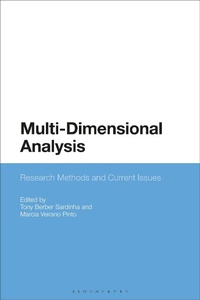
Multi-Dimensional Analysis
Research Methods and Current Issues
1st Edition
Published on 21. March 2019
304 pages
978-1-350-02383-3 (ISBN)
Description

Multi-Dimensional Analysis: Research Methods and Current Issues provides a comprehensive guide both to the statistical methods in Multi-Dimensional Analysis (MDA) and its key elements, such as corpus building, tagging, and tools. The major goal is to explain the steps involved in the method so that readers may better understand this complex research framework and conduct MD research on their own.
Multi-Dimensional Analysis is a method that allows the researcher to describe different registers (textual varieties defined by their social use) such as academic settings, regional discourse, social media, movies, and pop songs. Through multivariate statistical techniques, MDA identifies complementary correlation groupings of dozens of variables, including variables which belong both to the grammatical and semantic domains. Such groupings are then associated with situational variables of texts like information density, orality, and narrativity to determine linguistic constructs known as dimensions of variation, which provide a scale for the comparison of a large number of texts and registers.
This book is a comprehensive research guide to MDA.
Multi-Dimensional Analysis is a method that allows the researcher to describe different registers (textual varieties defined by their social use) such as academic settings, regional discourse, social media, movies, and pop songs. Through multivariate statistical techniques, MDA identifies complementary correlation groupings of dozens of variables, including variables which belong both to the grammatical and semantic domains. Such groupings are then associated with situational variables of texts like information density, orality, and narrativity to determine linguistic constructs known as dimensions of variation, which provide a scale for the comparison of a large number of texts and registers.
This book is a comprehensive research guide to MDA.
More details
Edition
1. Auflage
Language
English
Place of publication
London
United Kingdom
Publishing group
Bloomsbury Publishing PLC
Target group
College/higher education
Illustrations
120 bw illus
ISBN-13
978-1-350-02383-3 (9781350023833)
Copyright in bibliographic data and cover images is held by Nielsen Book Services Limited or by the publishers or by their respective licensors: all rights reserved.
Schweitzer Classification
Other editions
Additional editions
Tony Berber Sardinha | Marcia Veirano Pinto
Multi-Dimensional Analysis
Research Methods and Current Issues
Book
09/2020
Bloomsbury Academic
€60.84
Shipment within 15-20 days
Tony Berber Sardinha | Marcia Veirano Pinto
Multi-Dimensional Analysis
Research Methods and Current Issues
Book
03/2019
Bloomsbury Academic
€193.13
Shipment within 15-20 days
Persons
Tony Berber Sardinha is Professor of Applied Linguistics at the Pontifical Catholic University in São Paulo, Brazil.
Marcia Veirano Pinto is Adjunct Professor of English at the Federal University in São Paulo, Brazil.
Marcia Veirano Pinto is Adjunct Professor of English at the Federal University in São Paulo, Brazil.
Content
Preface
Introduction, Tony Berber Sardinha and Marcia Veirano Pinto (São Paulo Catholic University, Brazil)
Part I: Understanding the principles: origins of the method, corpus design and annotation
1. Multi-dimensional analysis: a historical synopsis, Douglas Biber (Northern Arizona University, USA)
2. Corpus design and representativeness, Jesse Egbert (Brigham Young University, USA)
3. Tagging and counting linguistic features for multi-dimensional analysis, Bethany Gray (Iowa State University, USA)
4. The Multi-dimensional Analysis Tagger, Andrea Nini (Aston University, UK)
Part II: Conducting an MD analysis: Quantitative and qualitative analysis
5. Multivariate statistics commonly used in multi-dimensional analysis, Pascual Cantos Gomez (University of Murcia, Spain)
6. Doing multi-dimensional analysis in SPSS, SAS and R, Jesse Egbert (Northern Arizona University, USA) and Shelley Staples (Purdue University, USA)
7. From factors to dimensions: interpreting linguistic co-ocurrence patterns, Eric Friginal (Georgia State University, USA) and Jack Hardy (Emory College of Arts and Science, USA)
8. Adding registers to a previous multi-dimensional analysis, Tony Berber Sardinha, Marcia Veirano Pinto, Carlos Kauffmann, Carolina Zuppardi and Cristina Mayer Acunzo (São Paulo Catholic University, Brazil)
Part III. Exploring the method
9. Examining lexical and cohesion differences in discipline specific writing using MDA, Scott A. Crossley, Kristopher Kyle and Ute Römer (Georgia State University, USA)
10. Using Discriminate Function Analysis in multi-dimensional analysis, Marcia Veirano Pinto (São Paulo Catholic University, Brazil)
11. Using multidimensional analysis to detect representations of national identity, Tony Berber Sardinha (São Paulo Catholic University, Brazil)
Bibliography
Index
Introduction, Tony Berber Sardinha and Marcia Veirano Pinto (São Paulo Catholic University, Brazil)
Part I: Understanding the principles: origins of the method, corpus design and annotation
1. Multi-dimensional analysis: a historical synopsis, Douglas Biber (Northern Arizona University, USA)
2. Corpus design and representativeness, Jesse Egbert (Brigham Young University, USA)
3. Tagging and counting linguistic features for multi-dimensional analysis, Bethany Gray (Iowa State University, USA)
4. The Multi-dimensional Analysis Tagger, Andrea Nini (Aston University, UK)
Part II: Conducting an MD analysis: Quantitative and qualitative analysis
5. Multivariate statistics commonly used in multi-dimensional analysis, Pascual Cantos Gomez (University of Murcia, Spain)
6. Doing multi-dimensional analysis in SPSS, SAS and R, Jesse Egbert (Northern Arizona University, USA) and Shelley Staples (Purdue University, USA)
7. From factors to dimensions: interpreting linguistic co-ocurrence patterns, Eric Friginal (Georgia State University, USA) and Jack Hardy (Emory College of Arts and Science, USA)
8. Adding registers to a previous multi-dimensional analysis, Tony Berber Sardinha, Marcia Veirano Pinto, Carlos Kauffmann, Carolina Zuppardi and Cristina Mayer Acunzo (São Paulo Catholic University, Brazil)
Part III. Exploring the method
9. Examining lexical and cohesion differences in discipline specific writing using MDA, Scott A. Crossley, Kristopher Kyle and Ute Römer (Georgia State University, USA)
10. Using Discriminate Function Analysis in multi-dimensional analysis, Marcia Veirano Pinto (São Paulo Catholic University, Brazil)
11. Using multidimensional analysis to detect representations of national identity, Tony Berber Sardinha (São Paulo Catholic University, Brazil)
Bibliography
Index
