

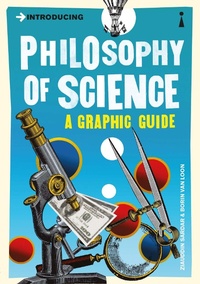
Introducing Philosophy of Science
A Graphic Guide
Published on 18. June 2015
176 pages
978-1-84831-980-6 (ISBN)
Description

What do scientists actually do? Is science "value-free"? How has science evolved through history? Where is science leading us? "Introducing Philosophy of Science" is a clear and incisively illustrated map of the big questions underpinning science. It is essential reading for students, the general public, and even scientists themselves.
More details
Other editions
Additional editions
Book
09/2011
Icon Books
€11.50
Shipment within 3-4 weeks
Persons
Content
- Intro
- Title Page
- Copyright
- Contents
- The Nature of the Beast
- Is Science "Absolute Objectivity"?
- Do We Trust Scientists?
- What Do Scientists Actually Do?
- Definitions of Science
- The Golem of Science
- The Contested Territory of Science
- Do Scientists Understand Science?
- Emergence and Development of Science Studies
- Science Studies in the 1960s
- Diverse Critical Approaches
- A Growth Industry
- Conflict within Science Studies
- Criticism from the "Low Church"
- Comparing the Radical Origins
- Why is Science Studies Important?
- A Very Short History of Science
- Fast Forward to the Renaissance.
- The Great March
- Heavenly Sparks
- Planet of the Apes
- Science in the Killing-fields
- Environmental Catastrophe
- Can Scientists Make Mistakes?
- A Question of Paradigms
- Fallen Idols
- The Vienna Circle: Logical Positivism
- The Circle's Influence
- Karl Popper's "falsifiability" Theory
- Against Induction
- Thomas Kuhn's Revolution
- The Structure of Scientific Revolutions
- Normal Science
- Revolutionary Science
- The Enemy of Science
- In Opposition to Kuhn
- The End of "Dominant Notions"
- Is Kuhn a Radical?
- The Birth of Big Science
- Supporting Big Science
- Feyerabend, the Anarchist
- Anything Goes
- A Free-for-all
- Sociology of Scientific Knowledge
- The Spirit of Science
- The Strong Programme
- The Basics of SSK
- Science as Social Construction
- The Effect of Reality
- The Construction of Objectivity
- The Science Tribe
- Constructionism vs. Strong Programme
- Theory-laden Observations
- The Context of "Tradition"
- Feminist Criticism
- Women in Science
- The Segregation of Women in Science
- The Invisible Woman in the Lab
- Androcentric Science
- Women as Providers
- More Women in Science
- Strong Objectivity
- Responsible Rationality
- Reproductive Labour
- Post-colonial Science Criticism
- Science and Empire
- Imperial Geography
- What Happened Under Colonialism?
- Empirical History of Islamic Science
- Indian and Chinese science
- Rediscovery of Civilizational Science
- Framework for Islamic Science
- Tawheed and Khalifah
- Ibadah: Non-violent Contemplation
- Rediscovering Indian Science
- Walking on Two Legs
- The Western View of Nature
- Other Views of Nature
- Assumption Shape Science
- What is Assumed "Efficient"?
- Assumptions of Genetic Differences
- The Racial Economy of Science
- The "Value" of Science
- The Myth of Neutrality
- Social Epistemology
- What Social Epistemology Asks .
- Science Communication
- Multi-culturalism and Scientific Knowledges
- Science Wars
- In Defence of Science
- Against the "Academic Left"
- Enter, Sokal (stage right)
- Blitzkrieg on Postmodernism
- Beyond the Hoax
- The Public Understanding of Science
- Publicity vs. Accountability
- How Science Has Changed
- The Crux of Funding
- Corporate Funding of Research
- The Profit Motive
- What Direction for Science?
- What Gets Scientific Attention?
- The Focus on "Celebrity Problems"
- Population and Poverty
- Patenting Knowledge
- The Neem Tree
- Appropriation of Indigenous Knowledge
- Intensified Appropriation
- Mode 2 Knowledge
- Consequences of Mode 2 Knowledge
- Uncertainty in Mode 2
- Policy Debates in the Balance
- "Mad Cow" Disease
- The MMR Scare
- Assessing the Bigger Picture
- Statistical Errors
- The Place of Ignorance
- A Choice of Ignorance
- "Ignorance-squared"
- The End of Doubt
- Safety and the Unknowable
- Other GM Risks
- Increasing the Uncertainty Stakes
- Beyond the Normal
- Post-Normal Science
- Selling the Post-Normal Agenda
- PNS vs. Constructionist Analysis
- PNS in Action
- The Precautionary Principle
- Origins of the Precautionary Principle
- Community Research Networks
- The Community Responds .
- Science Shops
- Where Now?
- The Democratic Solution
- Whose Science is It?
- It is Our Science
- Further Reading
- About the Author and Artist
- Acknowledgements
- Index
